
Jacob's Ladder Myth Meaning & Symbolism
A fleeing man dreams of a ladder bridging heaven and earth, a vision of divine connection and promise that transforms his destiny.
The Tale of Jacob's Ladder
The world was a hard place, and Jacob was a man running from its hardness. The air he breathed was thick with the dust of betrayal and the sharp scent of his own fear. Behind him lay the simmering rage of a brother wronged, the stolen blessing, the hollow victory. Before him lay only the unknown wilderness, a vast and empty throat waiting to swallow him.
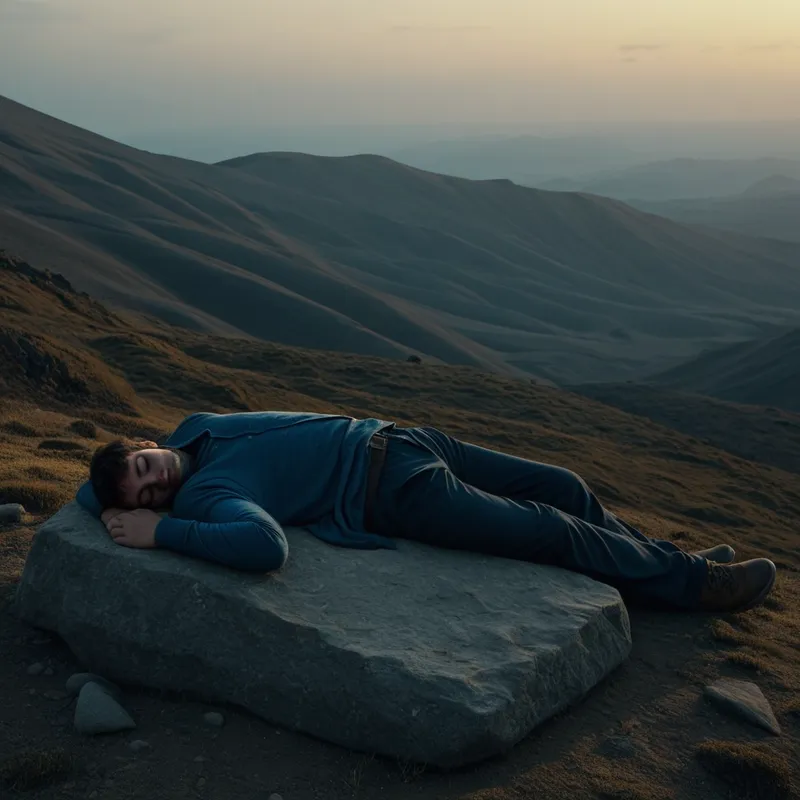
He walked until his legs were stone and the sun bled into the purple bruises of twilight. Finding a place where the earth rose in a stony shoulder, he gathered what stones he could lift and built a rough pillow. It was not for comfort, but a marker—a testament that a man named Jacob had passed this way and found only rock for his head. The desert cold seeped into his bones as he lay down, the vault of heaven a dark, indifferent dome above him.
Sleep took him not as a gentle tide, but as a sudden falling. And in that fall, the world split open.
The stone beneath his head grew warm, then vibrated with a deep, foundational hum. The ground was no longer barren earth but a threshold. From this very spot, rooted in his desperation, a structure began to form. It was a sulam—a ladder—but no ladder built by human hands. Its substance was of light and promise, its rungs carved from the fabric of the cosmos itself. It stood, unwavering, its base set upon the earth where he slept, and its top reached into the heart of the heavens, into the dwelling place of the Unnameable.
And upon it, they moved. Beings of fire and purpose, malakim, their forms both terrible and beautiful in the dream-light. They ascended in great, streaming currents, carrying the sighs and struggles of the earth upward. They descended in radiant cascades, bearing decrees and destinies downward. The air thrummed with the sound of their passage—a silent music that was the very frequency of connection.
Then, a Presence stood above the ladder. A voice, not of sound but of direct knowing, poured into Jacob’s soul. “I am YHWH, the God of Abraham your father and the God of Isaac. The land on which you lie I will give to you and to your offspring… Behold, I am with you and will keep you wherever you go.”
The promise filled the hollow places fear had carved. The vow of presence transformed the barren ground into a sacred center.
Jacob awoke. The first grey light of dawn stained the east. The ladder was gone, the angels vanished. But the stone was there, and the air itself felt charged, different. A profound awe, a terror of the holy, gripped him. “Surely YHWH is in this place, and I did not know it,” he whispered. “How awesome is this place! This is none other than the house of God, and this is the gate of heaven.”
He took the stone that had been his pillow, set it upright as a pillar, and anointed it with oil. He named the place Bethel. The man who lay down as a fugitive rose as a patriarch, marked by a vision that forever redefined the relationship between the wandering human soul and the fixed stars of the divine.
Cultural Origins & Context
This narrative is anchored in the Book of Bereshit (Genesis) (Chapter 28:10-22), a foundational text of the Abrahamic traditions. It belongs to the cycle of stories concerning the patriarchs—the mythic ancestors who shaped the identity and covenant of a people. For ancient nomadic and semi-nomadic tribes, such stories were not mere history but living maps of identity, explaining their relationship to the land, their god, and their destiny among nations.
The story of Jacob’s Ladder would have been transmitted orally long before its textual preservation, told around fires as a testament to divine faithfulness in the midst of human frailty and flight. Its societal function was multifaceted: it sanctified specific locations (like Bethel) as pilgrimage sites, it reinforced the concept of a personal and national covenant with God, and it provided a powerful metaphor for divine accessibility and communication. It answered a deep human question: In a vast and often hostile world, how does the divine interact with the mortal? The ladder was the answer—a structured, ongoing connection maintained by celestial messengers, assuring that no place, however desolate, was beyond the reach of the sacred.
Symbolic Architecture
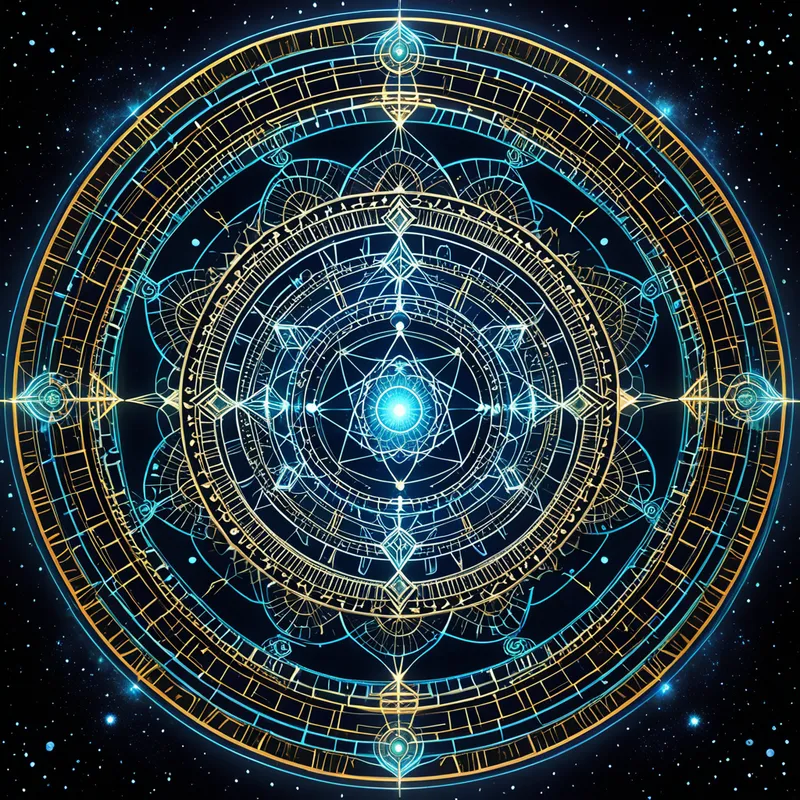
At its heart, the myth presents a supreme symbol of the axis mundi. The ladder is the central pillar of the world, the conduit that makes relationship between heaven and earth possible. It is the spine of the cosmos, and by extension, the backbone of the individual soul when it aligns with its deepest purpose.
The ladder is not a path of escape from the world, but the very structure that makes the world meaningful. It is the architecture of connection itself.
Jacob represents the flawed, striving human consciousness. He is the trickster in crisis, whose cunning has led him not to power but to exile. His sleep on the stone signifies a moment of utter vulnerability, the ego’s defenses collapsed. The stone pillow—hard, unyielding—is the catalyst. It represents the irreducible core of the self, the painful truth one must finally rest upon. From this point of conscious suffering, the unconscious reveals its transcendent content.
The angels ascending and descending signify the constant, dynamic exchange between the conscious and unconscious realms. They are the personified flow of insights, inspirations, fears, and impulses. Their movement indicates this is not a one-time revelation but an eternal process. The divine voice does not speak from a remote heaven, but from above the ladder—from within the structure of connection. The promise is one of grounding (“the land on which you lie”) and accompaniment (“I am with you”). The vision integrates the transcendent promise with immanent presence.
The Dreamer's Resonance
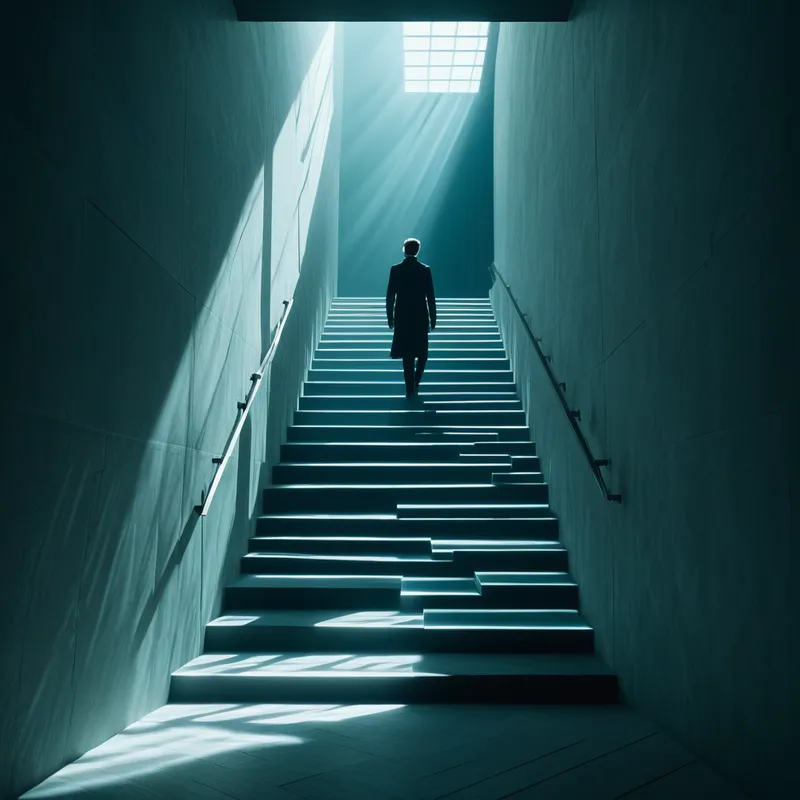
When this mythic pattern erupts in a modern dream, it rarely appears as a biblical pastiche. The dreamer may encounter a mysterious staircase in a familiar house that leads to unknown floors, a fragile rope bridge over an abyss, or a towering, impossible escalator in a corporate lobby. The somatic feeling is often one of profound ambivalence: awe mixed with vertigo, longing tangled with terror.
Such a dream marks a critical threshold in the psyche. The dreamer is, like Jacob, at a point of existential transition or crisis, often self-inflicted. The old identity or life strategy has led to a kind of internal exile. The ladder emerges as the psyche’s attempt to re-establish a severed connection—not necessarily to a theistic god, but to the deeper Self, to meaning, to a sense of purpose that feels divinely ordained. The ascent/descent imagery points to an urgent need to integrate “higher” spiritual or intellectual insights with the “lower” realities of the body, instinct, and practical life. The dream is an invitation to recognize the sacred (Bethel) in the very place of one’s current struggle and to anoint it, to make it a foundation for a new way of being.
Alchemical Translation
The alchemical process mirrored here is the sublimatio, not as an escape from matter, but as its redemption through connection. Jacob’s journey is a map of individuation.
The initial state is one of nigredo—the blackening. Jacob is in the shadow of his own deceit, fleeing through the psychic desert. The stone pillow is the prima materia, the worthless, heavy base matter upon which the work begins. Sleep is the necessary dissolution of conscious control, allowing the unconscious to work.
The vision of the ladder is the glorious albedo—the whitening, the revelation. It is the emergence of the transcendent function, the symbol that can hold the tension between the opposites of heaven and earth, spirit and instinct, promise and barren reality. The angels are the active agents of this psychic transmutation, circulating energy between the poles.
The vow, “I am with you,” is the core of the alchemical marriage—the coniunctio oppositorum. The divine promise to accompany the flawed human is the archetypal pattern for the ego’s covenant with the Self.
The final act is Jacob’s awakening and anointing. This is the beginning of rubedo—the reddening, the return to the world with newfound substance. He does not climb the ladder and disappear; he takes its meaning back into life. He sets up the stone, the once-painful foundation, now as a sacred pillar. He anoints it, a ritual of dedicating his conscious life to the truth of the vision. He re-names the place, which is to re-name his own experience. The fugitive (Jacob) begins his long transformation into one who “struggles with God” (Israel). The myth thus models the ultimate psychic transmutation: from a state of fractured self-interest to one of grounded, witnessed, and purposeful being, forever conscious of the ladder that stands in the place of our deepest rest.
Associated Symbols
Explore related symbols from the CaleaDream lexicon:
- Staircase
- Upstairs
- Lift
- Mattress
- Slope
- Higher
- Bunk
- Stair
- Incline
- Vertical
- Infinite Staircase
- Glass Elevator
- Electrician's Ladder
- Bamboo Ladder
- Ladder of Dreams
- Bookcase Ladder
- Ladder Shelf
- Upholstered Bed
- Padded Footstool
- Spiral Staircase
- Creaky Staircase
- Fire Escape
- Public Library Steps
- Holy Ground
- Celestial Bridge
- First Dream
- The Hierarchy
- Arch
- Shaft
- Mortgage
- Zenith
- Linear
- Rise