Itzamná Myth Meaning & Symbolism
The story of Itzamná, the celestial creator who brought language, culture, and the sacred order of time to the world from the primordial sea.
The Tale of Itzamná
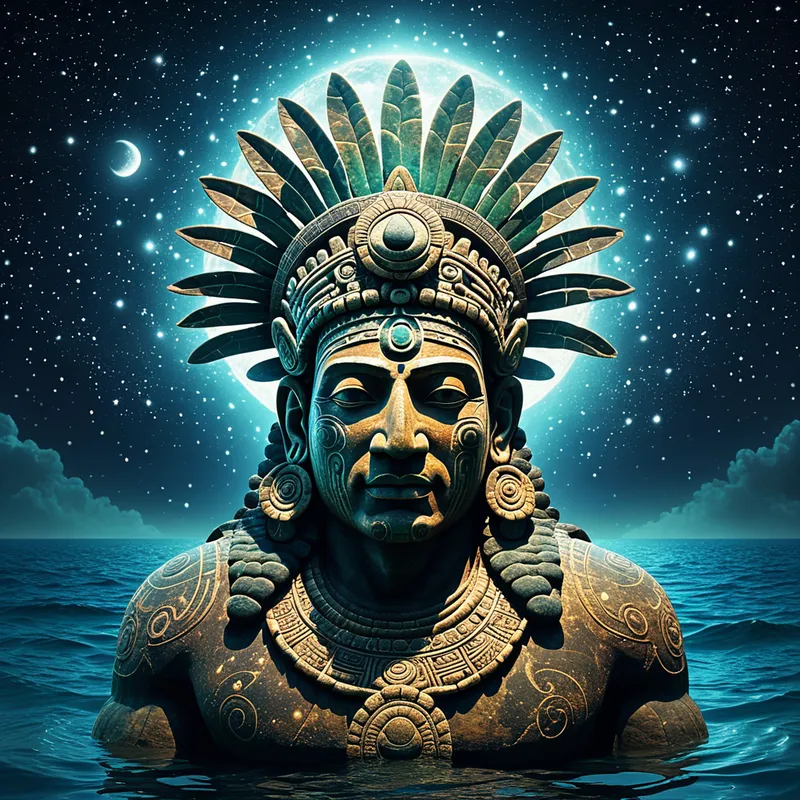
In the time before time, there was only the great, dark, and silent sea. Hunab Ku stirred in its depths, a pulse of potential in the endless black. From this pulse, from the meeting of the star-filled sky and the dreaming waters, a being was born. Not with a cry, but with a thought. He was Itzamná, the Lizard House, the Iguana, whose body was the vault of heaven and whose breath was the first light.
He rose from the waters, an ancient, gentle-faced god, his skin the color of dawn. With him came his consort, Ix Chel, the Lady Rainbow, her silver hair flowing like the Milky Way. Together, they looked upon the formless deep and saw not emptiness, but a canvas. Itzamná raised his hand, and from his fingertips fell not fire or thunder, but a soft, clarifying light. It pierced the darkness, separating the heavens from the waters, creating the space for the world to be.
But a world of light and dark was still a silent world. Itzamná sat upon the newly formed earth, at the very navel of creation, and he listened to the wind. He heard its whisper, its sigh, its potential for song. He took a piece of jade, green as the first life, and with it, he carved a sound into the air. This was the first word. Then another, and another, until he had gifted the people—the maize-beings he and the other gods would later fashion—the sacred gift of language. He did not give them commands; he gave them questions. He gave them names.
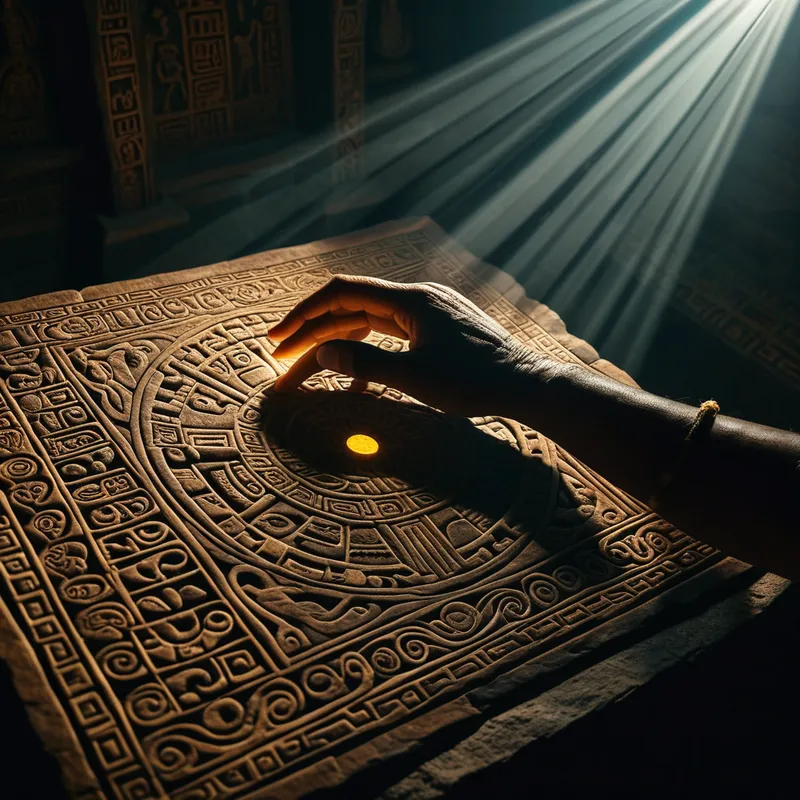
Next, from the patterns of the stars he and his wife had placed in the sky, he drew lines of meaning upon a great stone. These were the first glyphs, the sacred writing. He showed the people how to record the stories of the gods and the histories of their own hearts. But his greatest gift was one of order against the chaos of eternity. He studied the relentless journey of the sun, the faithful return of the moon in Ix Chel's arms, the dance of Venus. From this celestial choreography, he wove the Tzolk'in and the Haab', the interlocking wheels of sacred and solar time. He gave them the calendar, a map of destiny and a promise of cycles: of planting and harvest, of birth and death, and of renewal.
His work was not of conquest, but of patient, wise foundation. He taught the people the arts of healing, the science of the stars, and the sacred rites. He built the first houses, not as fortresses, but as shelters aligned with the heavens. When his work was complete, Itzamná did not ascend to a distant throne. He simply became. He was the sky that cradled the sun by day and the stars by night. He was the stone of the temple and the parchment of the codex. He was the very order of things, the wise, ancient presence in the first light of dawn, reminding the world that even from the silent, dark sea, meaning could be born.
Cultural Origins & Context
The myth of Itzamná is woven into the very fabric of Classic and Postclassic Maya civilization, primarily from the Yucatán Peninsula. Unlike myths centered on violent celestial battles, the stories of Itzamná come to us as foundational doctrine, recorded in the few surviving codices, such as the Dresden and Madrid Codices, and etched into the stone lintels and stelae of great cities like Copán and Palenque.
This was not a tale for the marketplace, but for the Ah Kin, the priestly scribe-astronomers who functioned as the custodians of time and knowledge. They were the "keepers of the days," and Itzamná was their divine patron. The myth served a profound societal function: it legitimized the entire Maya cosmological and political order. The king (K'uhul Ajaw) was seen as the earthly conduit to Itzamná, responsible for maintaining the sacred order the god had established through correct ritual and calendar observance. The myth explained why the world was structured, knowable, and bound by sacred cycles. It was the ultimate argument for civilization itself—for writing, astronomy, medicine, and architecture—as divine gifts that held chaos at bay.
Symbolic Architecture
Itzamná is not a god of raw power, but of intelligent structure. He represents the principle of consciousness imposing order on the unconscious, the logos bringing form to the primordial chaos.
He is the archetype of the cosmic mind, the architect who translates the swirling potential of the dream into the legible blueprint of reality.
His identity as the "Lizard House" or "Iguana" is deeply symbolic. The lizard, often seen sunning itself on stones, is a creature of two realms: earth and sky. Itzamná is this mediating principle, the conduit between the celestial realm of pure pattern (the stars) and the terrestrial realm of manifested life. He is not the sun itself, but the sky that contains it; not the stone, but the order inherent within it. His gifts—language, writing, the calendar—are all technologies of meaning. They are tools for differentiating the undifferentiated, for taking the unified, nameless flow of experience and creating the categories, stories, and rhythms that make a coherent world and a coherent self possible.
The Dreamer's Resonance
When the pattern of Itzamná stirs in the modern psyche, it often manifests in dreams of profound ordering. One might dream of discovering a forgotten, perfectly organized library within their own home, of suddenly understanding a complex and beautiful ancient language, or of watching chaotic, stormy waters suddenly calm into a glassy surface reflecting a star chart.
Somatically, this can feel like a deep, calming exhale after a period of anxiety, or a sudden clarity that cuts through mental fog. Psychologically, this dream pattern signals a critical phase of individuation: the ego is successfully drawing structures from the Self. The dreamer is not being overwhelmed by the unconscious (the primordial sea), but is actively engaged in the difficult, sacred work of building inner institutions—a personal ethics, a coherent life narrative, a sustainable routine. The conflict is the tension between inner chaos and the responsibility to create order. The figure of Itzamná in the dream affirms that the tools for this construction—the "language" and "calendar" of one's own soul—are innate and divinely bestowed.

Alchemical Translation
The alchemical journey modeled by Itzamná is the opus of coagulation: the bringing together of disparate elements into a stable, lasting form. The prima materia is the chaotic, watery state of a life or psyche without direction or meaning (the silent sea).
The first stage of the work is not action, but observation—the separation of light from dark, the conscious distinction between what is Self and what is not.
The modern individual undertaking this transmutation must first become the observer, the sky, creating inner space. Then, they must engage in the patient, scholarly work of self-definition: finding their own "glyphs" (the core values, traumas, and talents that define their personal myth) and learning to "write" with them. This is the development of a personal language of meaning. Finally, they must establish their "calendar"—the sacred rhythms and rituals that sustain their psyche. This could be a creative practice, a meditation routine, or a cyclical approach to work and rest that honors their inner nature.
The triumph of Itzamná is not a violent conquest, but the quiet, enduring victory of intelligent structure. The alchemical gold produced is not fame or power, but wisdom: the integrated, well-ordered psyche that can dwell comfortably between the heavens of its aspirations and the earth of its reality, a living temple built upon the once-formless depths.
Associated Symbols
Explore related symbols from the CaleaDream lexicon: