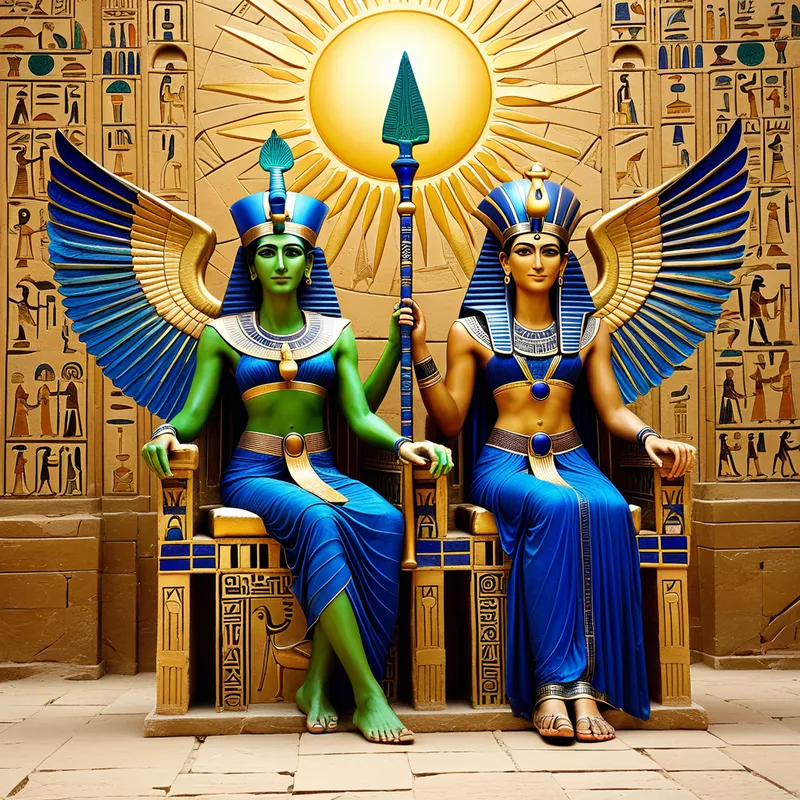
Isis and Osiris Myth Meaning & Symbolism
A myth of divine kingship, murderous betrayal, and a love so fierce it reassembles the dismembered, offering a map for the soul's descent and return.
The Tale of Isis and Osiris
In the First Time, when the world was still wet with the breath of the creator, the sun-god Khepri placed his children upon the black earth of Kemet. They were Osiris, whose skin was the green of the Nile’s life, and his sister-wife Isis, whose wings could span the horizon. With them ruled Nephthys and the desert god Set, whose domain was the red land of thirst and storm.
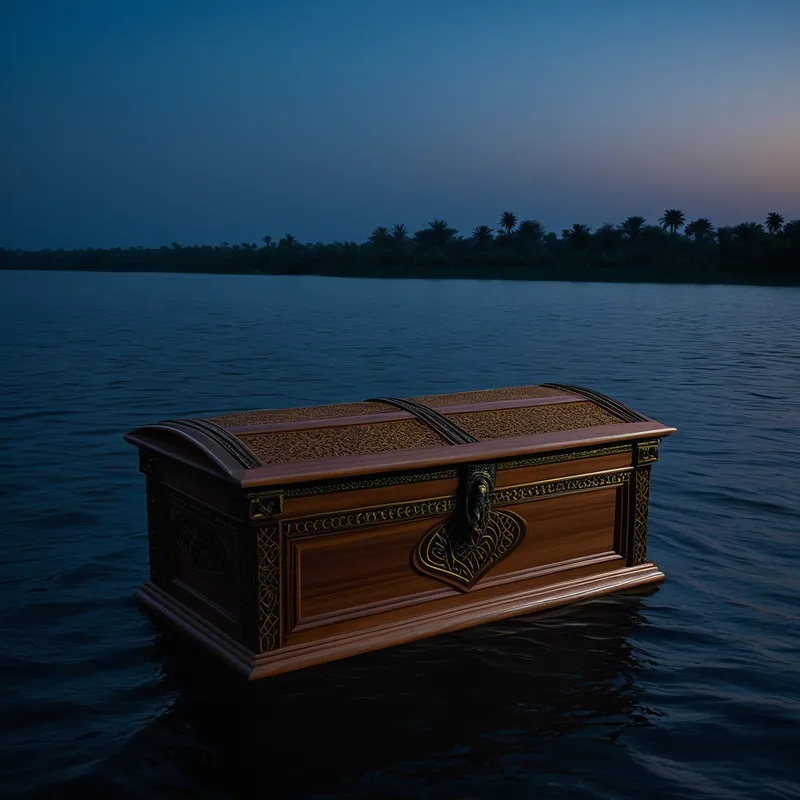
Osiris brought order, ma’at, teaching humanity the arts of agriculture, law, and worship. Where he walked, barley sprang high and vines grew heavy. His rule was a golden age, and this greatness festered in Set’s heart like a poison. At a great feast, Set unveiled a masterpiece of deception: a chest of fragrant cedar and ebony, inlaid with ivory and gold. “It shall belong,” he declared, “to whom it fits perfectly.” One by one, the guests tried and failed. When Osiris, trusting and curious, lay within, the chest was his very shape. In an instant, Set’s conspirators slammed the lid shut, sealed it with molten lead, and cast it into the Nile’s treacherous currents.
Isis’s wail tore the sky. Casting off her divine regalia, she became a woman gripped by a singular grief. She wandered the marshes, her feet bleeding, questioning every reed and bird. She learned the chest had drifted to the far shore of Byblos, encased within a tamarisk tree that grew with miraculous speed, becoming a pillar in the king’s palace. With cunning and magic, Isis retrieved the pillar, extracted the chest, and brought her husband’s body back to the hidden Delta marshes to mourn and, through her potent spells, to briefly revive him. From this union was conceived Horus, the avenger.
But Set, hunting by the light of a full moon, found them. His rage was a sandstorm. He seized the body of Osiris and in a fit of ultimate desecration, tore it into fourteen—some say forty-two—pieces, scattering them to the farthest nomes of Egypt. Isis’s despair now transformed into a relentless, meticulous love. With her sister Nephthys and the jackal-headed Anubis, she became a seeker of fragments. She traveled to every swamp, every desert wadi, recovering each sacred piece. Where a piece was lost forever, she erected a shrine. With magic, wax, and linen, she and Anubis performed the first act of embalming, reconstituting the body, creating the first mummy. Osiris did not return to the land of the living. He descended to rule the Duat, becoming king of the dead, whole and resurrected in a new, eternal kingdom. His heart, weighed against the feather of ma’at, was found true.
Cultural Origins & Context
This myth was not a single, canonical text but a living narrative woven into the very fabric of Egyptian civilization for over three millennia. It is found in fragments in the Pyramid Texts, the Coffin Texts, and most completely in Plutarch’s On Isis and Osiris from the 1st century CE. It was performed in temple rituals, most notably the annual Khoiak Festival, where effigies of the god were sown with grain, symbolizing his death and the land’s rebirth.
The myth functioned as the foundational theology for the Egyptian concept of kingship and the afterlife. Every Pharaoh was the living Horus, the son who avenged and succeeded his father, who became Osiris upon death. For the common person, it offered a template for hope: if the god-king could be dismembered and restored to eternal life, so too, through proper rites and a righteous heart, could they. The myth was a societal anchor, explaining the necessity of order (ma’at) against chaos (isfet), the cycle of the Nile’s flood and retreat, and the ultimate triumph of devoted love and ritual correctness over violent entropy.
Symbolic Architecture
At its core, the myth is a profound allegory of disintegration and reintegration, a map of the psyche’s journey through trauma toward a more complex wholeness.
Osiris represents the principle of conscious order, structure, and fertile life that is inevitably attacked by the psyche’s own shadow. He is the ego in its initial, naive wholeness—effective but unaware of its own vulnerabilities.
Set is not merely an external villain, but the necessary force of chaos, disruption, and unconscious rage that shatters a outgrown or rigidified state of being. His desert realm symbolizes the arid, fragmented psyche after a great trauma.
Isis embodies the active, seeking principle of the soul—the devoted consciousness that refuses to accept annihilation. She is love, but not a passive sentiment; she is love as a verb: searching, knowing, weaving, spell-casting. Her gathering of the scattered pieces is the painstaking work of recollection (re-collection) after a shattering experience.
The reconstituted body of Osiris is not the old life restored, but a new, sacred form—the mummy, the enduring essence. This symbolizes the birth of a psychological structure that can endure death, a consciousness that has integrated its encounter with the void.
The Four Sons of Horus guarding the canopic jars, and the forty-two pieces, hint at a process of differentiation. Wholeness is not homogeneity, but a sacred assembly of distinct, honored parts.
The Dreamer’s Resonance
When this myth stirs in the modern dreamer, it often signals a profound process of psychic dismemberment and the nascent call to reassembly. One may dream of losing body parts, of a cherished home or object being broken apart, or of frantically searching through labyrinthine spaces for something vital that is missing.
Somatically, this can feel like a literal fragmentation—a sense of being scattered, pulled in too many directions, or suffering from a loss of core integrity after a betrayal, a loss, or a life transition. The figure of Set in dreams may appear as a disruptive colleague, a violent stranger, or a natural disaster; it is the energy that has successfully destabilized the dreamer’s previous world.
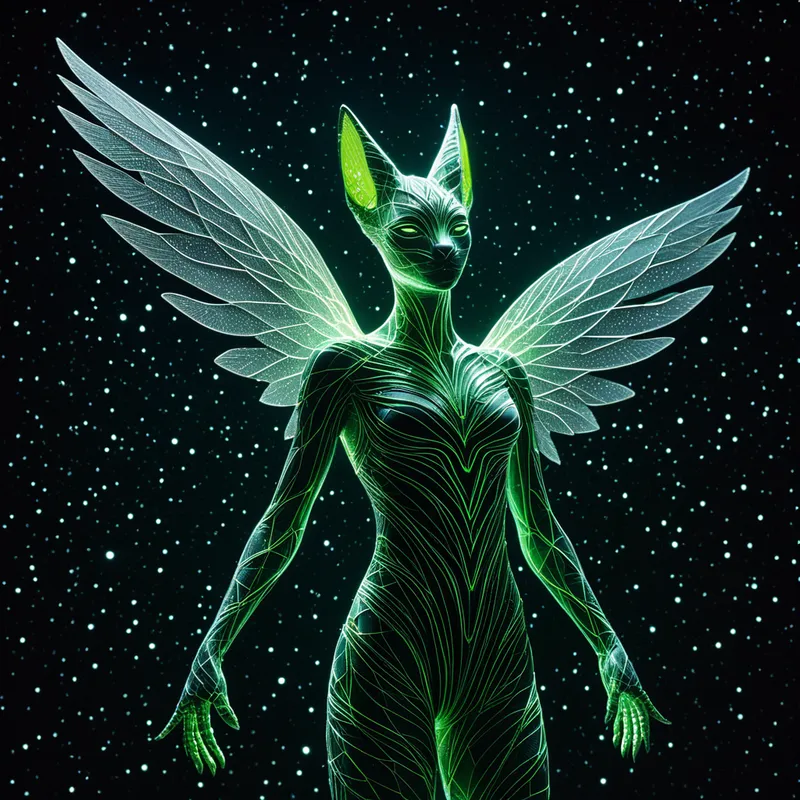
Conversely, dreaming of patiently gathering pieces, of repairing a broken vessel with gold (kintsugi), or of a nurturing, winged protective presence points to the activation of the Isis function within. This is the psyche’s innate healing intelligence beginning its work. The dreamer is not just suffering; they are, often unconsciously, initiating the search for their own scattered parts—lost talents, neglected wounds, disowned emotions—to be acknowledged and brought home.
Alchemical Translation
The alchemical journey mirrored in this myth is the opus contra naturam: the work against nature, which here means against the natural course of decay and forgetfulness. The chest is the prima materia, the sealed vessel of the initial crisis. Dismemberment is the essential separatio and mortificatio—the necessary breaking down of a complex into its constituent elements so that it may be purified and reconstituted at a higher level.
The work of Isis is the alchemical coniunctio—not a union of opposites, but a sacred gathering. It is the meticulous process of introspection, therapy, and shadow work where we reclaim our projections and integrate split-off aspects of the self.
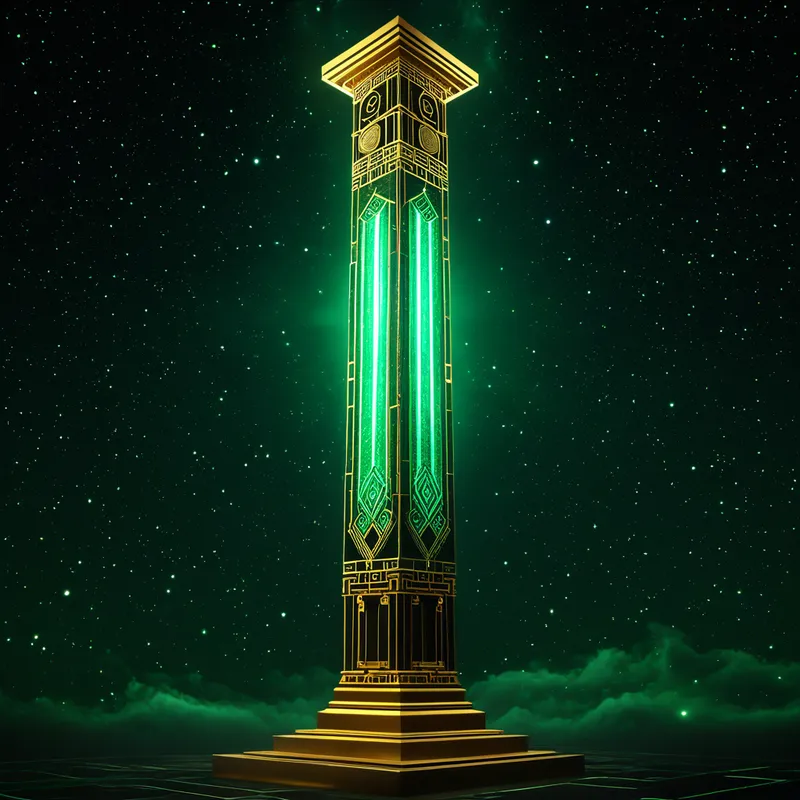
The final product is not the return of the old Osiris to his sunny throne, but his transformation into the Lord of the Duat. This is the psychological achievement of individuation: the ego, having faced its own mortality and fragmentation, no longer identifies solely with the bright, daytime consciousness. It now has a relationship with the underworld—the deep unconscious—and derives its authority from there. The individual becomes, like Osiris, a ruler of their own inner depths, stable and whole (Djed) precisely because they have been shattered and reassembled with consciousness and love.
Thus, the myth teaches that our deepest fragmentations are not final. They are an invitation—a brutal, painful one—to become a seeker, a weaver of our own scattered selves, and to achieve a wholeness that is conscious, sacred, and resilient enough to face the dark.
Associated Symbols
Explore related symbols from the CaleaDream lexicon: