Ishtar's Bazaar Myth Meaning & Symbolism
The goddess Ishtar descends to the underworld, stripped of her divine power at each gate, to confront her shadow and reclaim her sovereignty.
The Tale of Ishtar's Bazaar
Hear now the tale that echoes from the baked-brick ziggurats, a story whispered by the date palms along the twin rivers. It begins not with a birth, but with a disappearance. In the high heavens, the great goddess Ishtar, she of the roaring lion and the sweetest song, turned her gaze downward. Her beloved, the shepherd-god Tammuz, had been taken. The green had fled the earth, and the music had died in the reed pipes. A cold silence, the silence of the abyss, had swallowed his laughter.
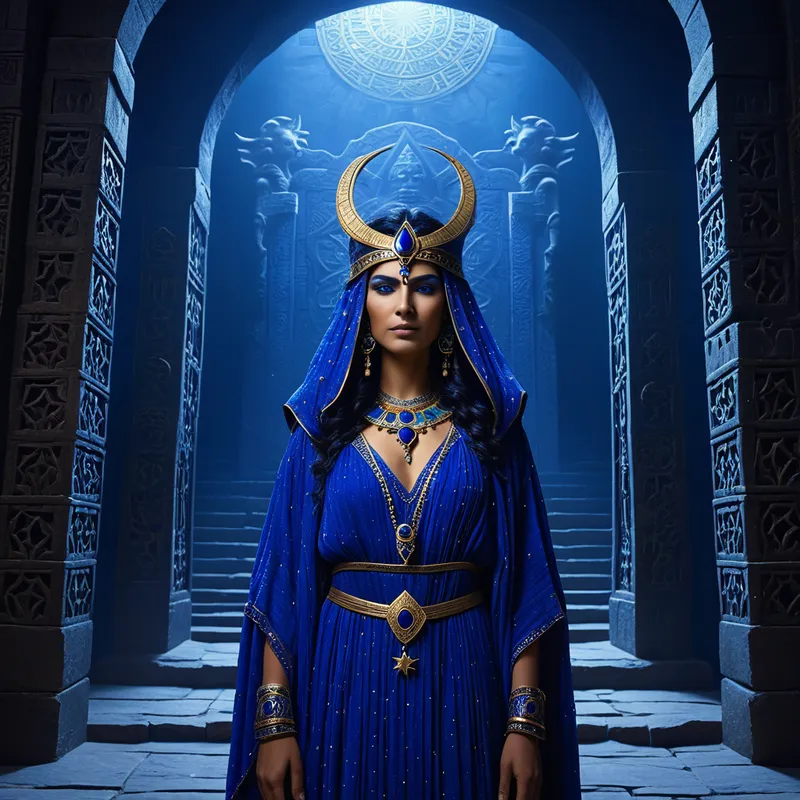
Ishtar’s heart, a drum of war and desire, beat a solitary rhythm of wrath and grief. She fastened her crown of the high heavens, clasped her lapis lazuli necklace that held the light of distant stars, donned her golden bracelets that chimed with the sound of conquest, and wrapped herself in the robe of sovereignty. Thus arrayed in the full panoply of her divine identity, she set her foot upon the Road of No Return, the path that leads to the Kur, the land from which none return.
Before her rose the first gate, a monstrous maw of shadow and basalt. Ereshkigal, Ishtar’s own sister and the sovereign of this silent realm, had set her watch. The gatekeeper, his eyes like cold pits, barred her way. “You may not enter clothed in the light of the world above,” his voice grated like stone on stone.
“Then take what you must,” Ishtar declared, her voice echoing in the hollow passage.
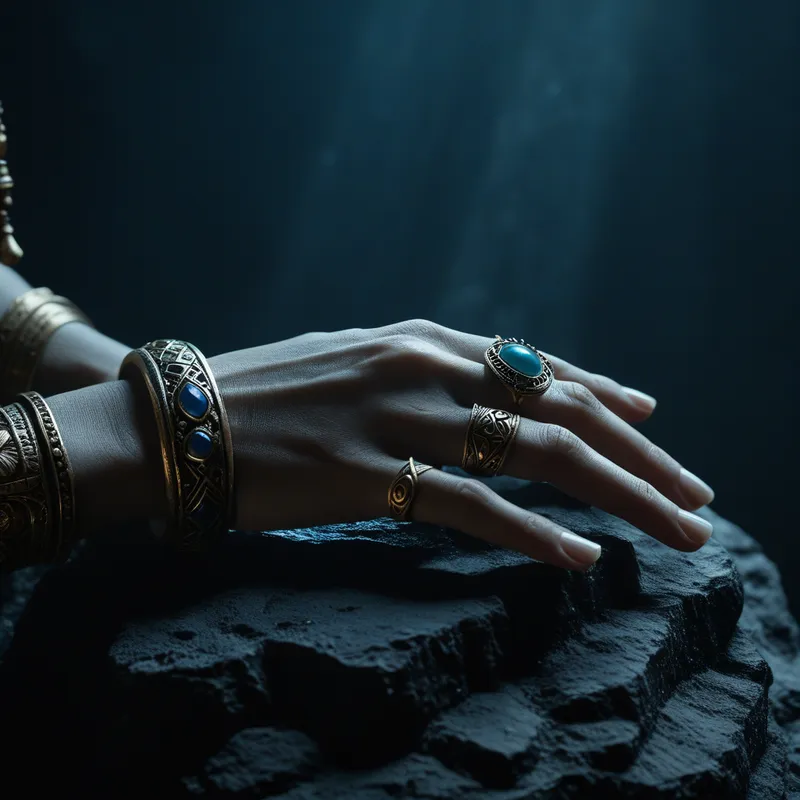
At the first gate, he demanded her great crown. The light around her dimmed. At the second, her starry earrings. The music of the spheres grew faint. At the third, her necklace of lapis. The connection to the celestial depths severed. Gate by gate, piece by piece, the Bazaar of Ishtar was held. Her bracelets, her girdle of birthstones, her breastplate, and finally, at the seventh and deepest gate, the very robe from her shoulders. Naked, shorn of all title and power, the Queen of Heaven stood as a shivering soul before the throne of Ereshkigal.
There was no welcome. The sixty ailments of the underworld flew from Ereshkigal’s eyes, striking Ishtar, who hung like a side of meat upon a hook. Above, all life ceased. Love withered, war stalled, the bull mounted not the cow. The world was a painted vase, beautiful and utterly still.
It was the quick-witted god Ea who fashioned a plan from tears and clay. He created Asu-shu-namir, a being of neither man nor woman, and sent it to the Kur. Asu-shu-namir spoke words of such empathy that they touched Ereshkigal’s barren heart. As the Queen of the Dead groaned with a forgotten feeling, the waters of life were released. Ishtar was revived, anointed with the oil of the deep.
But the laws of the Kur are iron. A soul for a soul. As Ishtar ascended, gate by gate, each article of her divine raiment was returned. Crown, necklace, robe—each piece settled back upon her, but they felt different. Lighter, or heavier? She could not say. And behind her, to take her place, went Tammuz, her beloved, to dwell half the year in the dust, so that the world above might know the turn of the seasons, the price of the green return.
Cultural Origins & Context
This myth, known to scholars as “Inanna’s Descent” (using the earlier Sumerian names), is not a mere story but a foundational ritual text. It was inscribed on clay tablets in cuneiform script, recited by priests and priestesses during the sacred marriage rites and lamentation ceremonies for the dying god Tammuz. Its primary function was cosmological: it explained the harsh, annual cycle of the Mesopotamian summer, when vegetation burned away under the sun, understood as the period of Tammuz’s captivity. Ishtar’s descent was the mythological engine behind this seasonal death.
Furthermore, it served a profound societal function. In a culture where the divine monarchy was central, the king was often ritually identified with Tammuz. The myth validated a core, difficult truth: that even divine (and by extension, royal) power is not absolute. It is subject to greater, cyclical laws of sacrifice and exchange. The goddess herself must pay the toll. This provided a narrative framework for understanding loss, political upheaval, and the necessary descent into periods of darkness that precede renewal, making it a crucial tool for cultural resilience.
Symbolic Architecture
At its heart, Ishtar’s journey is not a spatial but a psychological descent. The seven gates are not mere doors but stations of a profound kenosis—an emptying out. Each piece of regalia she surrenders represents a facet of her constructed, worldly identity: her sovereignty (crown), her allure and connection (jewelry), her protective power (breastplate), and finally, the very garment of her social self (robe).
To enter the realm of the soul, one must first be stripped of the costumes of the persona.
Ereshkigal is not merely a villainous sister; she is Ishtar’s own shadow, the repressed, chthonic counterpart to the celestial goddess. She is the power of the raw, unadorned, and often terrifying reality of loss, grief, and absolute vulnerability. Ishtar’s confrontation with her is a fatal embrace with everything her luminous identity denies. Hanging lifeless on the hook, she experiences the ultimate dissolution of the ego, a symbolic death necessary for any true transformation.
The rescue, orchestrated by Ea, is equally symbolic. Asu-shu-namir, the “one whose appearance is bright,” represents a transcendent function—a consciousness that exists beyond binary oppositions (male/female, above/below). It is this non-dual, empathetic awareness that finally moves the hardened heart of the shadow (Ereshkigal). True salvation comes not through force, but through a wisdom that acknowledges and holds the pain of the dark self.
The Dreamer's Resonance
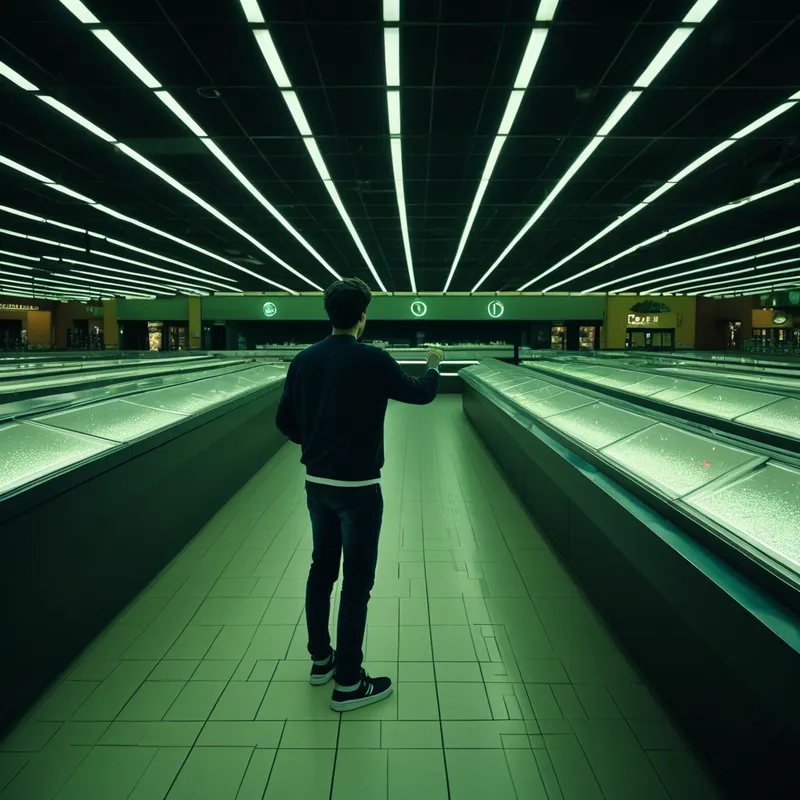
When this myth stirs in the modern unconscious, it rarely appears as a literal Babylonian tableau. Instead, one dreams of being compelled to enter a foreboding office building, a hospital, or a vast, empty department store—a modern Kur. The dreamer is often required to hand over their keys, wallet, phone, wedding ring, or professional ID at successive checkpoints. The somatic feeling is one of increasing exposure, vulnerability, and a terrifying lightness.
Such dreams signal a profound psychological process: the ego’s necessary descent. The psyche is initiating a rite of passage where the accumulated trophies and protections of one’s adapted life—the career, the relationships, the carefully curated self-image—are being called into question and temporarily suspended. It is the soul’s demand for authenticity, pressing the dreamer toward a state of naked self-confrontation. The anxiety is palpable because it feels like annihilation. Yet, this is the prelude to healing, indicating that a deep, foundational part of the self (the shadow or a lost creative potential, a Tammuz) has been neglected and must be reclaimed, even at great cost.
Alchemical Translation
The alchemy of Ishtar’s Bazaar maps the individuation process with stark clarity. The first stage is the Recognitio: a conscious feeling that something vital is missing, that life has become sterile (Tammuz is gone). This prompts the Descensus: the courageous, often rash decision to venture into the unknown depths of the psyche.
The seven gates are the alchemical Separatio and Mortificatio. Each surrendered attribute is a dissolution of a complex, a letting go of how we are known, even to ourselves. This is not destruction for its own sake, but the burning away of impurities to find the essential, unadorned core—the prima materia of the soul, which hangs lifeless on the hook.
The treasure is guarded by the dragon of our own resistance; to win it, we must first be devoured.
The revival by Ea’s cunning represents the Coniunctio—the sacred marriage. It is the moment when the conscious mind (Ea’s wisdom) sends a reconciling symbol (Asu-shu-namir) to make peace with the unconscious (Ereshkigal). This empathy births the “waters of life,” the Aqua Vitae that revives the integrated self.
Finally, the re-ascent and re-clothing signify the Multiplicatio. The powers and identities are reclaimed, but they are now transmuted. They are no longer worn as blind entitlements but as hard-won, conscious attributes, integrated with the knowledge of the dark. And the final law—Tammuz must take his turn in the underworld—is the ultimate alchemical truth: the process is never finished. Individuation is a cycle. Light demands darkness, consciousness requires a periodic return to the nourishing, fecund unconscious. We do not conquer the depths; we learn to trade with them, paying the necessary toll for our continued growth and the fertility of our world.
Associated Symbols
Explore related symbols from the CaleaDream lexicon: