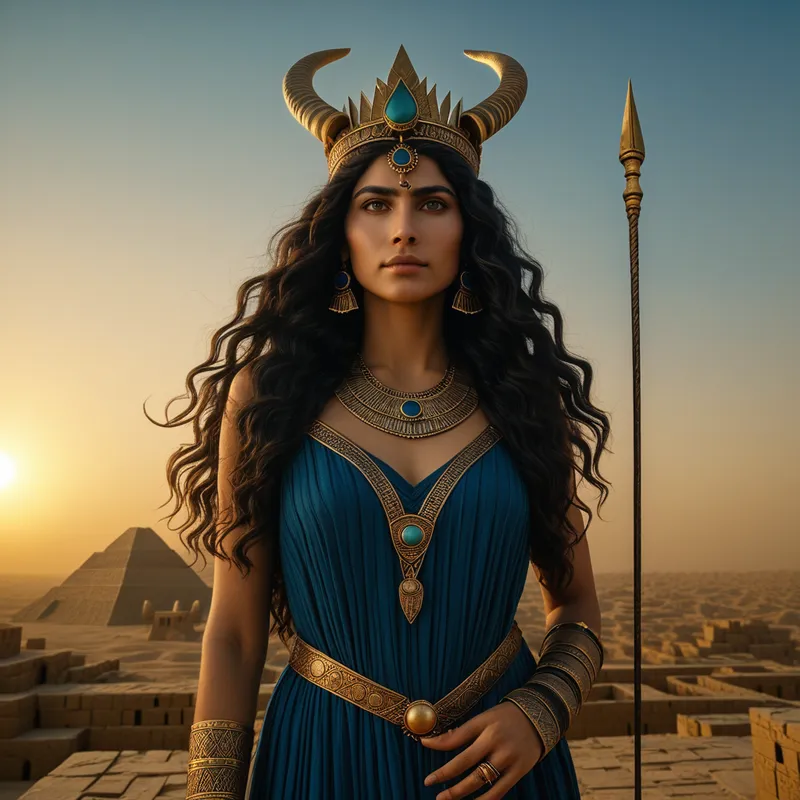
Ishtar Myth Meaning & Symbolism
The goddess Ishtar descends into the underworld, stripped of her power, to confront death and return transformed, embodying the cycle of life and psyche.
The Tale of Ishtar
Hear now the tale that stills the wind and hushes the stars. It begins not in the sun-drenched courts of heaven, but in the deep, silent chambers of a goddess’s heart. Ishtar, Lady of Heaven, she who commands the morning and the evening star, she whose word stirs love and whose glance kindles war, was gripped by a terrible longing. Her beloved, the radiant shepherd-god Tammuz, had been taken by the silent earth. The green world withered with his passing, and in Ishtar’s breast, love curdled into a dark and furious resolve.
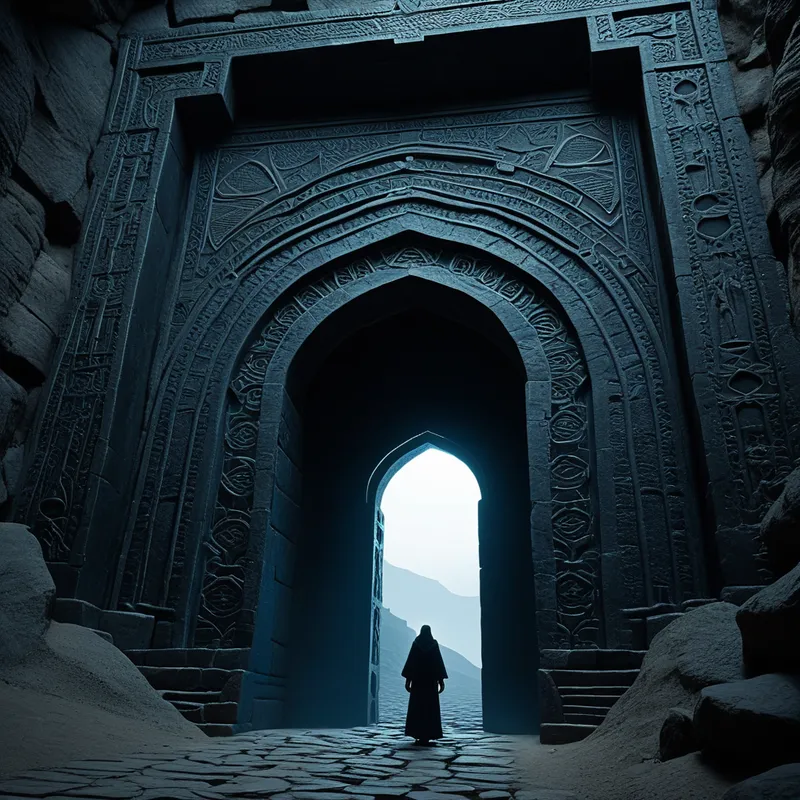
She turned her gaze from the high places, from the temples of Babylon and Uruk, and set her face toward the only road she had not traveled: the downward path. She approached the Kurnugia, the Land of No Return, a realm of dust and shadows ruled by her stern sister, Ereshkigal. At the first of seven gates, carved from obsidian and despair, a voice echoed from the gloom.
“Who dares approach the realm of the dead?”
“I am Ishtar, Queen of Heaven. Open the gate.”
“You may enter,” the gatekeeper intoned, “but as all who enter must, you must pay the toll. Give me your great crown.”
A shock ran through the heavens. Ishtar, without her crown? Yet, she removed it, feeling a portion of her divine radiance dim. The gate groaned open. At the second gate, they took her earrings, and the music of the spheres grew faint. At the third, her necklace of lapis lazuli, and the weight of her authority lessened. Gate by gate, she was stripped bare. Her breastplate, her girdle of birth stones, the bracelets upon her wrists and ankles—each a symbol of her power, her identity, her very connection to the world above. Finally, at the seventh gate, they took the last garment shielding her nakedness.
She stood in the throne room of Ereshkigal, a being of pure, raw power, stripped of every title and trapping. Her sister, upon her throne of bleached bone, did not see a rival queen, but a naked soul. In a flash of rage and recognition, Ereshkigal fixed the eye of death upon her. Ishtar fell, lifeless, and was hung upon a hook like a piece of meat.
And above, all life ceased. The bull would not mount the cow, the man would not touch the woman, the seed would not break open in the soil. The world was locked in a sterile, silent pause. The gods, in their panic, fashioned a being of pure cunning, Asushunamir, and sent it to the underworld to charm Ereshkigal. The plan worked. Moved by a pity she herself did not understand, Ereshkigal ordered Ishtar to be revived and sprinkled with the waters of life.
But the laws of the deep are absolute. A life for a life. As Ishtar, piece by piece, reclaimed her garments and ascended through the seven gates, returning to the light, a price was paid. Some say it was Tammuz who must take her place, descending for half the year, explaining the barren season. Others whisper that it was another, a substitute found in the shadows. Ishtar emerged, whole and yet utterly changed, carrying the dust of the underworld on her sandals and the knowledge of the hook in her soul. The world stirred, love and conflict bloomed again, but now under the gaze of a goddess who had seen the other side.
Cultural Origins & Context
This myth, known as Ishtar’s Descent to the Underworld, is not a mere story but a foundational pillar of the Mesopotamian worldview. It was inscribed on clay tablets in the Akkadian language, part of a rich tradition of lamentation hymns and ritual texts. It was likely recited by priests and priestesses, particularly during the annual mourning for Tammuz, which marked the scorching summer drought.
Its societal function was multifaceted. It was a divine explanation for the seasonal cycle—the death and rebirth of vegetation. It reinforced the cosmic order and the terrifying balance between the upper world of the living and the lower world of the dead. Most profoundly, it framed the very nature of power, love, and fertility not as simple givens, but as forces that must undergo a harrowing negotiation with their opposites: loss, sterility, and death. The goddess of life itself was not exempt from the realm of dust; she was subject to its laws, making her return not a simple victory, but a hard-won transformation that sustained the cosmos.
Symbolic Architecture
At its core, the myth is a masterful map of a psychological and cosmic process. Ishtar is not just a goddess; she is the archetypal principle of Eros in its fullest sense—the connective force of love, desire, fertility, and even the creative aggression of war. Her descent represents the inevitable journey of that life-force into confrontation with its own shadow, with all that it denies and fears.
The seven gates are the seven layers of identity, the personas and attachments we construct. To reach the core of our being, we must surrender them.
The crown of social role, the earrings of borrowed opinions, the necklace of achievements, the garments of physical pride—all must be left at the gate.
Nakedness before Ereshkigal is the ultimate encounter with the raw, unadorned Self, often experienced as a kind of death. Ereshkigal herself is the queen of the repressed—grief, rage, loneliness, all that is buried and un-lived. Ishtar’s suspension on the hook is the stasis of the psyche when it is identified with only one pole of existence, when life refuses to acknowledge death.
The rescue is not a heroic conquest. It is mediated by Asushunamir, a being of fluidity and charm, symbolizing the elusive, reconciling insight that can soften the heart of our own inner tyrant. The return is a reintegration, but with a cost—a part of our innocent, untested vitality (Tammuz) must remain conscious of the depths.
The Dreamer's Resonance
When this myth stirs in the modern dreamer, it announces a profound initiation. To dream of descending into a basement, cave, or subway; of being systematically stripped of clothing, jewelry, or tools; of meeting a powerful, fearsome, or grieving feminine figure in the depths—these are somatic echoes of Ishtar’s journey.
The psyche is undergoing a necessary kenosis, an emptying out. It is the process felt during a deep depression, a devastating loss, or a crisis of identity, where everything you thought you were is called into question. The dreamer is not breaking down but breaking open. The sterile pause in the myth mirrors the dreamer’s feeling that life has lost its color, its passion, its forward motion. This is not pathology, but the psyche’s solemn preparation for a recalibration at the deepest level. The body may feel heavy, numb, or trapped—the physical correlate of being “hung on a hook.”
Alchemical Translation
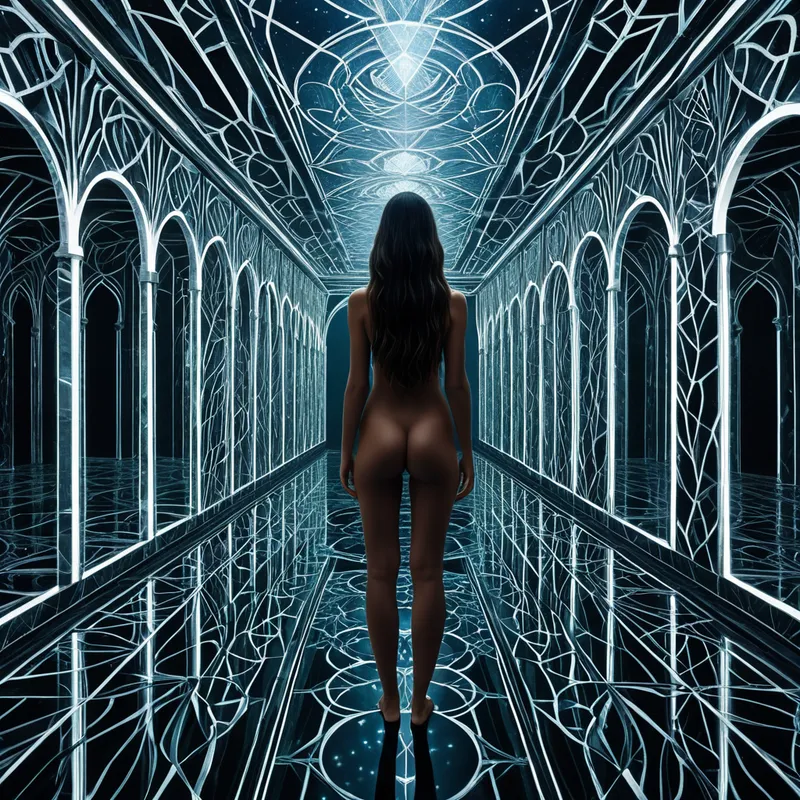
For the individual, Ishtar’s descent models the essential path of individuation. It is the alchemical nigredo, the blackening, where the prima materia of the personality is dissolved in the dark waters of the unconscious.
The conscious attitude, identified with its light and its power (Ishtar in heaven), must voluntarily turn toward what it has rejected. The ego’s treasures—its accomplishments, its self-image, its sense of control—are not stolen; they are surrendered as the toll for deeper passage.
The triumph is not in avoiding the hook, but in surviving it. The return is not to the old life, but to a life infused with the knowledge of the dark.
The modern individual’s “ascent” is the slow, often painful, process of reclaiming power not as an autocrat, but as a sovereign who has treated with the kingdom of shadows. The reclaimed “garments” are no longer mere adornments; they are now symbols of a hard-won wholeness. The lover who has grieved deeply loves more fully. The creator who has faced sterility creates with more authenticity. The warrior who knows her own fragility fights for what truly matters.
Ishtar’s myth tells us that life, in its fullest expression, is not a state of perpetual bloom. It is a cyclical descent and return, a love that is fierce enough to stare into the face of death, and a power that is true only because it has been stripped utterly bare and chose, still, to return to the world.
Associated Symbols
Explore related symbols from the CaleaDream lexicon: