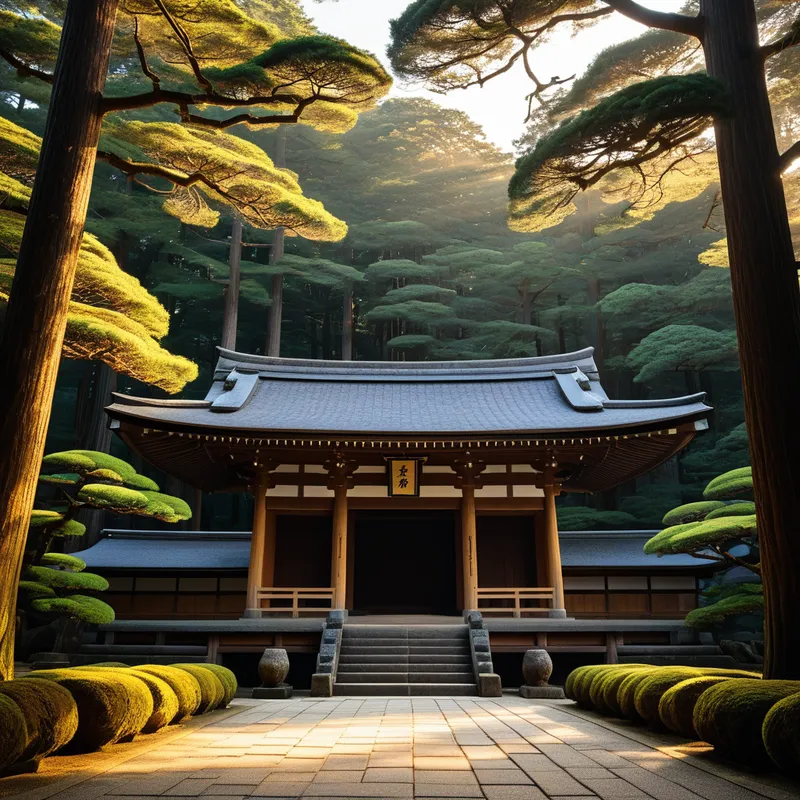
Ise Shrine Myth Meaning & Symbolism
The sacred myth of the Sun Goddess Amaterasu, enshrined at Ise, embodying the eternal cycles of renewal and the divine presence within the material world.
The Tale of Ise Shrine
Listen. Before history was written, when the world was still soft with the breath of the gods, there was a silence that held the promise of light. From this silence emerged Amaterasu Ōmikami, her radiance weaving the fabric of the sky and warming the first green shoots of the earth. Her light was order, life, and the rhythm of the days.
Yet, shadow is born from light. Her brother, Susanoo-no-Mikoto, raged with a tempest’s heart. In a fury of chaos, he defiled her sacred weaving hall, hurling a flayed heavenly horse through the roof, and scattering the looms. The world trembled. Amaterasu, in a grief deeper than any darkness, retreated into the Ama-no-Iwato. The sun vanished. The world was plunged into an endless, cold night where only the cries of myriad gods echoed in the void.
The deities gathered on the Ama-no-Yasukawa, their faces pale in the gloom. Desperation gave birth to cunning. They devised a sacred pantomime. Ame-no-Uzume mounted an upturned tub, and with the beat of feet and the clatter of ritual implements, began a dance so wild, so utterly abandoned, that her garments flew loose. The laughter of the eight hundred myriad gods roared like thunder, shaking the very stone of the cave door.
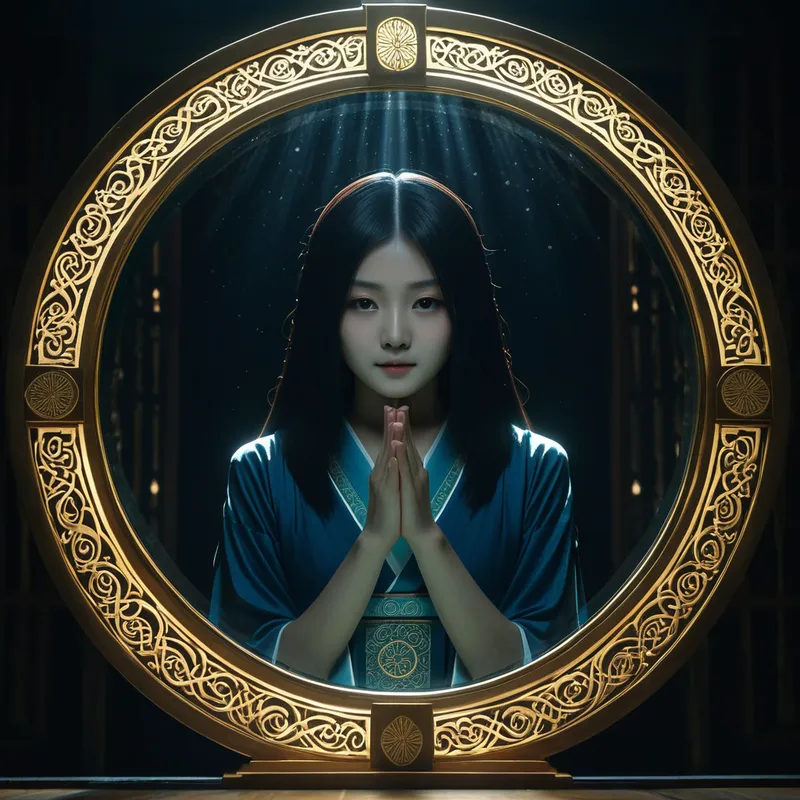
Inside her self-made prison, Amaterasu heard the riotous joy. A sliver of curiosity pierced her sorrow. “How can there be merriment while I am gone?” she whispered. She opened the door a crack. In that instant, the mighty god Ame-no-Tajikarao seized the edge and wrenched it open. Another god held before the crack the Yata no Kagami, polished to a perfect sheen.
Amaterasu saw her own reflection—a brilliance she had forgotten, a light so pure it seemed a stranger, yet was her very essence. Stunned by her own splendor, she leaned forward. The strong-armed god pulled her fully into the world. Light flooded the plains and mountains once more. Order was restored, but it was an order transformed by the knowledge of darkness.
Centuries flowed like rivers. To house this sacred essence, this divine reflection that saved the world, a shrine was built. Not in the distant High Plain of Heaven, but here, in the mortal world, where the Isuzu River sings over white stones. They built it of plain wood and thatched grass, a home for the mirror that once returned the sun to the sky. And so, the heart of the Sun Goddess came to dwell at Ise, a pulse of celestial light at the center of the land, waiting in quiet splendor for those who seek its reflection.
Cultural Origins & Context
The myth of Ise is not merely a story from the Kojiki and Nihon Shoki; it is the living breath of Shinto. The shrine itself, Ise Jingu, is the supreme embodiment of this tradition. Its primary function is to enshrine Amaterasu</abrikami, the divine ancestor of the Imperial line, making it the spiritual root of the nation’s identity.
The myth was preserved and performed by a hereditary priesthood and transmitted through ritual and the oral tradition of the norito. Its societal function was profound: it explained the cosmic order, legitimized the temporal authority of the Emperor as a descendant of the Sun, and established a sacred covenant between the people, the land, and the divine. Most critically, the practice of Shikinen Sengū—the complete, exact reconstruction of the shrine on adjacent sites—transforms the myth from a past event into a perpetual present. Every generation participates in the renewal of the world, actively rebuilding the house of the sun, ensuring the light never retreats permanently again.
Symbolic Architecture
At its core, the myth of Ise is a profound allegory of consciousness, its eclipse, and its return. The shrine is not just a location; it is a symbolic engine for a fundamental psychic process.
The mirror does not create the image; it reveals what is already present but unseen. The divine is not summoned from afar, but recognized within.
Amaterasu represents the conscious Self, the illuminating principle that gives coherence, meaning, and vitality to the inner world. Susanoo is not merely an antagonist; he is the necessary shadow, the chaotic, emotional, and destructive aspect of the psyche that the conscious ego cannot integrate. His rage forces the light into retreat, symbolizing a depression, a loss of meaning, or a profound crisis of identity—the soul’s dark night.
The Ama-no-Iwato is the prison of introspection turned inwards, a narcissistic withdrawal where the ego, wounded, hides from the demands of life and relationship. The salvation comes not through force, but through reflection and engagement. The Yata no Kagami is the ultimate symbol of self-recognition. It does not show Amaterasu an enemy or a plea; it shows her herself. This is the moment of gnosis: the realization that the source of light, value, and authority resides within one’s own being. The laughter of the gods signifies the vital, embodied life force (Ame-no-Uzume’s dance) that lures the isolated Self back into the collective, relational world.
The Dreamer's Resonance
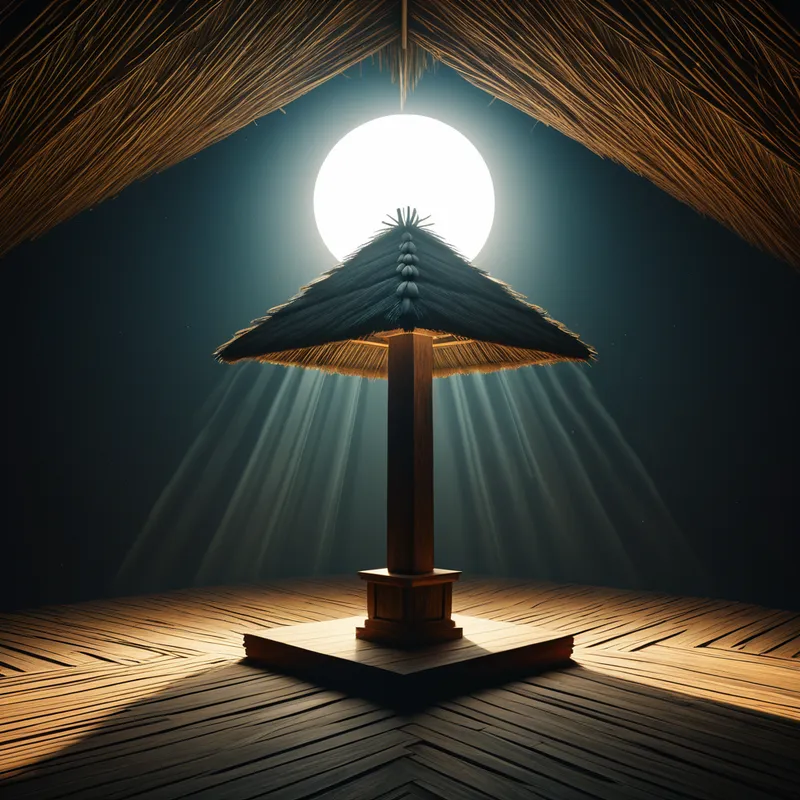
When this myth stirs in the modern unconscious, it often manifests in dreams of profound transition, concealment, and sought-after renewal. A dreamer may find themselves in a pristine, empty wooden building of profound simplicity, feeling both peace and a strange loneliness. They may be searching for a source of light in a darkened landscape, or staring into a mirror that reflects not their face, but a blinding light or a deep void.
Somatically, this can correlate with feelings of energetic depletion, a “hiding” from the world (akin to social withdrawal or depression), or conversely, a restless, chaotic energy (the Susanoo complex) that feels destructive and uncontrollable. Psychologically, the dreamer is navigating the tension between the need for egoic integrity (the contained, perfect shrine) and the eruptive forces of the shadow or the unconscious. The dream is the cave, and the process of interpretation becomes the mirror—the tool for self-recognition that can lead the dreaming psyche back into the light of awareness.
Alchemical Translation
The individuation process modeled by Ise is one of cyclical death and rebirth, where the very structure of the Self is ritually dismantled and rebuilt. It is the alchemy of renovatio.
To individuate is not to build a permanent monument to the Self, but to consent to its periodic, sacred dissolution and reconstruction.
The modern individual’s “shrine” is their constructed identity, their worldview, their most cherished beliefs about who they are. The myth instructs that this structure must not become rigid or eternal. The Shikinen Sengū is the psychic practice of voluntary deconstruction. It is the courage to examine, take apart, and renew one’s foundational premises. We are invited to become both the priest and the architect of our own soul.
The chaos of Susanoo is not an enemy to be vanquished, but the necessary catalyst that proves the old form is no longer inviolable. The retreat into the cave is a period of necessary incubation, where, in darkness, the new form is gestated. The return to light, facilitated by the mirror of self-reflection, is the emergence of a renewed consciousness—one that has faced its own shadow and recognized its own divine core, not in grandiosity, but in humble, pristine simplicity. Thus, the individual achieves not a static perfection, but a living, breathing wholeness that is perpetually renewed, just as the sun sets only to rise again, and the shrine stands eternal precisely because it is always being reborn.
Associated Symbols
Explore related symbols from the CaleaDream lexicon: