Isaiah's Vision Myth Meaning & Symbolism
A prophet's terrifying vision of a divine throne, cleansing fire, and a sacred call that shatters the self to forge a new purpose.
The Tale of Isaiah's Vision
The world was heavy. King Uzziah, who had ruled for decades, was dead, and the air in Jerusalem tasted of dust and uncertainty. In that year of the king’s death, the man Isaiah went up to the Temple, not for ceremony, but because the ground of his being had fallen away. He sought a foundation in the only place he knew.
He stood in the outer court, but his spirit was drawn inward, through the veil, into a place that was the Temple and yet was not. The stones dissolved into immensity. He found himself not in the Holy of Holies built by human hands, but in the true throne room of the cosmos.
And he saw.
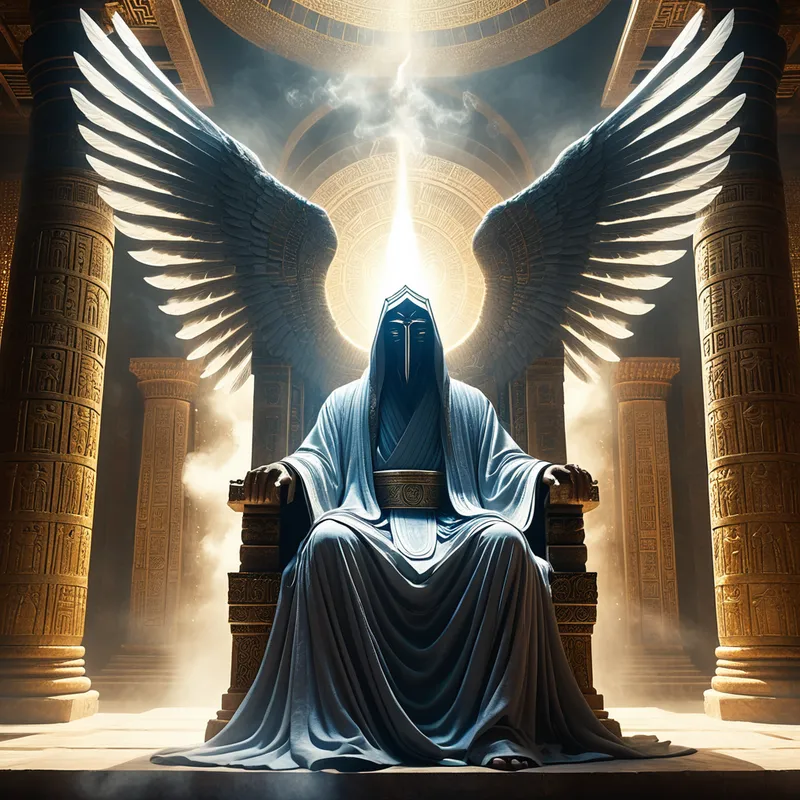
He saw Adonai sitting upon a throne, high and lifted up. The train of his robe filled the entire, unimaginable space—a fabric woven from galaxies and the deep hum of existence. Above him stood the Seraphim. Each one had six wings: with two they covered their faces, for not even they could bear the direct gaze of the Source; with two they covered their feet, a gesture of ultimate humility; and with two they flew.
And they called to one another, a sound that was not sound but the vibration of reality itself: “Holy, holy, holy is YHWH of Hosts; the whole earth is full of his glory!” The foundations of the thresholds shook at the voice of him who called, and the house was filled with smoke.
Isaiah did not feel awe. He felt annihilation. The vision did not elevate him; it obliterated him. In the face of absolute, radiant Holiness, his own being was revealed to him—not as a prophet, but as a man of unclean lips, dwelling among a people of unclean lips. The very organ of his vocation, his speech, was condemned. He was a crack in the crystal, a flaw in the song. “Woe is me!” he cried out, a raw scream into the smoking vastness. “For I am lost!”
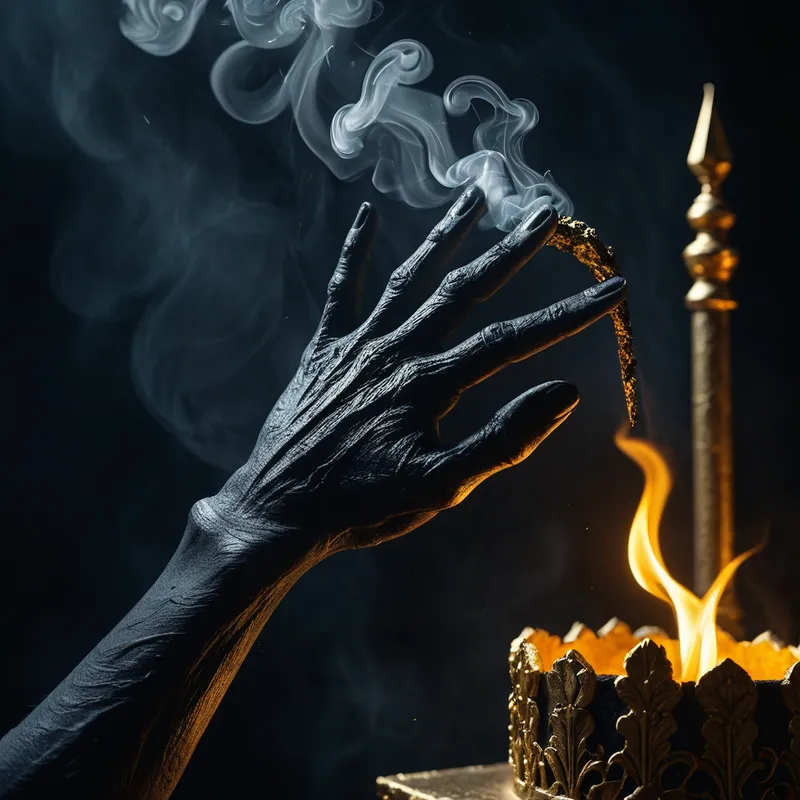
But the Holiness that shatters also mends. One of the Seraphim flew to the altar—a celestial furnace of devotion—and took a burning coal with a pair of tongs. It approached Isaiah, not with wrath, but with a terrifying mercy. “Behold,” the voice implied, “this has touched the altar; this is sacred fire.”
The Seraph touched the coal to Isaiah’s mouth. There was no metaphor. He felt the sear, the cauterizing pain that was also a cleansing. “Behold,” said the Seraph, “this has touched your lips; your guilt is taken away, and your sin atoned for.”
Then, from the center of the smoke and the shaking, came the Voice of the Throne itself. It did not ask for volunteers. It asked for a messenger. “Whom shall I send, and who will go for us?”
And from a man who a moment before was undone, from a mouth just purified by fire, came the answer, whole and unhesitating: “Here I am. Send me.”
Cultural Origins & Context
This account is found in the sixth chapter of the Book of Isaiah, a cornerstone of the prophetic tradition in Abrahamic scripture. It functions as Isaiah’s prophetic commissioning narrative, a genre where a figure is directly confronted by the divine and given a lifelong, often difficult, mission. Scholars place the historical Isaiah in the 8th century BCE, a time of political upheaval and moral anxiety for the kingdoms of Judah and Israel.
The story was preserved, recited, and eventually written down not as a mere biography, but as a foundational template for understanding the human encounter with the sacred. It was told to answer profound questions: How does a prophet come to be? What is the cost of hearing the divine word? The vision served to authenticate Isaiah’s harsh messages of judgment and hope, rooting his authority not in personal ambition, but in a traumatic, transformative initiation. In the culture’s memory, it established a pattern: true calling is preceded by a devastating self-reckoning made possible only by an experience of transcendent reality.
Symbolic Architecture
The myth’s power lies in its stark symbolic architecture, each element a facet of a profound psychological ordeal.
The Throne Room represents the irreducible, objective reality of the Self (in a Jungian sense)—the central, ordering principle of the psyche that exists beyond the ego’s control. It is not a friendly place for the personal identity; it is the seat of totality.
The Seraphim, the “burning ones,” symbolize the terrifying, purifying agents of the unconscious. Their six wings depict the paradox of approaching the numinous: reverence (covered face), humility (covered feet), and dynamic action (flight). Their cry of “Holy, holy, holy” is the psyche’s own recognition of its deepest, most integrated, and utterly other core.
The confrontation with the Holy is not an affirmation of the ego, but its dissolution. One does not meet God; one is met by God, and the meeting-place is the ruin of the old self.
Isaiah’s cry, “I am a man of unclean lips,” is the critical moment of ego-deflation. The “unclean lips” symbolize the totality of one’s adapted personality—all its compromises, false speech, and lived contradictions. In the light of the Self, the persona is seen as fundamentally inadequate, even fraudulent.
The Burning Coal is the central alchemical image. Taken from the altar (the place of sacrifice and transformation), it is the searing insight, the painful truth that must be integrated. It does not merely wipe away guilt; it burns away the capacity for the old, inauthentic way of being. The purification is traumatic and leaves a scar—a mark of the transformation.
The Dreamer's Resonance
When this myth stirs in the modern unconscious, it rarely appears as biblical pageantry. The dreamer may find themselves in a vast, sterile data center (the throne room), where a monolithic server hums with impossible power. Abstract, geometric light-forms (the Seraphim) move rhythmically, generating a deafening, logical mantra. The dreamer feels an overwhelming sense of exposure and fraudulence—perhaps their professional title, their social mask, feels like a lie shouted into a silent, judging cosmos.
The somatic experience is key: a trembling in the limbs, a tightening in the chest, a literal feeling of the throat constricting or the mouth going dry (“unclean lips”). The “coal” may manifest as a painfully bright light being applied to the forehead, a scalding liquid drunk, or a word of shattering truth spoken by a dream figure that burns upon hearing it. The dream is an initiation crisis. The psyche is forcing a confrontation between the comfortable, constructed ego and a vaster, more demanding potentiality within. The terror is not of punishment, but of being unmade and remade.

Alchemical Translation
The myth of Isaiah’s Vision is a precise map of the individuation process, specifically the stage of nigredo—the blackening, the dissolution. The ego’s journey is not to build a throne, but to witness its own dethronement.
First, there is the Call to the Interior Temple, a deep, often crisis-driven urge to seek meaning beyond the conventional (the death of King Uzziah). This leads to the Vision of the Self, a shocking, non-egoic awareness of the psyche’s own central authority and majesty. This vision inevitably produces the Ego-Inflation Crisis, where the personal identity, comparing itself to this majesty, falls into a state of “unclean” inadequacy and despair.
The coal is the liberating poison. The truth that seems to destroy us is the very substance of our redemption. We are not sent in spite of our wounds, but because the wound has become a mouthpiece.
Then occurs the crucial Cauterization. This is the painful integration of shadow material, the acceptance of one’s flawed humanity not as a shame to hide, but as the raw material sanctified by the encounter itself. The guilt is not forgiven from the outside; it is burned away by the heat of a new, unbearable consciousness.
Only from this place of seared-open humility can the Authentic Response emerge. “Here I am” (Hineni). This is not the ego volunteering; it is the whole being, now aligned with the Self, acknowledging its purpose. The mission that follows—often difficult, speaking unwelcome truths—is no longer a personal burden, but the natural expression of the transformed psyche. The individual has been shattered by the numinous and reassembled as a vessel for a work greater than themselves. The fire on the lips becomes the fire in the word.
Associated Symbols
Explore related symbols from the CaleaDream lexicon: