Isaiah Myth Meaning & Symbolism
A prophet's terrifying vision of a holy king initiates a lifelong ordeal of speaking unbearable truth, embodying the archetype of the wounded mouthpiece.
The Tale of Isaiah
The year King Uzziah died, the world grew thin. The solid stones of Jerusalem seemed to tremble, as if the keystone of an age had been pulled loose. In that hollowed-out silence, a man named Isaiah, son of Amoz, walked into the temple. It was not for sacrifice he came, but for solace—a seeking of the ground beneath the crumbling earth.
He stood in the outer court, the smell of old incense and cold ashes in his nostrils. Then, the air changed. It did not stir; it thickened, becoming a syrup of gold and terror. The foundations of the threshold began to hum, a note too low for hearing but felt in the marrow. He looked up.
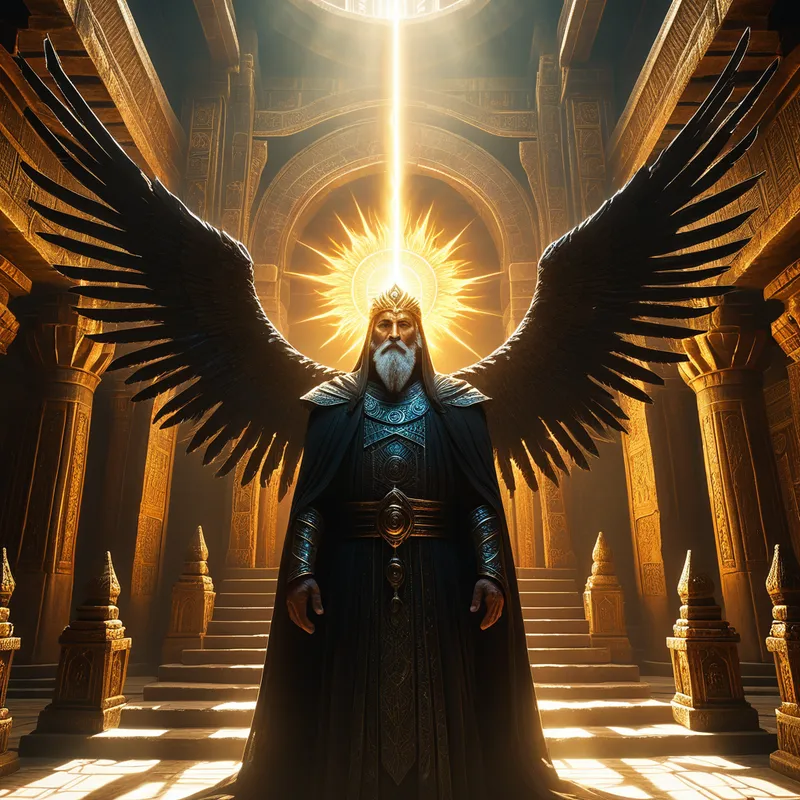
The temple was gone. In its place stretched an immeasurable hall of time and fire. High and lifted up sat a Throne, and upon it, a Form shrouded in the folds of a robe that filled the whole space with majesty. From it emanated a terrible, beautiful holiness—a sheer, annihilating otherness that made the very concept of "man" feel like dust. Around the Throne hovered the Seraphim, each with six wings: with two they covered their faces, unable to bear the direct gaze; with two they covered their feet, in humility; and with two they flew. Their call to one another shook the pillars of reality: "Holy, holy, holy is the YHWH of hosts; the whole earth is full of his glory!"
At the sound, the doorposts shook. The temple filled with smoke, and Isaiah’s own foundations gave way. His knowledge shattered. His righteousness unraveled. He did not see a God to be argued with, but Holiness itself, and in its blazing mirror, he saw only the truth of his own being and that of his people: a profound, communal stain. "Woe is me!" he cried, his voice a rasp in the thunderous silence. "For I am lost; for I am a man of unclean lips, and I dwell in the midst of a people of unclean lips; for my eyes have seen the King, YHWH of hosts!"
Then, movement. One of the fiery ones flew to him, holding in its hand a glowing coal taken from the altar with tongs. There was no question, no ceremony of consent. The seraph touched the coal to Isaiah’s mouth. The pain was not of mere flesh; it was the searing away of a lifetime of false words, easy lies, and complicit silence. "Behold," said the voice from the fire, "this has touched your lips; your guilt is taken away, and your sin atoned for."
Then came the Voice from the Throne, not in the earthquake or fire, but in the stillness after the burning: "Whom shall I send, and who will go for us?"
And from the man with the smoldering, purified mouth, the only possible answer arose, raw and whole: "Here I am. Send me." The vision sealed his fate with a terrible commission: to speak words that would make hearts fat, ears heavy, eyes shut—to prophesy until cities lay in ruin and a remnant was all that remained. The man walked out of the temple, into the blinding sun of a ordinary day, forever carrying the imprint of the Throne and the taste of sacred fire on his tongue. His life was no longer his own; it was a vessel for a message he could not unspeak.
Cultural Origins & Context
The scroll of Isaiah is not a single story but a tapestry woven over centuries, a core text of the prophetic tradition in ancient Judah. Its earliest layers originate in the 8th century BCE, a time of seismic political shifts. The Assyrian empire was a devouring wolf at the door, and King Uzziah’s death marked the end of a period of stability. The prophet Isaiah ben Amoz was a figure of the Jerusalem aristocracy, possibly with access to the royal court, giving his words a piercing political and social edge.
This myth was not merely recited; it was performed and inscribed as part of a living, struggling covenant. The prophets were the nation’s conscience, its divine alarm system. The call narrative—the foundational vision in the temple—served a critical function: it established the prophet’s authority not from lineage or political appointment, but from a direct, destabilizing encounter with the Divine. It was a story told to explain the source of the unbearable and often unpopular truths the prophet was compelled to deliver. Passed down through scribal schools and liturgical remembrance, it shaped the understanding of prophecy itself: not as fortune-telling, but as a vocation born in the searing intersection of human inadequacy and transcendent commission.
Symbolic Architecture
At its heart, the myth of Isaiah is an archetypal drama of vision and vocation, framed by the terrifying mechanics of holiness. The vision of the Throne represents the eruption of the numinous—the wholly Other—into the field of conscious awareness. It is not a gentle revelation but a catastrophic realignment of reality.
The call comes not when we are ready, but when we are ruptured. Vocation is born from the wound that holiness inflicts upon complacency.
The prophet’s immediate response—"Woe is me! I am a man of unclean lips"—is the essential human reaction to genuine consciousness expansion. It is the death of the ego’s self-assessment. The "unclean lips" symbolize the contaminated instrument of communication: our participation in collective falsehoods, our shared cultural shadow, our complicity in systems of injustice. The burning coal is the symbol of radical, painful purification. It is not a gentle cleansing but a cauterization. The guilt is taken away not by denial, but by the transformative fire that simultaneously destroys and seals.
The resulting vocation is a paradox: he is sent to speak, yet his speech will cause hardening. This reflects the profound psychological truth that the delivery of deep, unconscious content to a resistant consciousness often meets with defense and further repression. The prophet becomes the embodiment of the painful truth the psyche both needs and rejects.

The Dreamer's Resonance
When this myth stirs in the modern dreamer, it often manifests as dreams of overwhelming, awe-filled encounters that leave a sense of profound unsuitability. One might dream of standing before a vast, incomprehensible machine of light (the Throne) or being in the presence of an awesome, silent authority. The somatic feeling is one of visceral smallness and guilt—not for a specific crime, but for a fundamental state of being "unclean," inauthentic, or complicit.
The dream equivalent of the seraph’s coal might be a sudden, painful insight—a word heard, an image seen—that burns its way into the dreamer’s awareness, often centered on the mouth, throat, or heart. This signifies an initiation of the "speaking function." The dreamer is being prepared, however painfully, to give voice to something true that has been silenced within them or their environment. The subsequent dream narrative often involves being given an impossible or thankless task, reflecting the nascent feeling of a vocation that feels more like a burden than a gift. The psyche is rehearsing the ordeal of becoming a conduit for a truth larger than the personal self.

Alchemical Translation
The alchemical journey modeled by Isaiah is the transmutation of the wounded mouth into the instrument of vision. It begins with the nigredo, the blackening: the death of King Uzziah (the old, stable ruling consciousness) and the subsequent confrontation with the shadow ("unclean lips"). The blinding vision is the albedo, the whitening—not a gentle light, but a searing, clarifying fire that reveals all impurity.
The coal from the altar is the philosopher's stone for the soul—it is the point of contact where the transcendent fire meets the human flaw, not to punish, but to transmute.
The central alchemical operation is the application of this divine fire (the ignis dei) to the specific seat of the corruption: the lips. This is precision soul-work. The guilt is not merely forgiven; it is burned away and replaced with a catalytic seal. The individual is now a fused substance—part human limitation, part transcendent imperative. Their "I" has been irrevocably joined to a "Send me."
For the modern individual, this maps to the process of finding one’s authentic voice. It is not about building confidence, but about submitting to a purgation. It is the recognition that before we can speak our truth, we must acknowledge how our speech has been compromised—by fear, by collective lies, by trauma. The healing is not soothing; it is a cauterizing honesty applied directly to the wound. The resulting vocation is the ability to speak from that scarred place, to bear messages that may not be welcome, but which are, in their essence, aligned with a reality far deeper than conventional agreement. One becomes a sage not through accumulated knowledge, but through the enduring burn of a truth that chose them in the moment they saw themselves truly, and answered anyway.
Associated Symbols
Explore related symbols from the CaleaDream lexicon: