Io the Supreme Being Myth Meaning & Symbolism
The hidden myth of Io, the uncreated source from whom all potential and the primal parents of the world ultimately descend.
The Tale of Io the Supreme Being
In the beginning, there was not light, nor dark, nor substance. There was only the Te Kore. A great, soundless, boundless potential. And within this potential, there was consciousness. This was Io-matua-kore, Io the Parentless.
Io existed in the highest of the twelve heavens, a realm of pure being. From Io’s essence, from divine thought, the first impulses of creation stirred. Io breathed forth the sacred winds, the life-giving breaths that would animate all that was to come. And with these breaths, with profound and silent intention, Io brought into being the Ranginui and Papatūānuku.
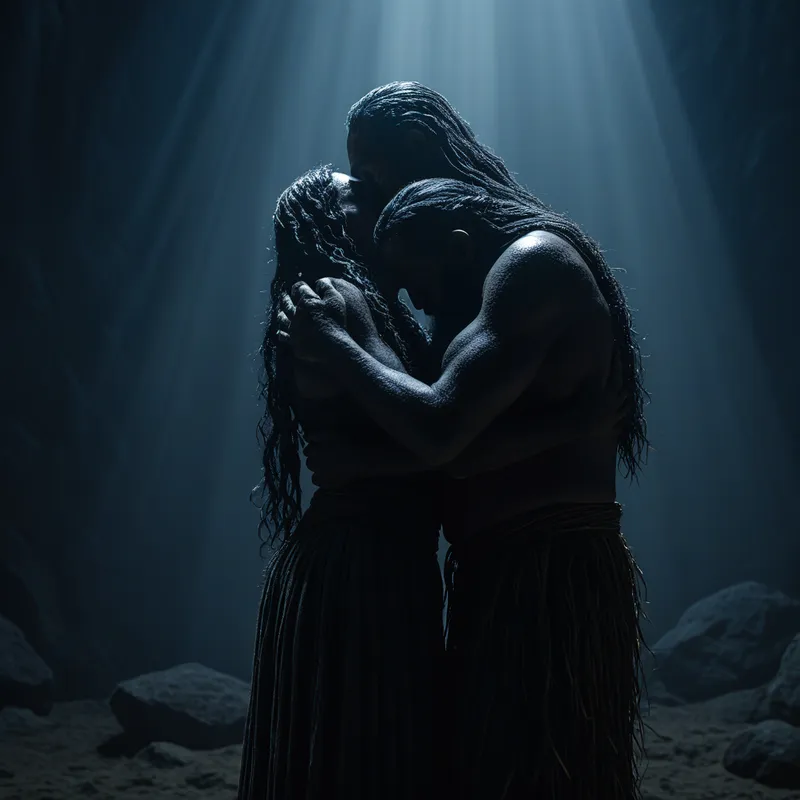
Rangi, the Sky Father, was vast and dark, adorned with the glittering, unformed sparks of stars. Papa, the Earth Mother, lay beneath, solid, warm, and waiting. They came together in a fierce and total embrace, a union so complete that no light, no space, no life could exist between them. Their love was the world, but it was a world of perpetual night.
In that cramped, warm darkness between their bodies, their children were born. The gods of the forest, of the sea, of cultivated food, and of wild things. Tāne, Tangaroa, Rongo, Tūmatauenga, and others. For untold ages, they lived in this twilight, postured and aching, unable to stand, to see, to fulfill their natures. The world was a silent, pressing womb.
A great sorrow grew among them. A longing for space, for light, for identity. They debated in whispers against the heartbeat of their parents. Should they kill them? Force them apart? The conflict simmered in the dark. Finally, Tāne-mahuta, the god of forests, took action. With his feet upon his mother Papa, and his mighty shoulders against his father Rangi, he began to push. He pushed with the slow, relentless strength of a growing tree. Muscles strained, the cosmic fabric groaned. A sigh like the first wind escaped from the parting bodies.
Then, with a sound that was the birth of sound itself, they were separated. Rangi was thrust upwards, weeping his dewy tears that became the morning rain. Papa remained below, her body now revealed in all its textured beauty—mountains, valleys, plains. And for the first time, Te Ao Mārama, the World of Light, flooded into being. The children gasped, stretching into the space, seeing each other, seeing the world their separation had created. But above, Rangi’s grief was a constant, gentle rain, and Papa’s warmth a perpetual, longing sigh. Their love remained, but now ordered, giving space for life to flourish. And far above even Rangi, in the highest heaven, Io remained, the silent, knowing source from which this entire drama of love, conflict, and light had ultimately unfolded.
Cultural Origins & Context
The narrative of Io exists within a sacred and restricted stratum of Māori knowledge. Unlike the more widely known stories of the Ranginui and Papatūānuku and their children, teachings regarding Io were traditionally held by high-ranking tohunga and learned elders. This knowledge was considered tapu of the highest order, shared only in appropriate settings, such as the whare wānanga.
Its function was not merely explanatory but ontological and sociological. It provided a theological foundation for the entire cosmos, situating the more active, personified gods within a framework of a supreme, impersonal principle. It validated the authority structure of the iwi and the hapū, as the chiefs (rangatira) and priests were seen as direct descendants of these gods, and thus, indirectly, of Io’s creative impulse. The myth served as the ultimate anchor for ritual, law (tikanga), and the profound spiritual connection to the natural world, all flowing from a single, supreme source.
Symbolic Architecture
Io represents the ground of being itself—consciousness prior to form, the unmanifest potential from which the duality of the world springs. Io is not a creator who acts, but a state of being from which creation emanates.
The supreme myth is not of a god who makes the world, but of the world that unfolds from the nature of divine consciousness.
The embrace of Rangi and Papa symbolizes the primordial unity—a state of undifferentiated wholeness where all opposites are merged. This state, while complete, is static and non-generative for conscious life. Their children, the various atua, represent the archetypal forces of nature and the human psyche, trapped in potential. The central, agonizing conflict—to remain in the bliss of unity or to commit the necessary "crime" of separation—is the fundamental drama of existence. Tāne's act is not one of patricide, but of cosmogonic differentiation. He is the principle of uprightness, of growth, of pushing into space, which makes experience and individual consciousness possible. The resulting world, Te Ao Mārama, is the realm of manifested life, born from the tension between the longing for connection (the parents' love) and the necessity of separation.
The Dreamer's Resonance
When this myth patterns a modern dream, it speaks to a profound process occurring in the deep psyche. Dreaming of being in a cramped, dark, yet warm and enveloping space may reflect a state of psychic incubation. The dreamer is in their own Te Kore, pregnant with a new potential self or a major life insight, but not yet ready to be born.
The somatic feeling is often one of constriction mixed with security—a longing to break free coupled with a fear of the cold, unknown light. Dreaming of forcefully pushing two immense entities apart mirrors the inner work of differentiating one's own identity: separating from internalized parental complexes, distinguishing thought from emotion, or carving out psychic space from an engulfing relationship or life situation. The rain in the dream may be the grief that accompanies this necessary separation, the acknowledgment of the loss of an old, unified state. The emergence into light signifies the dawn of new awareness, the "aha" moment where a previously unconscious conflict becomes conscious and manageable.
Alchemical Translation
The myth of Io models the entire journey of individuation, the alchemical process of becoming a distinct, integrated Self. It begins in the nigredo of Te Kore and the parental embrace—the chaotic, unified mass of the unconscious.
Individuation is the sacred crime of separating the heavens of mind from the earth of body, to create the living space for the soul.
The dreamer’s first task is to acknowledge the Io within—the core, essential Self that exists prior to and beyond personal history and complexes. This is connecting to the Io-matua-kore, the inner parentless source. The conflict among the children represents the turmoil of competing inner forces (persona, shadow, anima/animus) arguing over how to live. The heroic act, guided by the Tāne archetype (the striving spirit, the will to grow), is to consciously enact the separation. This is the albedo: differentiating thought from feeling, conscious from unconscious, self from other.
The resulting Te Ao Mārama is the citrinitas—the illuminated psyche where these separated elements can be seen and related to. The final stage, the rubedo, is not depicted in the separation myth itself but is implied in the ongoing relationship between Rangi and Papa. It is the conscious re-integration of the opposites—sky and earth, spirit and matter, masculine and feminine—not in a regressive fusion, but in a conscious, loving relationship across the created space. The individuated Self lives in that space, connected to the earthly reality (Papa) and the spiritual heights (Rangi), while remaining anchored in its own supreme source (Io).
Associated Symbols
Explore related symbols from the CaleaDream lexicon:
- Sky — The father principle of consciousness, spirit, and limitless potential, whose separation from the earth creates the space for mental and spiritual life.
- Earth — The mother principle of the body, the unconscious, and tangible reality, the grounding foundation from which all manifested life grows.
- Darkness — Represents the fertile void of Te Kore, the state of potential, the unconscious, and the womb-like embrace before differentiation.
- Light — Symbolizes Te Ao Mārama, the dawn of consciousness, awareness, clarity, and the illuminated world brought forth by separation.
- Separation — The cosmogonic and psychological act of differentiation, the necessary "crime" that creates space for individual identity and experience.
- Parent — The archetypal source, both as the primal parents Rangi and Papa and the parentless source Io, representing origins and the complex from which one must differentiate.
- Tree — Embodies Tāne-mahuta, the force of upright growth, the axis mundi connecting earth and sky, and the slow, relentless strength required for psychological development.
- Rain — The tears of Rangi, symbolizing the grief, melancholy, and emotional cost that accompanies necessary separation and growth.
- Wind — The sacred breaths of Io, representing the animating life force, spirit, and the first impulse of creation from the unmanifest.
- Void — Te Kore itself, the state of pure potential, the nothingness that contains everything, the psychological ground zero before a new phase of being.
- Order — The cosmic and psychic structure that emerges from chaos through the act of separation, establishing the conditions for life and law.
- Essence of Being — The core nature of Io, representing the fundamental, uncreated consciousness or Self that exists prior to and underpins all personal identity.