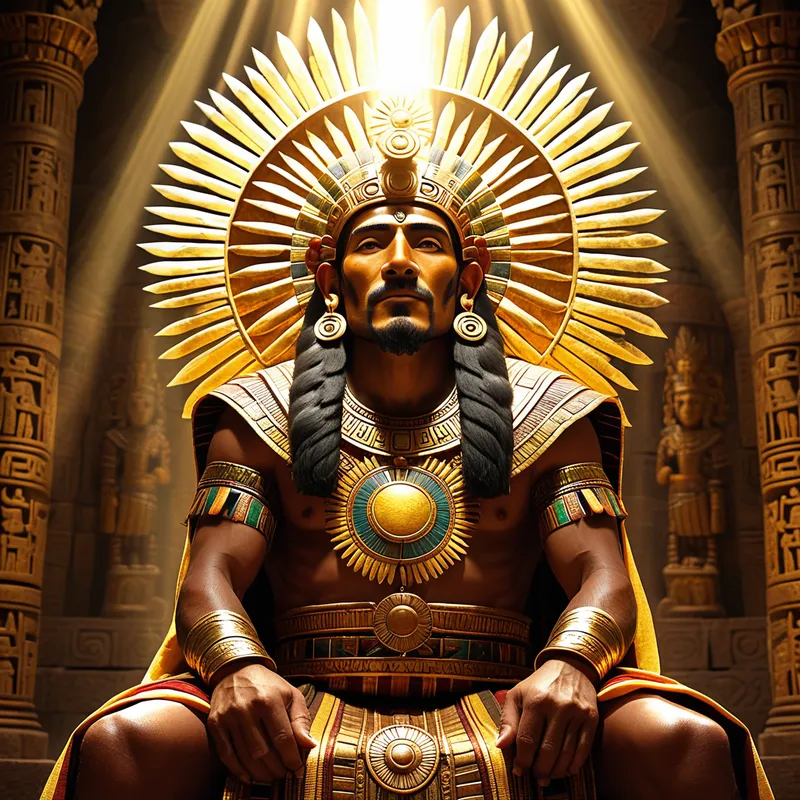
Inti Myth Meaning & Symbolism
The story of Inti, the Sun God, emerging from darkness to establish cosmic order, light, and civilization for the children of the earth.
The Tale of Inti
In the beginning, there was only T’oqo, a deep and silent darkness. No mountain pierced the sky, no river sang to the sea. The earth was a formless, sleeping thing, and the people huddled in cold shadow, their hearts as dim as the unlit world.
From the sacred waters of Lake Titicaca, a longing was born. It was not a sound, but a pressure—a gathering heat in the womb of the world. The darkness trembled. Then, a crack. A fissure of impossible gold split the eastern horizon. It was not a gentle dawn, but a violent, glorious birth. The sun, Inti, heaved himself into the sky.
He was not merely a ball of fire. He was a being of pure, intelligent radiance. His face was a disk of hammered gold, too brilliant to behold. His body was warmth itself, and his gaze was law. Where his light fell, the chaos recoiled. Shadows fled, revealing the contours of the land—the mighty spine of the Andes, the deep valleys, the silent stones. The earth shuddered awake, and for the first time, felt its own form.
But light alone was not enough. The people below remained scattered, living like fearful animals. Inti saw this. His heart, a furnace of paternal love, stirred. He would not rule a kingdom of shadows and strangers. He called forth his children. From the same sacred island in the lake, Manco Cápac, and his sister-wife, Mama Ocllo, emerged. Inti gifted them a staff of solid gold. "Go," his light whispered upon them. "Walk the earth. Where this staff sinks into the ground with a single thrust, there you will found a kingdom. There, you will teach my children to weave, to build, to sow, and to worship. You will bring my order to the land."
And so they walked, the golden children of the sun, piercing the wild earth with their divine rod. They wandered valleys and crossed mountains, until one day, on a high plain between two rushing rivers, the staff plunged deep into the fertile soil and disappeared. The earth accepted it. Here, Cusco was born. Under Inti’s unwavering gaze, stone rose upon stone, terraces carved the mountainsides, and a people became an empire. The sun did not set; he merely withdrew his visible face each night, traveling in his golden bark beneath the world, to be born again, triumphant, with every dawn. His rule was eternal, his covenant unbroken: light for worship, order for devotion.
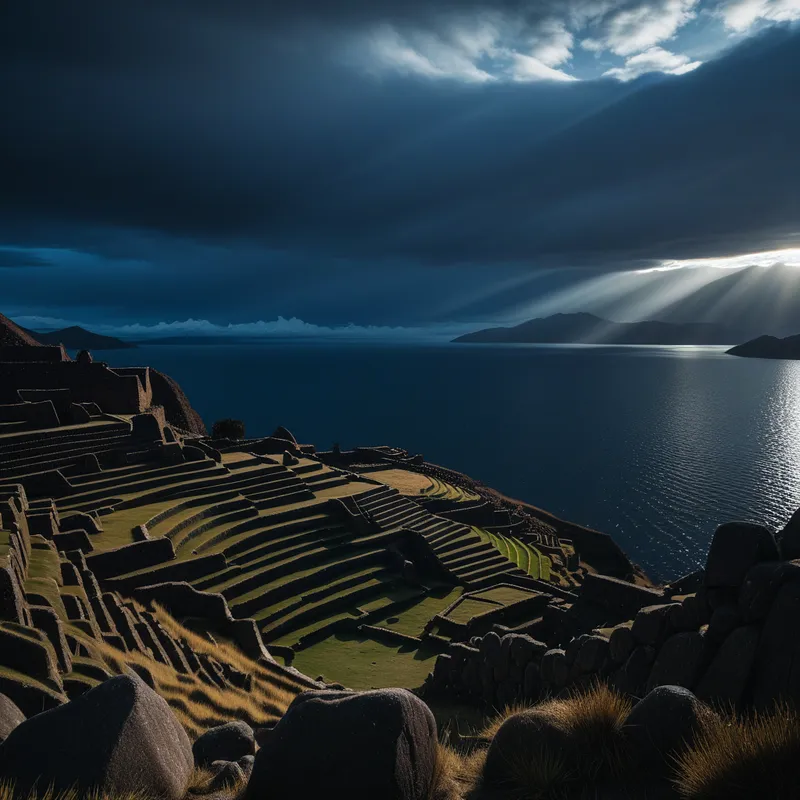
Cultural Origins & Context
The myth of Inti is the foundational narrative of the Tawantinsuyu, the Inca Empire. Unlike myths preserved in codices, this was a living, breathing doctrine of state, transmitted orally through generations of panacas and recited by official rememberers, the amautas. Its primary function was socio-political: it established the divine right of the Sapa Inca to rule. By tracing the royal lineage directly to Inti, the myth provided an unassailable cosmological justification for imperial expansion, social hierarchy, and the centralized authority of Cusco as the "navel of the world."
The myth was performed and reinforced in spectacular public rituals, most notably the Inti Raymi. During this solstice celebration, the Sapa Inca, as Inti’s living representative, would enact rituals to "tether" the sun, preventing his flight and ensuring his return to nourish the empire. The temple of Coricancha, sheathed in gold to capture and reflect the sun’s light, was the physical and spiritual anchor of this myth. Thus, the story was not just a tale of the past; it was a continuous, enacted reality that structured time, agriculture, and the very identity of the Inca people.
Symbolic Architecture
At its core, the myth of Inti is a supreme allegory for the emergence of consciousness from the unconscious. T’oqo represents the undifferentiated, potential-laden state of the psyche before the dawn of ego-awareness. Inti’s violent, glorious birth is that first, cataclysmic moment of self-awareness—the "I" that emerges, separates, and begins to cast light on the inner landscape.
The sun does not create the world; it reveals the world that already exists, waiting in the dark to be known and named.
Inti symbolizes the ruling principle of consciousness—the logos, order, and discriminating light that structures chaos. His children, Manco Cápac and Mama Ocllo, represent the application of this conscious principle into the world: culture, law, technology, and social order (the masculine and feminine aspects of civilization). The golden staff that finds its home is the symbol of divine mandate and right alignment—when conscious action is in harmony with the deeper, nourishing layers of the psyche (the earth), a stable center (Cusco, the Self) can be established. The sun’s daily journey is the eternal cycle of consciousness engaging with the world, then retreating to be replenished by the unconscious (the underworld voyage), in a process of perpetual renewal.
The Dreamer's Resonance
When this mythic pattern stirs in the modern dreamer, it often manifests as a profound transition from a period of inner confusion, stagnation, or "dark night of the soul" toward a new clarity of purpose. One might dream of a long, cold night suddenly shattered by a blinding, warm light that feels intelligent and paternal. Or dream of finding a simple, powerful tool (a key, a pen, a seed) that, when used, effortlessly unlocks a new path or foundation in life.
Somatically, this can feel like a sudden influx of energy, a warming in the chest, or a release of chronic tension held in the eyes and forehead—the physical seat of focused awareness. Psychologically, it is the process of "coming to one’s senses," of a ruling idea or self-concept finally crystallizing after a long gestation in darkness. The conflict present is the residual fear of the formless dark and the immense responsibility that comes with bearing light—the fear of the new identity and the duty it imposes. The dream is an affirmation from the deepest Self: a new, organizing principle of the psyche is being born.
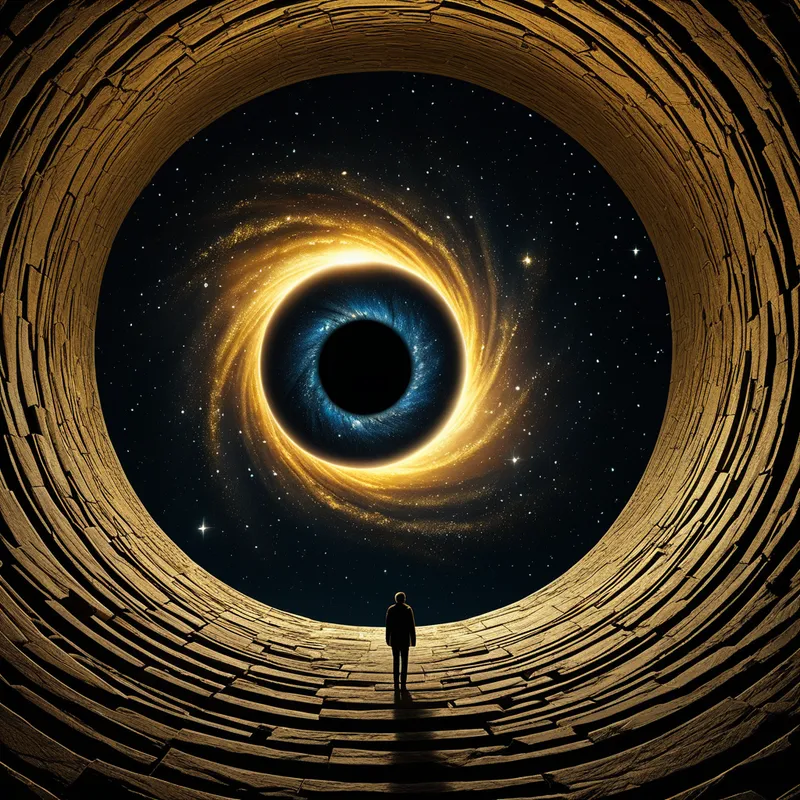
Alchemical Translation
The alchemical journey mirrored in Inti’s myth is the opus of moving from the massa confusa (the chaotic prima materia) to the creation of the Lapis Philosophorum, the Philosopher’s Stone, which here is symbolized by the established, golden city of Cusco—the integrated Self. The first stage, nigredo, is the reign of T’oqo, a necessary dissolution and containment. The albedo, the whitening, is the first piercing ray of dawn, the moment of illumination.
The supreme alchemical fire is not in the crucible, but in the unwavering gaze that holds the tension between light and shadow, order and chaos, until a world is forged.
Inti’s act is the rubedo, the reddening or sun-making: the application of sustained, conscious heat and light to coagulate the soul’s scattered elements into a coherent, enduring form. The modern individual undergoes this transmutation when they move from a life experienced as happening to them (chaos) to a life they author from a central, solar principle. This "solar principle" is not egotism, but the discovery of one’s inner law, one’s golden staff—a unique talent, vocation, or ethical core that, when planted, naturally organizes one’s life into a fertile, flourishing kingdom. The daily journey of the sun becomes the individuated person’s task: to consciously engage with the world, then retreat into reflection and the nourishing darkness of the unconscious, in a cycle that does not consume, but perpetually renews. To become a ruler of one’s inner empire is to become, like Inti, a faithful steward of the light one has been given.
Associated Symbols
Explore related symbols from the CaleaDream lexicon: