Indra's Net Myth Meaning & Symbolism
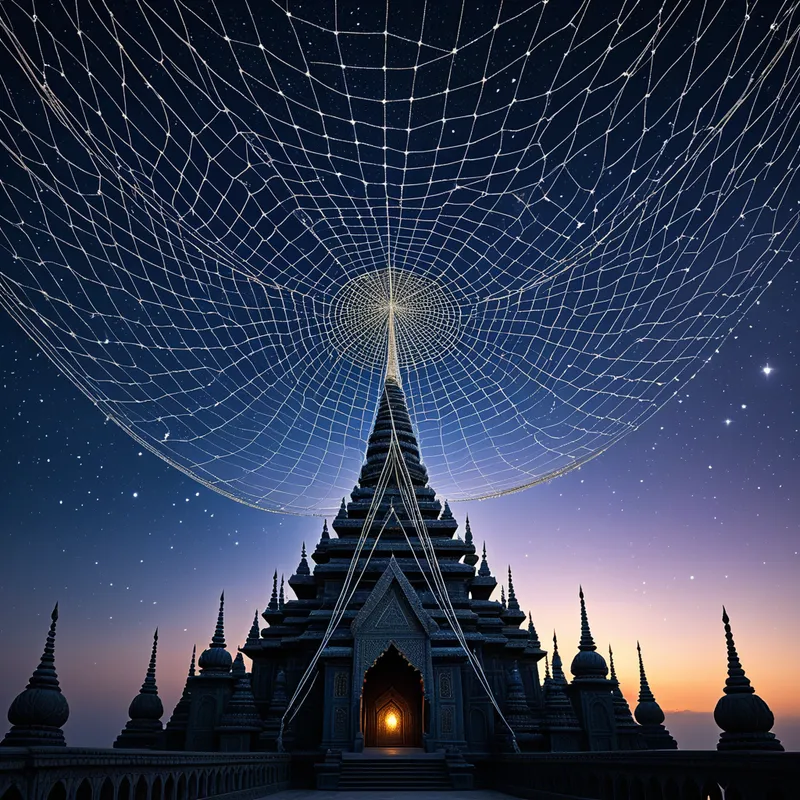
A cosmic net of infinite jewels, each reflecting all others, symbolizing the profound interdependence and illusory separation of all phenomena.
The Tale of Indra's Net
In the celestial heights of Svarga, where the air is perfumed with ambrosia and the light has no source, the king of the Devas held court. Indra was mighty, his thunderbolt ever-ready, his elephant Airavata by his side. Yet, a profound restlessness stirred within him. He had conquered demons, commanded storms, and drank the sacred Soma, but a deeper mystery eluded his grasp. What was the true fabric of this dazzling, chaotic creation over which he presided?
His divine architect, Vishvakarma, sensing the god-king's unease, undertook a work of unimaginable scale. From the essence of primordial space and the laughter of stars, he wove a net. It was not a net of rope or silk, but of silver light and intention. This net was vast beyond all measure, stretching to the very horizons of existence. And at every single intersection of its infinite threads, Vishvakarma set a perfect, multifaceted jewel.
Each jewel was a masterpiece of clarity, cut with such precision that it held within its heart a perfect reflection of every other jewel in the entire net. Look into one, and you saw not just its own radiant color, but the image of the jewel beside it, and within that image, the reflection of another, and another—an endless, recursive hall of mirrors made of light. The entire cosmos was caught in this shimmering lattice, every star, every thought, every leaf, and every god, represented in those glittering nodes.
Indra approached the net, his divine senses overwhelmed. He focused on a single jewel, a deep blue one that reminded him of a monsoon cloud. Within it, he saw the reflection of a red jewel, and within that red jewel, he saw the blue one again, now containing the red, containing the blue… ad infinitum. He shifted his gaze to another, a clear one like a drop of morning dew, and saw the same phenomenon. Every jewel, unique in its place, contained the entirety of the net. To change one was to change the reflection in all others. To remove one was impossible, for the net itself would unravel.
A profound silence fell over Svarga. The clamor of celestial music faded. Indra stood before the net, his thunderbolt hanging slack at his side. The illusion of his solitary, kingly power dissolved. He was not a ruler standing apart from his kingdom, but a node in an infinite, living tapestry. His very being was interwoven with the being of the ant in the dust, the demon in the underworld, and the silent sage in meditation. He saw that his sovereignty was not a command, but a relationship; his strength not an isolation, but a reflection of the whole. The net did not answer his restless question—it became the answer, a silent, shimmering truth hanging in the air of heaven.
Cultural Origins & Context
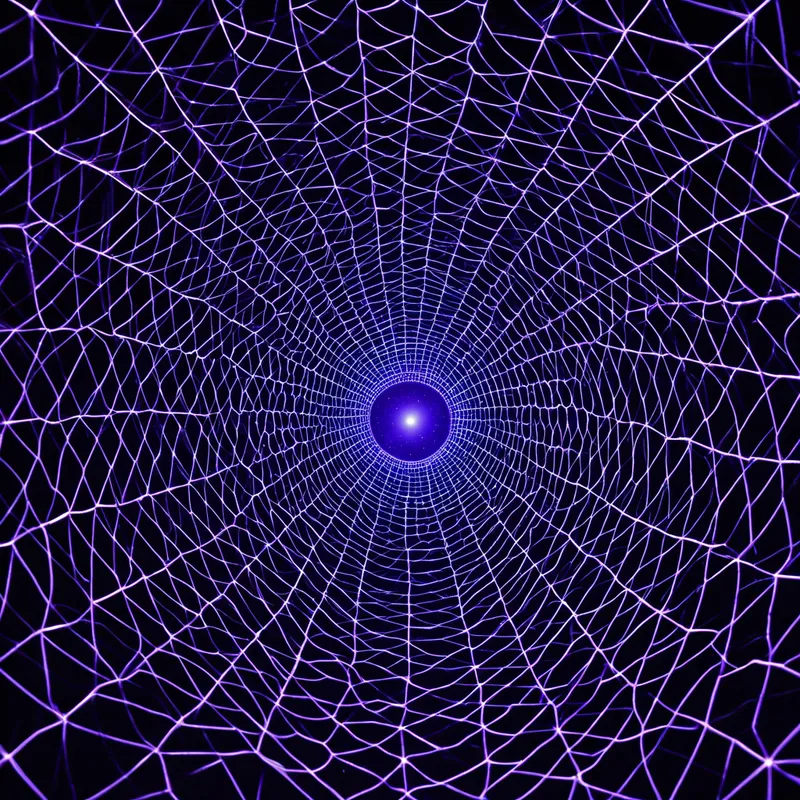
The myth of Indra's Net finds its most famous articulation in the Brahmana texts and, most poetically, within the Avatamsaka Sutra of the Buddhist tradition, which absorbed and elaborated upon this profound Hindu cosmological image. Its transmission was oral long before it was written, passed down by rishis and storytellers in the courts of kings and in forest hermitages.
Its function was not merely to describe a pretty celestial object, but to serve as a pedagogical and meditative tool of the highest order. In a culture deeply invested in concepts of Dharma, Samsara, and the interconnectedness of all life (Brahman), the Net provided a tangible, visual metaphor for a reality that is fundamentally non-dual. It was a story told to philosophers to illustrate <abbr title=""illusion" or "cosmic play"; the principle that the phenomenal world is a relative reality">Maya, not as mere trickery, but as a divine, inter-reflective play. It was told to kings to teach humility and the ethics of interdependent rule. It was a cosmic model that collapsed the distance between the macrocosm and the microcosm, suggesting that the structure of the universe is mirrored in the structure of the mind.
Symbolic Architecture
At its heart, Indra's Net is a metaphysical blueprint of reality. The net itself represents the fabric of space, time, and causality—the structured, manifest universe. The jewels are every individual phenomenon: you, me, a mountain, a memory, a galaxy. They are discrete, unique, and possess their own "suchness."
The jewel is the individual soul; the reflection is the universe it contains.
This is the core revelation: each jewel, while maintaining its unique position and identity, perfectly reflects all others. This symbolizes the principle that every entity in the cosmos contains the pattern of the whole within itself. In psychological terms, the individual psyche is not an isolated fortress. It is a nexus point where the entire collective human experience—all archetypes, all histories, all potentials—intersects and is reflected. Your inner world mirrors the outer, and the outer is shaped by the reflections within.
The infinite recursion—a jewel reflecting a net of jewels, each reflecting the net again—speaks to the nature of perception and consciousness itself. There is no "first" jewel, no ultimate, separate source of light. Illumination emerges from the relationship between the nodes. This dismantles the ego's claim to primacy. The self is not a solitary sun, but a participant in a cosmic hologram, where the whole is encoded in every part.
The Dreamer's Resonance
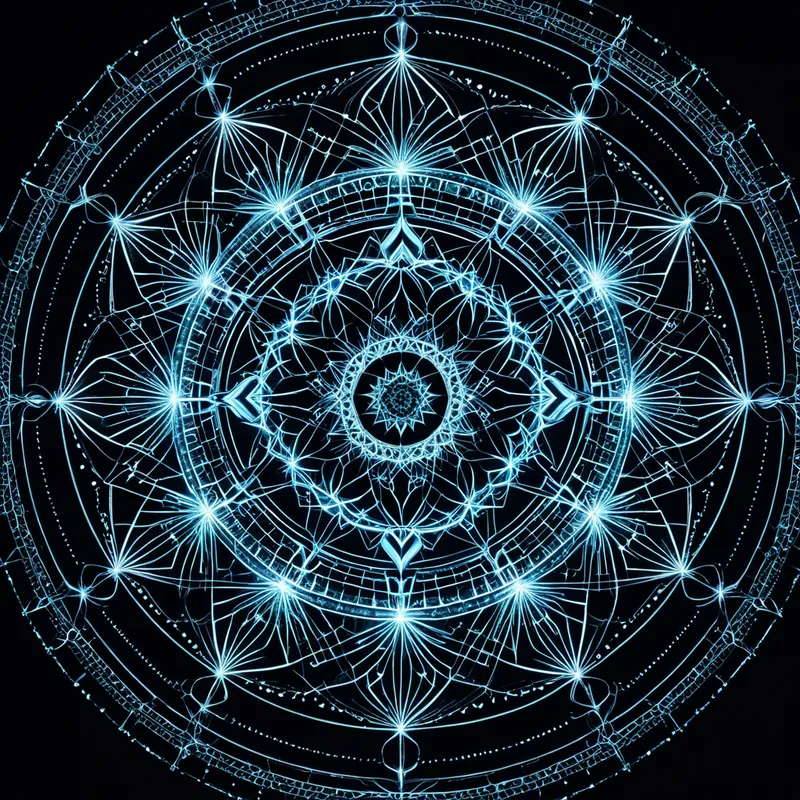
When the pattern of Indra's Net weaves itself into modern dreams, it often signals a profound shift in the dreamer's perception of self and relationship. One might dream of a vast, shimmering web connecting all people in a city, or of a room where every mirror reflects not the dreamer, but a different scene from their life or the life of a stranger, all visibly connected by strands of light.
Somatically, this can accompany feelings of expansion, tingling, or a loss of bodily boundaries—not as dissociation, but as interconnection. Psychologically, it marks the process of the ego confronting its embeddedness. The dreamer is undergoing what might be called a "relational awakening." The rigid boundaries between "me" and "not-me," between personal history and collective story, begin to soften. This can be both terrifying (a loss of cherished isolation) and immensely relieving (the end of existential loneliness). It is the psyche's way of integrating the truth that our individuality is not contradicted by our universality, but is its most exquisite expression.

Alchemical Translation
The alchemical work modeled by Indra's Net is the transmutation of the leaden perception of separation into the golden awareness of unity-in-diversity. The modern individual's "Indra moment" is that shock of recognition when one realizes that their personal struggle—be it with grief, love, or purpose—is not a private drama staged in a vacuum.
The path of individuation is not to polish your single jewel in isolation, but to realize it is a prism for all others.
The first stage is Observation: like Indra, we must gaze deeply into the facets of our own being—our memories, complexes, and drives—and see reflected there the patterns of our family, our culture, and the archetypes. We see the mother in our longing for nurture, the warrior in our anger, the trickster in our anxiety.
The second is Integration: understanding that these reflections are not foreign invasions, but the very substance of a connected self. We stop trying to cut away the "undesirable" reflections and begin to understand their place in the whole tapestry of who we are. This is the alchemical solve et coagula: dissolving the illusion of a separate self and reconstituting it as a conscious node in the net.
The final stage is Responsibility: the sobering, beautiful realization that to work on one's own jewel—to clarify it through introspection, to heal its cracks through compassion—is to affect the clarity of the entire web. Your healing subtly shifts the reflection in all who are connected to you. Your individuation becomes a service to the whole. You become, like Indra, not a ruler of a separate domain, but a conscious, responsible participant in an infinite, interdependent, and brilliantly reflective creation. The net is not out there; it is the very structure of a conscious life.
Associated Symbols
Explore related symbols from the CaleaDream lexicon:
- Connection
- General
- Net
- Vivid
- Also
- Various
- Perspective
- Fragment
- Takes
- Variety
- Ipad
- Extent
- Server
- Colorful
- Thousand
- Internet of Things
- Fractal Pattern
- Cosmic Connection
- Glass Prism
- Kaleidoscopic Visions
- Layered Dreamscape
- Tanzanite Shard
- Zircon Crystal
- Tanzanite Zip
- Molecular Model
- Dewdrop
- Peering into a Bug's Eye
- Mantis Shrimp
- Chameleon Eyes
- Seagrass Meadow
- Fractal Garden
- Psychedelic Dreamscape
- Mosaic Organ
- Fractured Dimensions
- Fractal Design
- Kaleidoscopic Patterns
- Echoing Shapes
- Maze of Colors
- Pointillist Dots
- Energized Colors
- Color Wheel
- Kaleidoscopic Literature
- Silk Cord Necklace
- Wireless Router
- Circuit Board
- Smart TV
- Smart Home Hub
- Kaleidoscopic Neon Sign
- Fragments of Mosaic Tiles
- Quantum Realm
- Stardust Trail
- Kaleidoscope Vision
- Universal Consciousness
- Existence Fragment
- Symbiotic Unity
- Fractal Universe
- Ripple in Space
- Fractal Vision
- Echoes of Consciousness
- Patterns of Existence
- Kaleidoscopic Image
- Cubist Landscape
- Ripple Effect
- Rope Net
- Fishing Net Made of Vines
- Mosaic Design
- Neural Network
- Wi-fi Waves
- Online Echo
- Cyberspace
- Quantum Entanglement
- Gravitational Waves
- Mandelbrot Set
- Non-euclidean Geometry
- Quantum Decoherence
- Gravitational Lens
- Quantum States
- String Theory
- Relativity
- Cellular Automata
- Topology
- Electromagnetic Spectrum
- Relativistic Space
- Manifolds
- Spacetime Fabric
- Cantor's Infinity
- Emergent Property
- Analogy
- Meronym
- Aspect
- Pixel
- Neuron
- Fractal
- Cutaway
- Cohesion
- Cosmos
- Continuum
- Expansive
- Radar
- Dimension