
Incense to the Gods Myth Meaning & Symbolism
The myth of how incense, the sacred scent of the gods, was stolen for humanity, forging a fragile bridge between mortal need and divine grace.
The Tale of Incense to the Gods
Hear now a tale not of thunder, but of scent; not of conquest, but of a stolen whisper. In the age when the world was young and raw, the air of the earth was a tapestry of simple smells—damp soil, crushed herbs, the iron tang of blood from sacrifice. But high on Olympus, the air was different. It was woven with a fragrance so divine it was the very breath of eternity: the sweet, resinous perfume of incense.
This sacred scent belonged solely to the gods. It rose from their celestial groves, trees that wept tears of golden gum, and coiled around their gleaming halls. It was the aroma of their immortality, a pleasure too exquisite for mortal lungs. Humanity, toiling below, knew only the harsh smells of life and death. Their offerings—the fat and bones of bulls burning on open altars—sent up a greasy, pleading smoke that was coarse and desperate. The gods accepted this, but they did not savor it. A gulf, vast and olfactory, lay between heaven and earth.
But the daimon who walks the boundaries, Hermes, he of the winged sandals and cunning mind, saw this divide. Or perhaps he heard the unspoken longing in the silent prayers of priests, or smelled the poverty of their smoky offerings. His heart, ever capricious and strangely compassionate, was stirred. He would not bring fire, like Prometheus; he would bring fragrance.
He descended to a hidden grove where the trees of the gods touched the mortal world. Their bark shone like polished amber, and where they were wounded, they wept great, fragrant tears. With a touch lighter than a breeze, Hermes collected these hardened tears—not with violence, but with a thief’s grace. Some tales whisper it was a nymph, Leucothoe, transformed into such a tree, who offered her essence willingly, moved by a tale of mortal sorrow. The resin was warm, humming with a captured sunbeam.
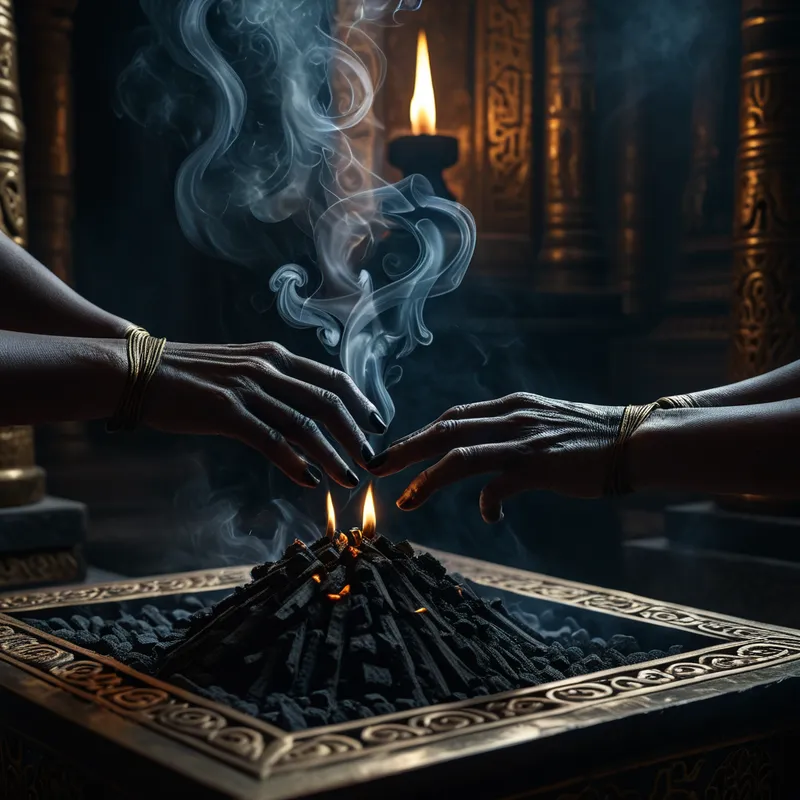
He brought his treasure not to a king, but to a humble priest at a wayside shrine. He showed the mortal how to place the precious lumps on hot charcoal within a thymiaterion. The priest, hands trembling, obeyed. The resin did not burn with flame, but melted, surrendering itself in a silent, willing dissolution. A plume of smoke, unlike any other, began to rise. It was not grey, but a luminous blue-white. It did not choke, but cleansed. It carried not the stench of consumption, but the ethereal scent of the divine itself—piney, sweet, mysterious.
The smoke curled upward, a slender, scented bridge. On Olympus, the gods paused. Zeus inhaled, and the stern line of his brow softened. Aphrodite smiled, for the scent was akin to desire itself. This was not a demand, not a bribe of burnt flesh, but an offering of beauty, a shared pleasure. They accepted it. They allowed the bridge to stand. The fragrant theft was forgiven, for it was a gift to both sides. From that day, the smoke of incense became the true voice of prayer, a silent, aromatic word spoken directly to the soul of the divine.
Cultural Origins & Context
This myth, woven from various threads in ancient poetry and cult practice, was not a single, canonical epic but a pervasive cultural understanding. It is glimpsed in the hymns, in the descriptions of rituals by writers like Hesiod, and in the very logic of Greek sacrificial practice. The primary function was etiological—it explained why incense was central to ritual. More importantly, it defined the new terms of engagement with the divine.
In a society where religion was embedded in the civic and personal fabric, the act of thysia (sacrifice) was a foundational social contract. The older model involved the literal consumption of offerings: the gods received the smoke and scent of the burned inedible parts, while the worshippers feasted on the meat. Incense introduced a more refined, abstracted layer. It was a pure offering, consumed entirely by the act itself, leaving no material residue for the mortal community. Its use marked the most sacred moments—libations, prayers, oracular consultations, and the rites of the Eleusinian Mysteries. The myth provided a sacred pedigree for this practice, elevating it from mere custom to a divine gift, a stolen secret that legitimized its power.
Symbolic Architecture
At its core, the myth of incense is about the alchemy of communication and the nature of a true offering. The stolen resin represents a mediated transcendence—something of the divine realm is physically brought into the human sphere, not to be owned, but to be transformed back into an immaterial bridge.
The most profound offering is not what you give up, but what you willingly dissolve into a medium that carries your intention beyond itself.
The thymiaterion becomes a crucible. The solid, precious resin (the valued object, the ego's treasure) must be subjected to the heat of devotion (the coals of focused intention) to undergo a radical change of state. It does not burn to ash, but sublimes into smoke—an invisible, pervasive, and connective essence. This is the symbolic death of the literal for the birth of the spiritual. The smoke is the prayer made visible and olfactory; it is intention rendered into a form that can permeate the boundary between the conscious and the unconscious, the human and the archetypal.
Hermes, as the agent, is crucial. He is the archetypal psychopomp, the guide of souls. His theft is not an act of defiance for its own sake, but a bridging action. He facilitates the connection, translating a divine substance into a human ritual language. He represents the necessary trickster function in the psyche that bypasses rigid rules to establish a more authentic, direct line of communication with the inner Self (the gods within).
The Dreamer's Resonance
When this myth pattern stirs in the modern dreamer, it often manifests around themes of futile offering or longed-for connection. One might dream of trying to send a vital message with a broken phone, or offering a gift that is repeatedly ignored or rejected. The somatic feeling is one of frustration and hollow effort—the "greasy smoke" of the old sacrifices.
Alternatively, a dream may present a moment of profound, non-verbal communication: a shared silence filled with understanding, a gesture that conveys volumes, or a scent that triggers deep memory and emotion. This is the "incense smoke" bridge forming. The psychological process at work is the transformation of one's mode of engagement. The ego is being shown that its current offerings—perhaps relentless striving, intellectual analysis, or material proofs (the "burnt flesh")—are not reaching the deeper, intuitive, or spiritual layers of the psyche. The dream calls for a shift towards offering something intangible yet deeply personal: vulnerability, authentic feeling, creative expression, or contemplative presence. It is an invitation to stop shouting across the chasm and instead learn to send a scented whisper.

Alchemical Translation
For the individual on the path of individuation, this myth models the critical shift from ego-driven striving to Self-oriented communion. The initial state is one of separation: the conscious mind (the mortal realm) feels cut off from the nourishing, guiding wisdom of the unconscious (the divine realm). The ego may make loud, costly sacrifices—burning out in pursuit of goals, offering up its energy and time in ways that feel demanding and transactional.
Psychic transmutation begins when we stop sacrificing our substance on the altar of achievement and start dissolving our attachments on the coals of awareness.
The "theft" of incense is the rebellious, insightful moment when the psyche realizes a new mode is possible. It is the decision to take a fragment of one's own innate divinity—a moment of beauty, a spark of inspiration, a genuine feeling—and treat it as sacred material. The alchemical crucible is the container of daily practice: meditation, journaling, art, or sincere reflection. Placing the "resin" on the "coals" is the act of subjecting that inner treasure to the heat of conscious attention, not to destroy it, but to release its essence.
The resulting "smoke" is the integrated experience. It is the insight that permeates one's being, the calm that arises from letting go, the intuitive knowing that guides without force. This fragrant offering is then received by the greater Self, creating a feedback loop of inner connection. The bridge is built not by conquering the unconscious, but by learning its language of symbol, scent, and subtlety. The myth ultimately teaches that the most powerful offering to the gods within is the willing dissolution of our most hardened, precious resistances into the graceful smoke of acceptance and understanding.
Associated Symbols
Explore related symbols from the CaleaDream lexicon: