Inanna's Descent Myth Meaning & Symbolism
The Queen of Heaven descends to the land of the dead, is stripped, killed, and resurrected, embodying the ultimate cycle of sacrifice and renewal.
The Tale of Inanna's Descent
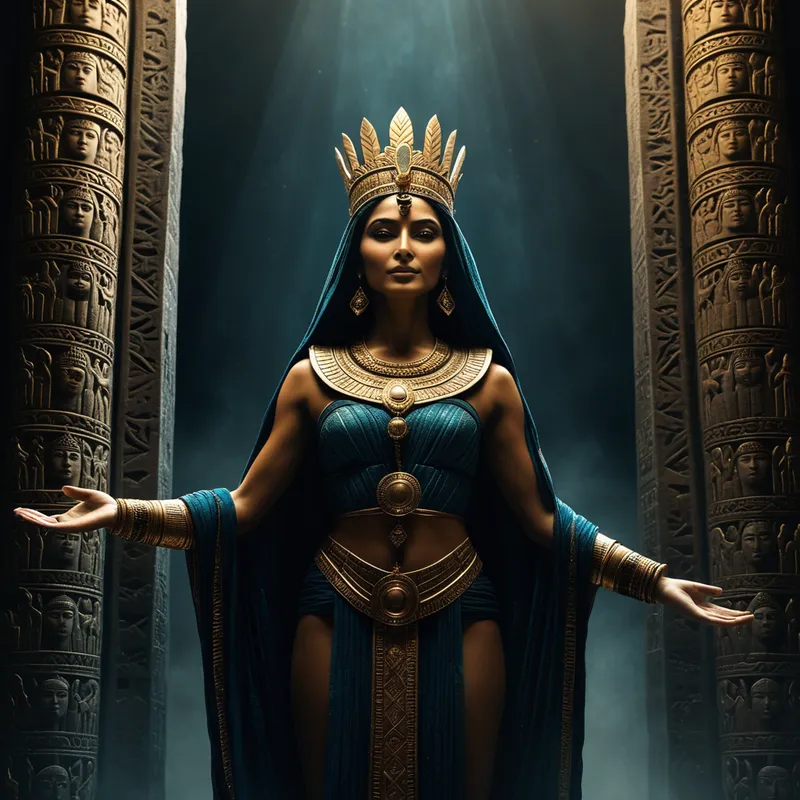
Hear now the story that shakes the pillars of heaven and earth. The tale is of Inanna, she who holds the me, the divine decrees of civilization. From her celestial city of Uruk, she turned her ear not to the songs of lovers or the clamor of battle, but to a deeper, silent call—the call from the Great Below, the Kur, ruled by her dark sister, Ereshkigal.
With a heart full of a purpose she would not name, even to herself, Inanna arrayed herself in the regalia of her power. The shining crown of the steppe upon her brow, the lapis lazuli measuring rod and line in her hands, tiny lapis stones strung about her neck, a golden breastplate over her heart, and the pala dress, the garment of ladyship. She daubed her eyes with the ointment called “Let him come, let him come,” and took up her great cylinder seal. Thus armored in her very identity, she abandoned heaven and earth and set her foot upon the road from which there is no return.
Before the first gate of the underworld, Neti, face like weathered stone, stood barring her way. “Who are you?” he demanded. “I am Inanna, Queen of Heaven, on my way to the East,” she declared. But Ereshkigal, sensing the intrusion into her silent realm, gave cold instruction: “Let her enter, but let her be stripped. At each gate, let one of her sacred garments be removed.”
And so, the unmaking began. At the first gate, her crown was taken. The sky grew dim. At the second, her rod and line. The world lost its measure. At the third, her lapis beads. Song died in her throat. At the fourth, her sparkling breastplate. Her heart beat naked against the dark. At the fifth, her golden ring. Her will dissolved. At the sixth, her pala dress. Her dignity was shed. At the seventh and final gate, they took her last garment, the garment of ladyship. Naked and bowed low, Inanna entered the throne room of her sister.
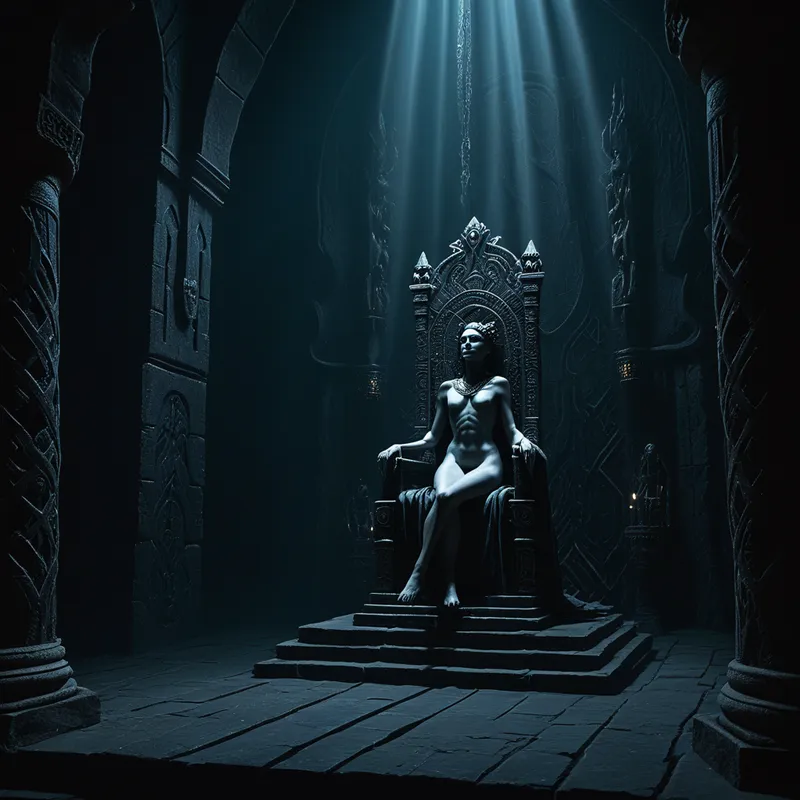
Ereshkigal sat upon her throne, swollen with the pains of childbirth and the weight of the dead. She fixed her eyes on the naked, shining form of her sister, this queen of light who dared enter the kingdom of dust. Without a word, the Anunnaki passed their judgment. They fastened upon Inanna the eye of death. They spoke against her the word of wrath. They struck her. Her body turned to a piece of rotting meat. They hung her corpse upon a hook on the wall.
For three days and three nights, the world above withered. Love ceased, war stalled, the cows did not bull, the plants did not grow. All life held its breath, waiting.
But Inanna, in her wisdom, had left instructions with her loyal vizier, Ninshubur. If she did not return, Ninshubur was to lament at the temples of the gods. And so she did, until Enki, the clever god, heard her cries. From the dirt under his fingernails, he fashioned two beings: the Kurgarra and the Galatur. To them, he gave the food of life and the water of life, and a strategy of empathy.
They slipped into the underworld like shadows. They did not confront the queen of the dead, but sat with her in her agony. As Ereshkigal cried out, “Oh, my insides!” they echoed her cry, “Oh, your insides!” As she mourned, “Oh, my outside!” they mourned with her, “Oh, your outside!” Seen and mirrored in her profound loneliness, Ereshkigal’s heart softened. In gratitude for this unheard-of compassion, she granted them a boon. They asked for the corpse hanging on the hook. They sprinkled it sixty times with the food of life, sixty times with the water of life. And Inanna arose.
But the laws of the Kur are absolute. No one leaves the land of the dead without providing a substitute. As Inanna ascended back through the seven gates, her garments were returned, but a retinue of galla demons, fierce and unyielding, climbed with her, their task to drag someone back in her place. They found no worthy substitute until they came to Uruk and found Inanna’s young husband, Dumuzid, seated upon her throne, clad in fine garments, not mourning her at all. In a flash of wrath and cold necessity, Inanna fastened the eye of death upon him. “Take him!” she said. And so Dumuzid was taken, to spend half the year in the underworld, while his compassionate sister, Geshtinanna, takes the other half. And with this terrible bargain, the cycle of life, death, and return was sealed into the very fabric of the world.
Cultural Origins & Context
This myth, one of the most complete and psychologically complex to survive from ancient Sumer, was inscribed in cuneiform on clay tablets over 4,000 years ago. It was not mere entertainment but a sacred narrative, likely recited during ritual ceremonies, perhaps tied to the cycles of the seasons, the reign of kings, or rites of passage. The figure of Inanna was central to Sumerian cosmology; she was the dynamic force of connection—between heaven and earth, love and war, fertility and destruction. Her descent provided a divine model for the most harrowing human experiences: loss, failure, and the confrontation with absolute negation. By telling her story, the Sumerians gave shape to the invisible journey of the soul, legitimizing despair as a sacred passage with the potential for renewal, albeit at a terrible cost.
Symbolic Architecture
The myth is a perfect map of a psychological death. Inanna’s seven divine me represent the constructed identity—the roles, achievements, and masks we call a “self.” The seven gates are the stages of its systematic deconstruction.
To descend is to consent to the unmasking. Each surrendered garment is a released attachment, a death of who you thought you were.
The naked corpse on the hook is the ego in a state of total annihilation, the necessary void before recreation. Ereshkigal is not merely a villain; she is the ultimate aspect of the Self, the holder of the shadow, the keeper of all that is rejected, painful, and “dead” within us. Her realm is the unconscious itself. The rescue is not a heroic battle but an act of profound empathy. The Kurgarra and Galatur, born from the dirt of wisdom (Enki), represent a new, non-dual consciousness that can witness pain without fear or judgment. They save Inanna by saving Ereshkigal from her isolation. Finally, the substitution of Dumuzid reveals the brutal law of psychic economy: a profound transformation always demands a sacrifice. Something of our old, unconscious life—often symbolized by the naive, entitled, or unreflective part (Dumuzid on the throne)—must be given over to the depths.
The Dreamer's Resonance
When this myth stirs in modern dreams, it often manifests as sequences of loss, nakedness, or being trapped in descending, labyrinthine spaces. You may dream of losing your job, your home, or your name. You may find yourself in a basement, a cave, or a subway tunnel that goes too deep, stripped of your belongings. This is not a prophecy of literal disaster, but a somatic signal of an ongoing psychic descent.
The body in the dream may feel heavy, cold, or paralyzed—an echo of Inanna as a corpse on the hook. This is the psyche’s way of enacting a necessary ego death. The dreamer is undergoing a process where an old adaptation, a former way of being in the world, is no longer viable and is being dismantled by the unconscious. The galla demons in a modern context might appear as relentless anxieties, health issues, or life circumstances that force a confrontation with what has been ignored. The dream is the ritual space where this sacred, terrifying dismantling is safely rehearsed.
Alchemical Translation
For the modern individual seeking wholeness or individuation, Inanna’s journey is the archetypal blueprint for the nigredo—the blackening, the putrefaction, the first and most crucial stage of alchemical transmutation.
The throne of the Self cannot be reached by climbing higher, but by descending into the very thing you are most afraid of becoming.
We are called, like Inanna, to abandon the “heaven” of our idealized self-image and consent to the journey downward. Our “me”—our career, relationships, beliefs—must be willingly surrendered at the gates. This is not a passive loss but an active sacrifice to a deeper truth. The confrontation with our personal Ereshkigal—our depression, grief, rage, or primal pain—is the central ordeal. We cannot fight her. We must, with the help of the “sexless” wisdom from within (the impartial, observing consciousness), learn to sit with her, to echo her cries, to offer the compassion that her isolated realm has never known.
The resurrection is not a return to the old self, but a rebirth infused with the knowledge of the abyss. You are re-clothed, but you wear your garments differently; you know they are not you. And the final, alchemical step is the sacrifice of Dumuzid: the conscious, willing offering of a part of your instinctual, naive, or entitled nature to the cyclical depths. This establishes a rhythm—a dialogue between the upper and lower worlds. You learn to live dynamically, spending part of your energy in the world of light and action, and part tending to the rich, dark soil of the soul. Inanna’s descent teaches that true power is not invulnerability, but the resilient capacity to die and be reborn from the core of one’s own darkness.
Associated Symbols
Explore related symbols from the CaleaDream lexicon: