Impermanence Myth Meaning & Symbolism
The story of Siddhartha Gautama's confrontation with aging, sickness, and death, leading to the foundational insight of all conditioned things passing away.
The Tale of Impermanence
Listen. The story begins not in a time of myth, but in a moment of profound human shock.
In the perfumed heart of the Shakya kingdom, a prince was born into a fortress of permanence. His name was Siddhartha. His father, the king, built for him a palace of ivory and jade, a world walled against time itself. Here, youth was eternal, beauty unfading, pleasure unceasing. The prince knew only the lotus-scented breeze, the sound of silk, the taste of sweet fruits. He was married to a woman of peerless grace, and a son was born to him. The world was a perfect, held breath.
But the king, in his love and fear, knew a secret: the world outside the walls was not so. He commanded that no hint of decay, no whisper of sorrow, should ever cross the palace threshold. The old, the sick, the dead—all were banished from the prince’s sight. The kingdom conspired in this beautiful lie.
Yet, the prince’s spirit stirred. A restlessness, deep as a root, pushed against the gilded cage. He desired to see his city, his people. Reluctantly, the king ordered the streets swept clean and adorned. But the gods, or fate, or the prince’s own destiny, had other plans.
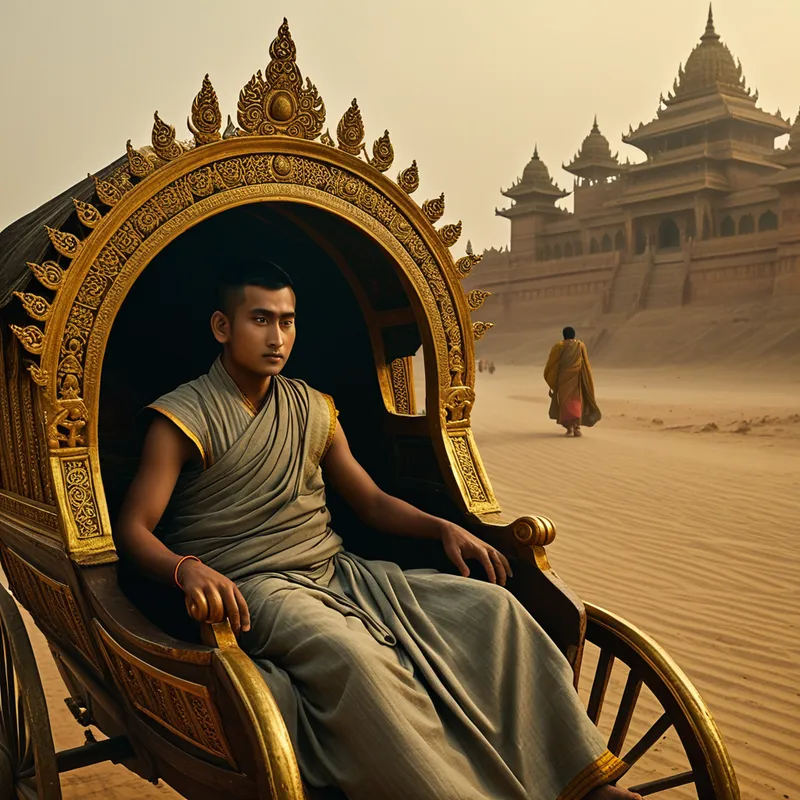
On the first journey, as the chariot rolled through the cheering crowds, Siddhartha’s eyes fell upon a figure leaning on a staff. His back was bent like a weathered bow, his skin was parchment stretched over bone, his eyes were milky pools. “Charioteer,” the prince whispered, his voice tight. “What manner of man is this?” The charioteer, his heart heavy, spoke the forbidden truth: “My lord, this is an old man. It is the way of all who live. Youth forsakes the body. Strength ebbs away. This… is aging.”
A cold finger traced the prince’s spine. The perfect world cracked.
On the second journey, he saw a man writhing on a mat, his body consumed by fever, his face a mask of agony. “And this?” Siddhartha demanded, his royal certainty crumbling. “This is sickness, my lord,” came the reply. “It visits all beings, high and low, without warning.”
The crack became a chasm.
On the third, most terrible journey, the procession halted for a somber crowd. Borne upon a litter was a still, cold form, mourners wailing, tearing their hair. “What is this silence that swallows all sound? What is this stillness that ends all motion?” The charioteer could barely speak: “This is death, my prince. The great end. The inevitable destiny of every living thing.”
The palace of permanence shattered into dust. That night, as his beautiful wife and newborn son slept, Siddhartha looked upon them and saw not just their loveliness, but the ghost of the old man, the shadow of sickness, the silent approach of the corpse-bearer within them. The shock turned, alchemically, into a resolve as hard as diamond. He would find the answer to this terror. He would find what, if anything, does not change.
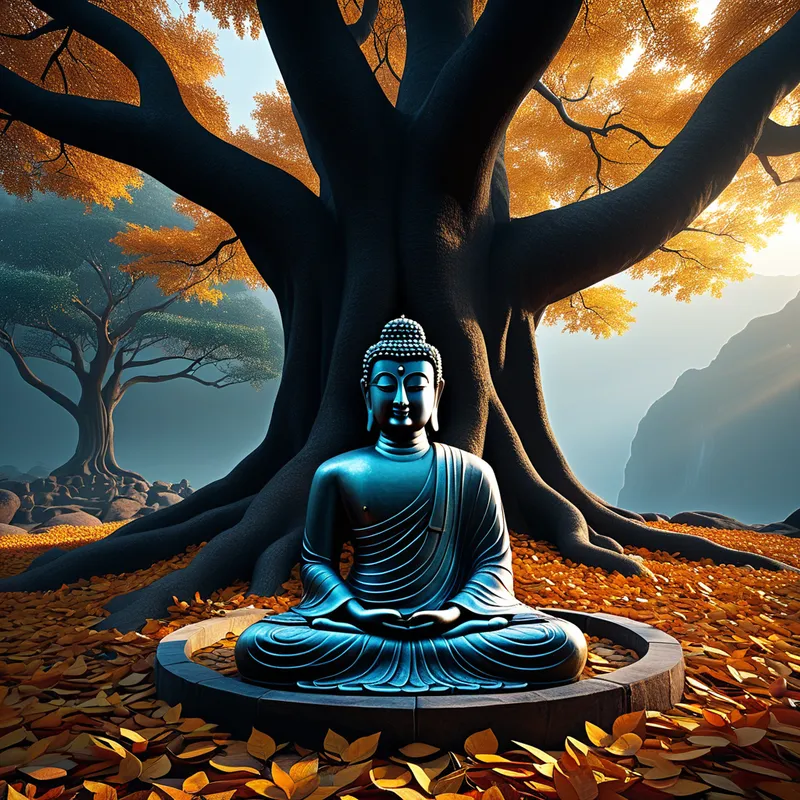
In the deepest hour of the night, he kissed his family farewell, exchanged his silks for the rough cloth of a seeker, and passed through the gates—not into the city, but into the vast, unknown forest. The great quest had begun. He sought teachers, mastered austerities, pushed his body to the brink, but the question of impermanence remained, a wolf at his heels. Finally, weary, he sat beneath a pipal tree at Bodh Gaya, vowing not to rise until he understood.
The demon Mara came, sending armies of fear and desire, parading visions of sensual delight and horrific doubt. Siddhartha touched the earth, calling it as his witness. The earth roared, and Mara fled. In the profound silence that followed, as the morning star glittered in the pre-dawn sky, his mind pierced the final veil.
He saw, not as a thought, but as a direct perception, the endless rising and passing of all conditioned things—thoughts, feelings, empires, stars, his own body. He saw the relentless chain of cause and effect, Pratītyasamutpāda, that wove this tapestry of fleeting forms. And in seeing its endless flow, he saw its essential emptiness of any fixed self. The terror of impermanence dissolved. In its place arose a vast, unshakable peace. The one who sat beneath the tree was no longer Prince Siddhartha. He was the Buddha. He had awakened to the truth of Anicca.
Cultural Origins & Context
This is the foundational narrative, not of a distant pantheon, but of a historical man’s psychological and spiritual crisis. It originates in the Pali Canon, the earliest Buddhist texts, passed down orally by monastic communities for centuries before being committed to writing. The story of the “Four Sights”—the old man, the sick man, the dead man, and finally the peaceful ascetic—is the pivotal turning point in every biographical tradition of the Buddha.
Its societal function was multifaceted. For the monastic Sangha, it was the origin story, the “call to adventure” that validated the renunciant life as a legitimate and heroic response to the human condition. For lay followers, it served as a powerful, relatable memento mori, a narrative tool to instill a sense of spiritual urgency (saṃvega) and to contextualize the Buddha’s teachings not as abstract philosophy, but as a lived solution to a universal problem. It was told not to glorify the prince, but to illuminate the path he discovered—a path open to all who dare to look honestly at life’s transient nature.
Symbolic Architecture
The myth’s symbols are stark, universal, and psychologically devastating. The walled palace represents the constructed self, the ego’s desperate project to create a permanent, separate identity immune to the flow of time. It is the illusion of control, the childhood fantasy of safety we all cling to.
The Four Sights are not random misfortunes; they are the inevitable messengers of reality, breaking through the ego’s defenses. They symbolize the three poisons in action: aging (the decay of what we cling to), sickness (the intrusion of uncontrollable suffering), and death (the ultimate annihilation of the separate self). The fourth sight, the serene ascetic, represents the possibility of a different relationship to these facts—not denial, but understanding.
The journey out of the palace is the journey from the ego’s fiction into the soul’s reality. It is the ultimate rebellion against the tyranny of wishful thinking.
The Bodhi tree is the axis mundi where this confrontation reaches its climax. It symbolizes grounded, unwavering attention—the ability to sit with the terrifying truth without fleeing into distraction or denial. The defeat of Mara is the internal victory over the psyche’s own addictive patterns of craving and aversion, which are reactions to impermanence. The awakening itself is the symbolic death of the ego-identified self and the birth of a consciousness that participates in the flow of change without being destroyed by it.
The Dreamer's Resonance
When this myth stirs in the modern dreamer, it often manifests as profound somatic and architectural imagery. You may dream of your childhood home dissolving into sand, or your teeth falling out—a classic symbol of anxiety about aging and loss of power. You may dream of being in a beautiful, familiar room that suddenly has a crack in the wall, a crack that grows no matter how you try to repair it, until the entire structure collapses into a serene, empty landscape.
These dreams signal a psychological process of de-integration. The psyche’s rigid structures, built to deny flux, are being challenged by a deeper truth. The anxiety felt upon waking is the ego’s protest. The dream is not a prophecy of literal loss, but an invitation to release your grip. It asks: What palace are you desperately maintaining? What aspect of your identity, relationship, or career are you trying to make permanent against the natural law of change? The dream presents the “sight” you have been avoiding.
Alchemical Translation
The alchemical work modeled here is the transmutation of clinging into freedom. The base metal is our instinctive, terrified reaction to impermanence—our greed for more, our hatred of loss, our delusion of permanence. The myth provides the furnace and the formula.
First, the Calcination: The shock of the Four Sights burns away the naive innocence of the prince. It is the necessary disillusionment, the burning of the false self’s comfortable lies. In our lives, this is the painful but crucial experience of loss, failure, or betrayal that shatters our illusions.
Then, the Solutio: Leaving the palace is a dissolution into the unknown. The old identity (prince, householder) is dissolved in the waters of seeking and austerity. We must allow our fixed self-concepts to soften and flow.
The confrontation under the Bodhi tree is the Coagulatio—the facing of the shadow (Mara) and the solidification of intent. It is the point where we stop running and decide to understand our suffering.
The final transmutation is not finding something permanent to hold onto, but discovering the capacity to let go, gracefully, of everything. The gold is not a static state, but the fluid, compassionate awareness that can dance with dissolution.
The awakening is the Rubedo, the reddening, the achievement of the philosopher’s stone. The stone here is the realized understanding of Anicca. It does not stop change; it allows you to become one with the process of change. The individuated self is no longer a brittle statue fearing the weather, but becomes the river itself—always moving, always whole, never the same twice. The peace of the Buddha is not the peace of a frozen eternity, but the vibrant, compassionate peace of one who has made friends with the endless, beautiful, dying world.
Associated Symbols
Explore related symbols from the CaleaDream lexicon: