Imperial Chrysanthemum Myth Meaning & Symbolism
A celestial gardener's sacrifice creates the chrysanthemum, a symbol of enduring life and imperial authority born from profound loss and alchemical transformation.
The Tale of Imperial Chrysanthemum
Listen, and let the veil between heaven and earth grow thin. In an age when the Mandate of Heaven was newly settled upon a dynasty, the Emperor ruled with a brilliance that rivaled the sun. His palaces were marvels, his armies invincible, his granaries overflowing. Yet, in the deepest chamber of his being, a cold wind blew. For all his power, he was haunted by the specter of time—the inevitable decay, the fading of his line, the autumn that follows every summer’s peak.
Within the Forbidden City, far from the gilded halls, lived a humble gardener named Heng Yu. His hands were calloused from earth, his soul attuned not to politics, but to the silent language of roots and stems. He tended the Imperial gardens, but his heart belonged to a single, secluded terrace where he nurtured a secret. It was a plant given to his ancestor by a wandering xian, a plant that had never bloomed. Its leaves were a dull grey, its stem like brittle bone. It was said to be a child of the stars, a jing fallen to earth, longing for a home it could not remember.
One year, a blight fell upon the land. Not a blight of pestilence, but of spirit. A profound melancholy, a weltschmerz of the empire itself, seeped from the throne. Flowers in the grand gardens withered before opening. Trees bore fruit that was hollow inside. The Emperor’s countenance darkened, and with it, the vitality of the realm dimmed. Heng Yu watched his own secret plant grow paler, as if feeding on the surrounding despair.
Driven by a compassion deeper than duty, Heng Yu sought an audience. He stood before the Dragon Throne, not with a petition, but with a truth. “The garden mirrors the gardener,” he whispered, his voice barely stirring the incense-heavy air. “The land withers because its heart has forgotten how to bloom.” The Emperor, in his isolation, saw not a servant, but a mirror to his own barren sovereignty. In a moment of imperial will, he commanded: “Make it bloom. Not for me, but for the land. Use whatever essence is required.”
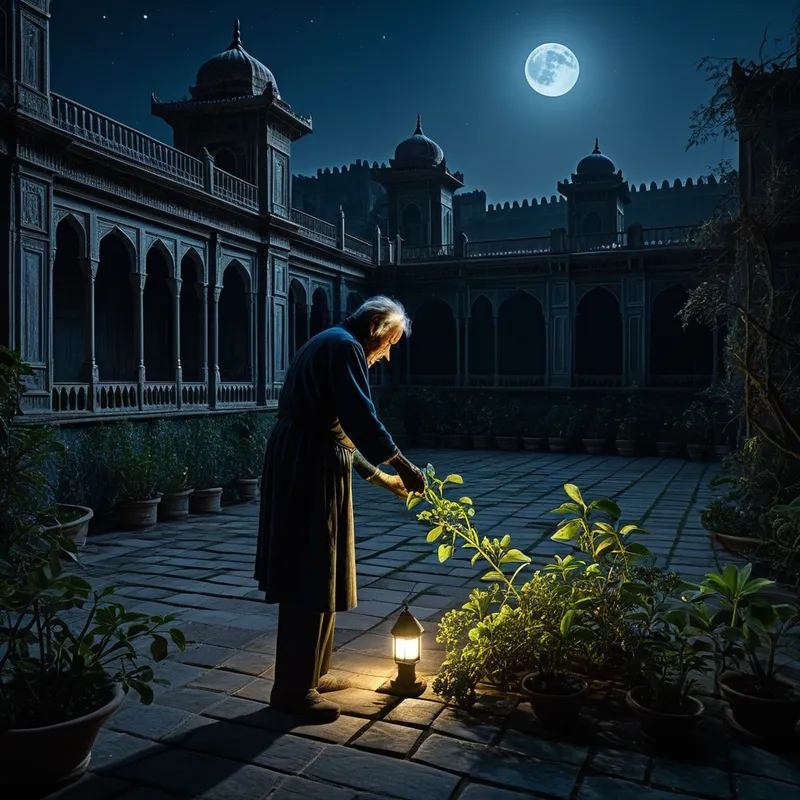
Heng Yu returned to his terrace under a moon that was a sliver of ice. He knew the lore whispered by his ancestor. The star-plant would only bloom when watered with a sacrifice of pure, unyielding life—not taken, but given. He knelt. Placing his hands upon the grey leaves, he did not pour water from a jug, but willed his own vitality, his qi, his very years, into the rootless thing. He sang to it of autumn’s crisp clarity, of resilience after frost, of beauty that declares itself not in spite of ending, but because of it.
As he sang, his hands grew transparent. His breath became mist, then shimmering light. His body, from the fingertips upward, began to dissolve into a cascade of luminous particles. He was not dying; he was translating. His flesh became sap, his bone became stem, his final, smiling breath became fragrance. Where the gardener knelt, the grey plant shuddered. Then, it erupted.
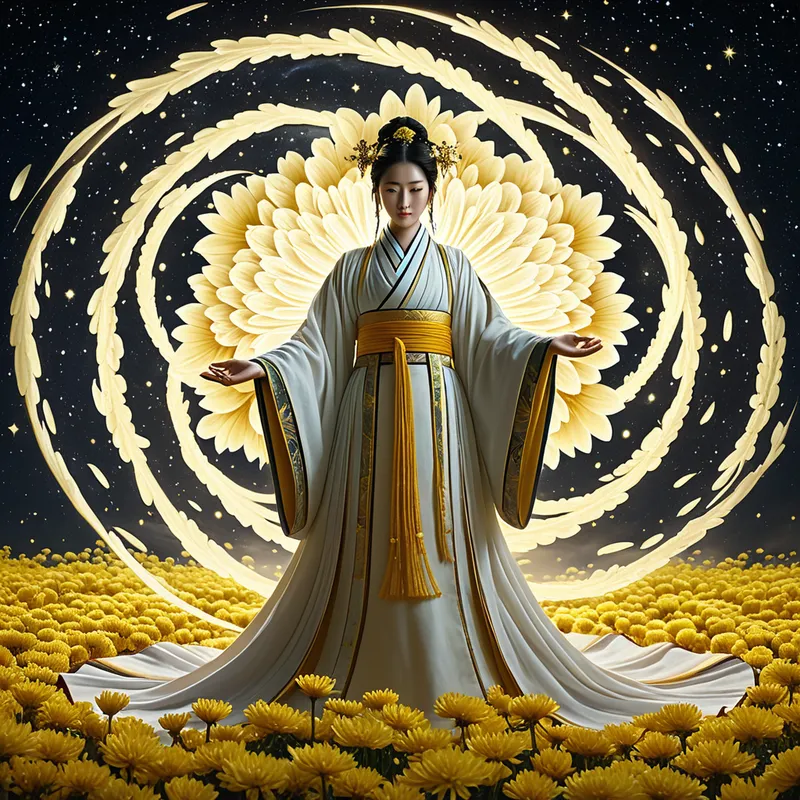
Not with a single bloom, but with a thousand. Petals of burnished gold and imperial white unfurled, layered like the robes of heaven. A fragrance, clean and austere as mountain air after rain, filled the terrace, then the gardens, then the very halls of the palace. It was the Chrysanthemum. The Emperor, feeling the shift in the air, rushed to the terrace. He found not his gardener, but a sea of radiant flowers, glowing with an inner light under the moon. In their center, one perfect bloom bore upon its petals a pattern like a celestial seal—the very mark of sovereign authority. The Emperor understood. The mandate to rule was not about defying autumn, but about embodying its most enduring beauty. He bowed, not as an emperor to a subject, but as one soul to another who had completed a sacred transaction. The blight of spirit lifted. The dynasty had found its true symbol.
Cultural Origins & Context
The myth of the Imperial Chrysanthemum is not found in a single, canonical text like the Classics of Mountains and Seas, but is a narrative archetype woven into the cultural fabric through folklore, Daoist allegory, and the symbolic language of the imperial court. It synthesizes several profound strands of Chinese thought.
Its transmission is that of the oral tradition—likely told by court historians, Daoist adepts, and master gardeners as a parable for rulers. Its societal function was multifaceted. For the imperial institution, it provided a mythic origin for the chrysanthemum’s status as a symbol of longevity, nobility, and the literati's ideal of retiring in integrity (blooming in the autumn of life). It transformed the flower from a mere plant into a vessel of the Mandate of Heaven itself, legitimizing authority not through conquest alone, but through a symbiotic, sacrificial relationship with the essence of the land and its people.
For the common folk, it was a tale that dignified sacrifice and unseen labor. The gardener, Heng Yu, represents the countless unnamed individuals whose essence sustains the realm. The myth affirms that true power and beauty are alchemical processes, born from the convergence of celestial gift (the star-plant) and human devotion (Heng Yu's sacrifice). It grounds imperial symbolism in an act of profound, personal transformation, making the symbol resonate with a deeply human, psychological truth.
Symbolic Architecture
At its core, the myth is a map of psychic transformation where sovereignty is earned through surrender, and life is affirmed through a conscious engagement with mortality.
The Unbloomed Star-Plant represents latent potential, the Self in its dormant, unintegrated state. It is celestial in origin—our deepest, transpersonal nature—but stranded and grey in the earthly realm of ego and temporal power. The Emperor’s Melancholy symbolizes the crisis of the conscious ego. He has all the outer trappings of the Ruler, but his realm is hollow because it is disconnected from the nourishing, sacrificial depths of the unconscious (the gardener, the earth).
True sovereignty is not the imposition of will upon life, but the conscious sacrifice of the personal will to the flowering of a transpersonal pattern.
Heng Yu, the Gardener, is the archetype of the mediator or the psychopomp. His consciousness is not fixated on the throne (ego), but is attuned to the soil (the unconscious, the body, the instinctual). His sacrifice is not a destruction, but a transmutation. He does not die; he becomes the process itself. His act models the ultimate psychological truth: to bring the latent Self into bloom, the identifying consciousness of the ego must willingly dissolve its boundaries and invest its energy into the deeper pattern.
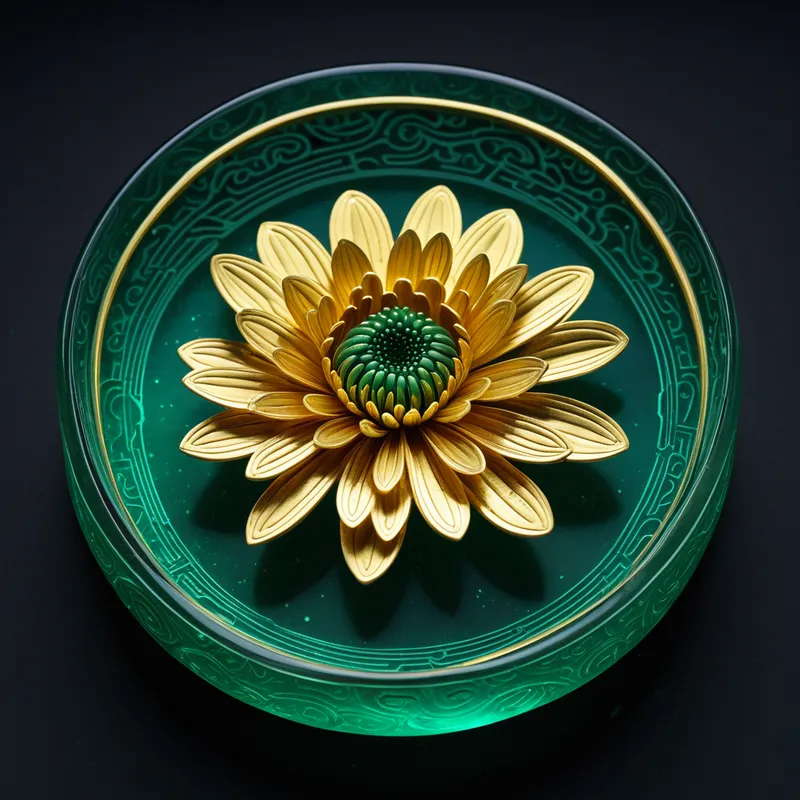
The Chrysanthemum that results is the symbol of the integrated Self. Its autumn blooming signifies wisdom, maturity, and beauty that incorporates the knowledge of an ending. Its imperial colors mark it as the new, legitimate center of the psyche—a sovereignty born of alchemy, not of conquest.
The Dreamer's Resonance
When this myth stirs in the modern dreamer, it often signals a profound crossroads in the process of individuation. To dream of a grey, withering plant in a sterile or grandiose setting reflects a felt sense of inner impoverishment. One may have achieved outer success (the Emperor’s palace) but feels a vital, flowering essence is missing, leading to a depressive blight on one’s inner world.
Dreams featuring a humble, skilled figure (a gardener, a potter, a custodian) offering a crucial but costly solution point to the emergence of a guiding function from the unconscious—the part of the psyche that knows how to tend and transform. The core, transformative dream image is the act of voluntary dissolution. This might appear as the dreamer’s hands turning to light, breathing life into an object until one fades, or willingly stepping into a transforming fire. Somatic sensations accompanying such dreams can include a feeling of profound release, a buzzing energy in the hands or chest, or a paradoxical warmth amidst a scene of loss.
This is the psyche rehearsing the sacrifice of a rigid ego-identity to feed a larger, more authentic pattern of being trying to emerge. The dreamer is not dreaming of death, but of symbolic death—the necessary end of a current psychological configuration to allow for a more complete one to blossom.

Alchemical Translation
The myth of the Imperial Chrysanthemum is a perfect allegory for the alchemical solutio and coagulatio, applied to the psyche. The modern individual’s journey often begins in the state of the Emperor: identified with a persona of control, achievement, or social standing, yet feeling an inner autumn, a sterility of meaning.
The Nigredo, or initial darkness, is the melancholic blight—the recognition that the current “rule” of one’s life is insufficient. The call then comes to engage with the Gardener within—the neglected, earthy, instinctual self that is connected to the body, to patience, to the slow cycles of growth and decay. This part of us holds the secret, the “star-plant” of our unlived potential.
Individuation is the empire where the ruler must become the sacrificial gardener, and the gardener is revealed as the true sovereign.
The alchemical operation is Heng Yu’s sacrifice: the solutio. This is the conscious, willing dissolution of the old ego attachments. In a human life, this translates as: letting go of a defining career title to find a truer vocation; releasing a long-held self-narrative of victimhood or superiority; sacrificing the need for total control to allow for organic growth. It is the investment of one’s vital energy (qi) into the dormant Self.
The resulting Chrysanthemum is the coagulatio—the new, solidified form of the personality. It is not a return to the old Emperor, but the establishment of a new center of gravity. The individual now “rules” their life with the authority of authenticity. Their power is resilient like the chrysanthemum, blooming in the autumn of challenges, rooted in the sacrifice that gave it form. They carry within them the fragrance of that transformation—a maturity that acknowledges mortality and thus chooses to bloom with profound and enduring intention.
Associated Symbols
Explore related symbols from the CaleaDream lexicon: