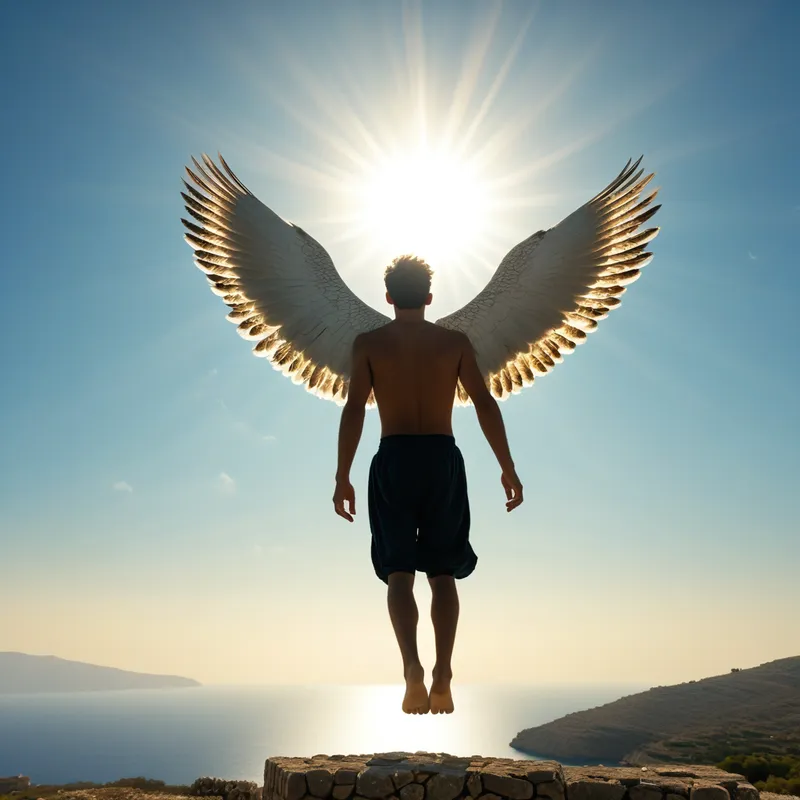
Icarus' Wings Myth Meaning & Symbolism
A master craftsman and his son escape a labyrinth with wings of wax and feathers, but youthful ambition defies paternal wisdom, leading to a fatal fall.
The Tale of Icarus’ Wings
Listen, and hear a tale not of gods on high, but of the genius of mortals, and the price it exacts. In the great palace of [Minos](/myths/minos “Myth from Greek culture.”/), a darkness was woven in stone. The [Labyrinth](/myths/labyrinth “Myth from Various culture.”/), a twisting, swallowing beast of corridors, held at its heart a deeper darkness: the [Minotaur](/myths/minotaur “Myth from Greek culture.”/). Its architect, Daedalus, was now its prisoner, trapped with his young son, [Icarus](/myths/icarus “Myth from Greek culture.”/), in the very tower he had designed. [The sea](/myths/the-sea “Myth from Greek culture.”/), a vast sapphire moat, laughed at their captivity. King [Minos](/myths/minos “Myth from Greek culture.”/), wrathful and cunning, controlled every ship, every path. [The earth](/myths/the-earth “Myth from Hindu culture.”/) and [water](/myths/water “Myth from Chinese culture.”/) offered no escape.
But Daedalus was a man who conversed with the principles of [the world](/myths/the-world “Myth from Tarot culture.”/). Gazing at the sea-gulls crying on [the wind](/myths/the-wind “Myth from Various culture.”/), he saw a path not on land or water, but in the air itself. In secret, he gathered feathers fallen from [the sky](/myths/the-sky “Myth from Persian culture.”/)—the quills of eagles, the down of hawks, the pinions of gulls. With careful hands, he laid them out, from smallest to largest, crafting the semblance of mighty wings. He fastened them with thread and sealed their roots with beeswax, warmed over a low flame until it flowed like pale honey. He fashioned two pairs: one large and seasoned, for his own experienced shoulders, and one, lighter and perhaps more perfect, for his son.
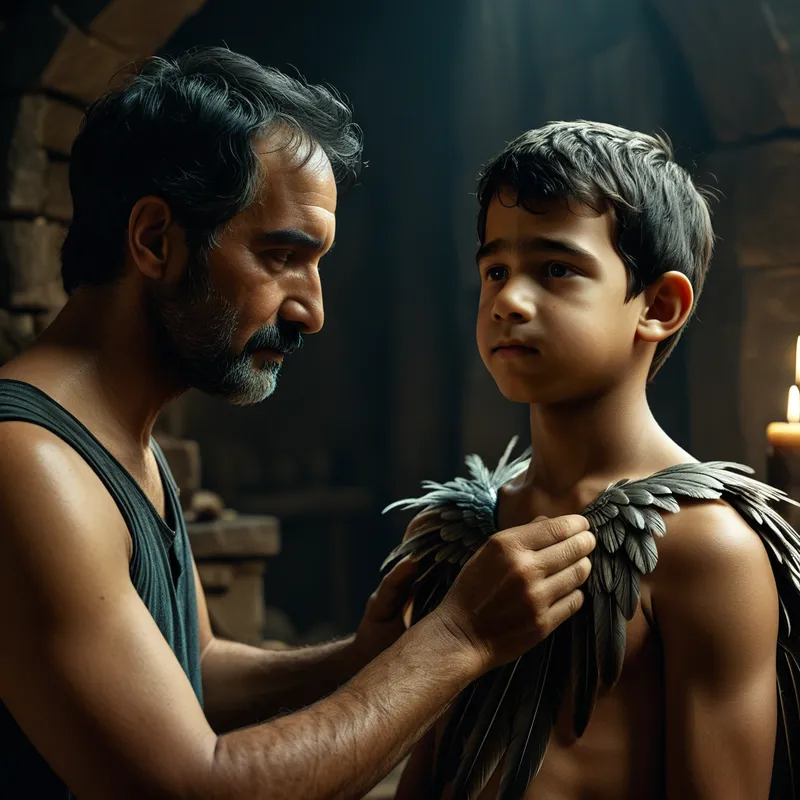
On the day of their flight, high on [the tower](/myths/the-tower “Myth from Tarot culture.”/) parapet, the wind plucked at their tunics. Daedalus’s face was grave, etched with the lines of a hard-won wisdom. He fastened the wings to Icarus’s strong back, his fingers lingering. “My son,” he said, his voice barely above the wind’s whisper, “you must follow a middle course. Fly too low, and the damp sea spray will clog your wings, drag you into [the abyss](/myths/the-abyss “Myth from Kabbalistic culture.”/). Fly too high…” He paused, looking not at his son, but at the distant, blazing orb of the sun. “Fly too high, and the heat of the sun will melt the wax that binds you. Keep to my path. Follow me.”
And then they were aloft. The first dizzying lurch of the ground falling away, the incredible, terrifying silence of the air, broken only by the rush of wind through feathers. Daedalus led, a steady, strong beat. Below, the fishermen and shepherds looked up, surely believing they saw gods. Icarus felt it—the ecstasy of it. The rules of earth were undone. The warnings of his father became a faint echo, drowned by the roar of his own pulse, by the sheer, unbounded joy of ascent. He began to climb, each stroke taking him higher, closer to the source of all light and warmth. The air grew thin and pure. The world below became a painted toy, the sea a shimmering sheet of metal.
He felt the sun’s embrace, not as warmth, but as a glorious, conquering fire. He was master of the sky. And then, a single, warm droplet fell upon his shoulder. Then another. He glanced back. A feather, loosened, spiraled away. The sleek seam of his left wing was softening, weeping wax. Panic, cold and sharp, pierced the euphoria. He beat harder, but the motion only hastened the collapse. The structure unwove itself. Feathers, once a unified tapestry of flight, became a scattered, falling cloud. The glorious ascent became a terrible, silent rush. The embrace of the air became a fist. He called for his father, but the wind stole the sound. The bright, indifferent sea rose to meet him. In a place that would be named the Icarian Sea, the waters closed over him, and the sun shone on, unmoved.
Daedalus, turning at the sudden silence, saw only feathers floating on the waves. The great inventor, who had outwitted labyrinths and kings, could not outwit the grief that now grounded him forever. He buried his son on a lonely island, and flew on, his victory ashen in his mouth.
Cultural Origins & Context
This haunting story reaches us primarily through the Roman poet Ovid, in his epic [Metamorphoses](/myths/metamorphoses “Myth from Greek culture.”/). While Ovid gave it its most famous and poetic form, the myth is older, rooted in the rich tapestry of Greek storytelling. It belongs not to the grand cycles of the Olympians, but to the later, more human-centric world of heroes and ingenious mortals. It functioned as a powerful paradeigma—an exemplary story.
Told by bards and later written by scholars, it served multiple societal functions. On one level, it was a foundational myth for the geography of the Aegean Sea, explaining the name of the Icarian Sea. On a deeper level, it was a cultural narrative about the boundaries of human innovation (techne). The Greeks revered skill and craft, embodied by figures like [Hephaestus](/myths/hephaestus “Myth from Global/Universal culture.”/) and Daedalus himself. Yet, they maintained a profound respect for the natural order and the limits set by the divine (moira). The story of Icarus is a cautionary tale, a reminder that human brilliance, unchecked by wisdom (sophrosyne) and respect for natural law, leads to catastrophe. It was a lesson for the young about heeding experienced counsel, and for the ambitious about the perils of hubris—the overweening pride that invites ruin.
Symbolic Architecture
The myth is a perfect, tragic geometry of symbols. Daedalus represents the disciplined, creative intellect—[the ego](/myths/the-ego “Myth from Jungian culture.”/) that can engineer solutions, that understands [material](/symbols/material “Symbol: Material signifies the tangible aspects of life, often representing physical resources, desires, and the physical world’s influence on our existence.”/) cause and effect. The [Labyrinth](/symbols/labyrinth “Symbol: The labyrinth represents a complex journey, symbolizing the intricate path toward self-discovery and understanding one’s life’s direction.”/) is the complex, entrapping [problem](/symbols/problem “Symbol: Dreams featuring a ‘problem’ often symbolize internal conflicts or challenging situations that require resolution and self-reflection.”/) of [life](/symbols/life “Symbol: The symbol of ‘Life’ represents a journey of growth, interconnectedness, and existential meaning, encompassing both the joys and challenges that define human experience.”/), often of our own making. The wings are the sublime, transcendent technology born of that intellect; they are the [human](/symbols/human “Symbol: The symbol of a human represents individuality, complexity of emotions, and social relationships.”/) [spirit](/symbols/spirit “Symbol: Spirit symbolizes the essence of life, vitality, and the spiritual journey of the individual.”/)’s aspiration to break free from all constraints.
Icarus embodies the untamed, impulsive [aspect](/symbols/aspect “Symbol: A distinct feature, quality, or perspective of something, often representing a partial view of a larger whole.”/) of the [psyche](/myths/psyche “Myth from Greek culture.”/)—the youthful puer spirit, the ecstatic drive that seeks union with the sublime without regard for the [vessel](/symbols/vessel “Symbol: A container or structure that holds, transports, or protects something essential, representing the self, emotions, or life journey.”/) that contains it.
The sun is not merely a celestial body; it is the symbol of the absolute, the divine, the ultimate source of consciousness and truth. To seek it directly is to seek annihilation of the earthly self.
The wax is the critical, binding element—the fragile, melting point where ambition meets [reality](/symbols/reality “Symbol: Reality signifies the state of existence and perception, often reflecting one’s understanding of truth and life experiences.”/). It represents the necessary but vulnerable [connection](/symbols/connection “Symbol: Connection symbolizes relationships, communication, and bonds among individuals.”/) between lofty aspiration (the feathers) and practical, earthly grounding. The sea, which drowns Icarus, is the unconscious, the primal, undifferentiated state from which conscious life emerged and to which it can catastrophically return.
The core tragedy is not simply disobedience, but a failure of [integration](/symbols/integration “Symbol: The process of unifying disparate parts of the self or experience into a cohesive whole, often representing psychological wholeness or resolution of internal conflict.”/). Daedalus’s warning outlines the [path](/symbols/path “Symbol: The ‘path’ symbolizes a journey, choices, and the direction one’s life is taking, often representing individual growth and exploration.”/) of individuation: [the middle way](/myths/the-middle-way “Myth from Buddhist culture.”/), avoiding the [swamp](/symbols/swamp “Symbol: Represents the subconscious mind, emotions, and the complexities of personal issues.”/) of unconscious inertia (the sea spray) and the fire of identification with the archetypal, which burns up the individual ego (the sun). Icarus fails to hold the [tension](/symbols/tension “Symbol: A state of mental or emotional strain, often manifesting physically as tightness, pressure, or unease, signaling unresolved conflict or anticipation.”/) of the opposites, and is destroyed by the one he sought to embrace.
The Dreamer’s Resonance
When this myth stirs in the modern dreamscape, it often signals a critical moment of psychic inflation or impending deflation. To dream of crafting or wearing wings speaks to a burgeoning sense of potential, a creative or spiritual breakthrough that promises liberation from a personal “labyrinth”—be it a job, a relationship, or a state of mind.
Dreaming of flying with Icarus’s joyous, reckless abandon often coincides with real-life periods of manic confidence, where boundaries feel irrelevant. The somatic sensation in the dream might be one of exhilarating lightness, of heat and light. However, the dream may shift. The feeling of wax softening, of feathers detaching, is the psyche’s early warning system. It is the somatic registration of an unsustainable position, a “high” that cannot be maintained. The subsequent fall is not always present in the dream; sometimes the dream ends at the moment of melting, leaving the dreamer with a profound, anxious unease upon waking. This is the body and unconscious mind processing the reality that an ambition, an identity, or a project is structurally unsound and headed for a painful correction.
Alchemical Translation
In the alchemy of the soul, [the myth of Icarus](/myths/the-myth-of-icarus “Myth from Global/Universal culture.”/) maps the perilous stage of sublimatio—the spiritual ascension. The base material (the imprisoned self in [the labyrinth](/myths/the-labyrinth “Myth from Greek culture.”/)) is heated by the fire of desire and intellect (Daedalus’s plan) and attempts to rise to a higher, purified state. This is a necessary, glorious, and dangerous phase of growth.
The alchemical goal is not to remain in the sublime vapor, but to coagulate the insight back into a renewed, grounded form. Icarus fails to complete the cycle.
Daedalus represents the guiding principle of the Senex (the old wise man), which must be integrated with the energy of the Puer (the eternal youth). For the modern individual, the “flight” might be a new career path, a spiritual awakening, or the launch of a profound creative work. The “wax” is our psychological constitution—our mental health, our relationships, our physical stamina—that must be strong enough to bear the heat of expansion.
The individuation process modeled here demands that we heed the Daedalus within: the voice of caution, experience, and respect for our limits. It asks us to channel the fire of the Icarus spirit—its ambition, joy, and reach—without identifying with it completely. The true [triumph](/myths/triumph “Myth from Roman culture.”/) is not in touching the sun, but in learning to navigate the middle atmosphere, to hold the tension between heaven and earth, and to land, transformed, on a farther shore. The goal is not to avoid the flight, but to survive it, carrying the knowledge of both the labyrinth and the sun within a wiser, humbler, and more integrated self. [The fall](/myths/the-fall “Myth from Biblical culture.”/) is not the end of the story for the one who understands the myth; it is the avoided fate that makes the successful journey meaningful.
Associated Symbols
Explore related symbols from the CaleaDream lexicon: