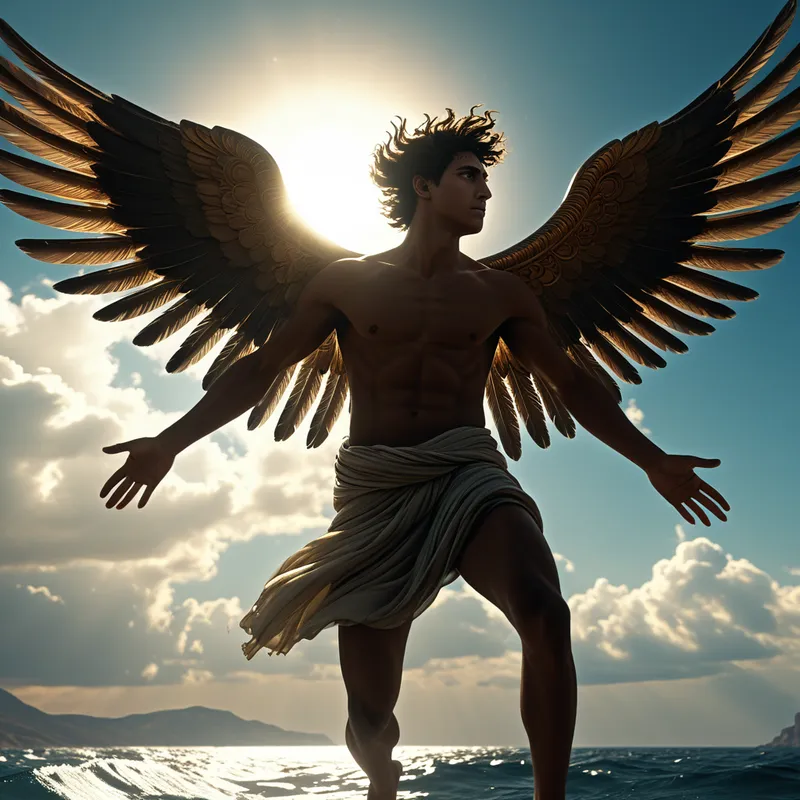
Icarus falling from the sky af Myth Meaning & Symbolism
A youth, borne aloft by crafted wings, flies too close to the sun, melting his bindings and falling into the sea—a timeless parable of ambition's zenith and nadir.
The Tale of Icarus falling from the sky af
Hear now the tale of the boy who touched the sun and was baptized by the sea.
In the heart of a labyrinth, a prison of stone and shadow built by his own father’s genius, young Icarus waited. The air was cool and still, thick with the scent of damp earth and despair. His father, Daedalus, whose mind could bend wood and stone to his will, now turned his art to a more desperate medium: feather and wax. Stranded by a king’s wrath on the island of Crete, their only escape lay not across the guarded sea, but through the unguarded sky.
With hands that had fashioned wonders and horrors, Daedalus gathered feathers—discarded plumes from gulls and hawks—and bound them with thread. He softened yellow beeswax over a low flame, its sweet, smoky scent filling their cell. Layer upon layer, he crafted two great wings, fixing them to his son’s shoulders and then his own. They were things of fragile beauty, a blasphemy against the domain of the gods. “Follow my path,” Daedalus warned, his voice gravelly with fear and love. “Fly the middle course. If you sink too low, the sea’s damp will clog your wings and drag you down. If you soar too high, the sun’s fire will melt their binding. Keep to my side, and look only at the horizon.”
Then they leapt from the highest cliff.
The first rush was terror, then a triumph so fierce it sang in the blood. The world fell away—the labyrinth became a child’s puzzle on the ground, the sea a vast, shimmering plain of lapis lazuli. The wind, once a howling jailer, now bore them up. Icarus felt the divine thrill of it. He saw his father, a steady, laboring shape ahead, but his own heart beat with a wilder rhythm. The sun, Helios, called to him. It was not just a ball of fire; it was the source of all light, the throne of power, a golden promise. The cautionary words dissolved in the thin, intoxicating air.
He banked upward. The air grew warmer, sweeter. The wax on his shoulders began to soften, a subtle, warning pliancy he mistook for freedom. Higher. The sun filled his vision, a blinding, all-consuming embrace. He was almost there, almost one with the radiant heart of the sky.
Then came the drip.
A single, hot tear of wax rolled down his arm. A feather loosened, spun away into the gulf below. Panic, cold and sharp, pierced the euphoria. He beat his wings, but the motion was wrong—unbalanced. More feathers slipped from their moorings. The great apparatus unraveled in the solar furnace. The sky, his ally, became a vast, indifferent blue vacuum. For a moment, he hung, a boy suspended between heaven and earth. Then he fell.
The descent was not swift, but eternal. The wind screamed past, not as a bearer but as a mourner. He saw the sea rushing up to meet him, its surface no longer beautiful but pitiless and dark. He saw his father, a distant, receding speck of anguish, unable to turn back. The last thing Icarus knew was the shocking, final embrace of the cold water, the world going from fire to silence, from light to endless, crushing dark. The sea, which he had scorned from above, took him and named him hers.
Cultural Origins & Context
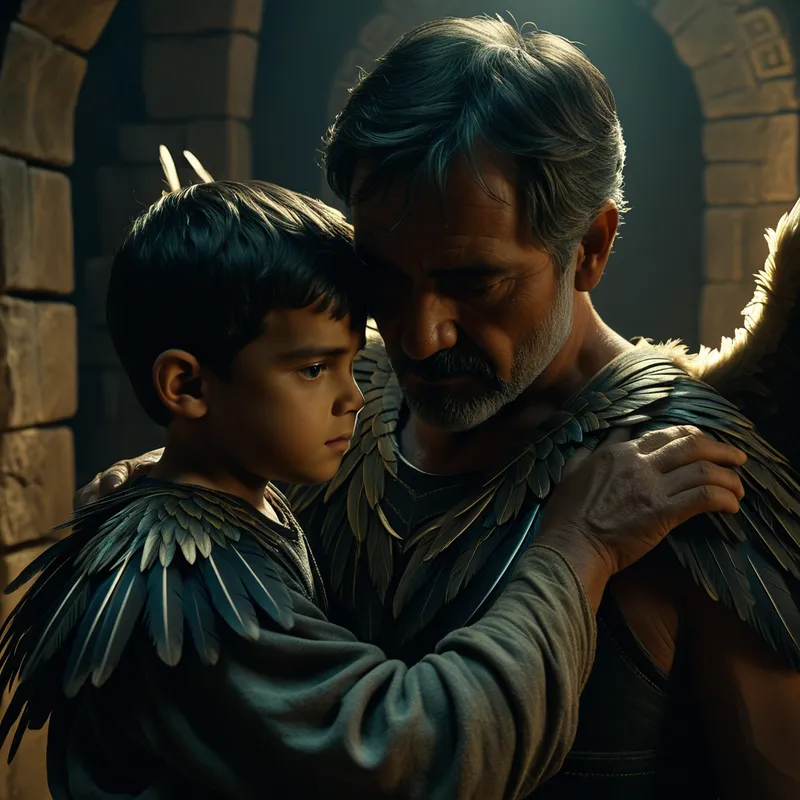
The myth of Icarus is a thread woven into the vast tapestry of Greek mythology, most famously preserved in the Metamorphoses of the Roman poet Ovid. It belongs not to state religion, but to the rich corpus of moral and cautionary tales told by poets and storytellers. It was a narrative tool, passed down through epic cycles and later literary collections, used to illustrate profound cultural values.
In the context of the ancient Greek worldview, the story functioned as a powerful lesson on hubris and sophrosyne. The Greeks lived in a cosmos bounded by Moira, where every being, mortal and divine, had an ordained place and limit. To transgress these boundaries was to invite Nemesis. Daedalus and Icarus, through their artificial wings, committed a double transgression: escaping a king’s justice and trespassing in the aerial realm of the gods. The tale was told to reinforce the necessity of the “middle way,” of heeding wisdom (Daedalus as the mentor) and respecting natural and divine law. It was a societal check on unbridled ambition and a poetic meditation on the tragic gap between human ingenuity and human fragility.
Symbolic Architecture
At its core, the myth is an archetypal map of the psyche’s ascent and catastrophic fragmentation. Icarus represents the pure, aspiring spirit of the Ego, intoxicated by its own potential and the allure of the Self (symbolized by the unifying, all-powerful Sun). The wings are the brilliant, yet fragile, constructions of the conscious mind—technology, ambition, intellectual pride.
The Sun is not merely a celestial body; it is the symbol of ultimate consciousness, divine knowledge, and psychic totality. To fly towards it is the soul's deepest impulse; to believe one can possess it is the ego's fatal error.
The wax is the critical binding agent—it represents the libido or psychic energy that holds our complex nature together, but it is of the earth (bees, matter). It cannot withstand the pure, unmediated radiance of the divine. The fall is the inevitable dissolution when an immature consciousness, inflated by its own success, attempts to bypass the necessary stages of integration and directly apprehend the numinous. The sea that receives him is the unconscious—the primal, maternal, and chaotic realm from which consciousness first emerged and to which it returns when its structures fail.
The Dreamer's Resonance
When this myth erupts in the modern dreamscape, it signals a critical moment of psychic inflation and impending deflation. To dream of soaring with artificial wings speaks to a period of exhilarating success, breakthrough, or expanded identity—perhaps a new career peak, a spiritual awakening, or a creative triumph. The dreamer feels liberated, above their problems, gifted with a god-like perspective.
The moment of melting and falling, however, is the somatic signature of a psychological correction. It is the unconscious enforcing a necessary humility. The dream body may feel a sudden loss of control, a visceral plunge, or the terrifying sensation of dissolution. This is not merely a nightmare of failure; it is a profound initiation. The psyche is demonstrating the consequences of an ego that has become too identified with its own achievements, too disconnected from the grounding realities of the body, relationships, or the shadow self. The dream is a stark, embodied warning that one is flying too close to a source of energy (the “sun” of ambition, recognition, or idealization) that is currently too potent for one’s integrated self to contain.
Alchemical Translation
The alchemical journey, or the path of individuation, is precisely about navigating the Icarus flight without succumbing to the fall. Daedalus represents the guiding function of the Senex principle—experienced, cautious, grounded wisdom. His successful flight is the model: he respects the limits of his materials and his mortal station, achieving liberation through discipline and the “middle course.”
The goal is not to avoid the sky, but to craft a vessel—a conscious attitude—that can endure the increasing intensity of the light one approaches.
The alchemical operation mirrored here is sublimatio—the spirit’s ascent from base matter. But pure sublimatio without coagulatio (return to earth, embodiment) leads to disintegration. Icarus’s fall is a failed, yet essential, part of the process. His dissolution into the sea is a symbolic solutio—a return to the primal waters of the unconscious for recalibration. The modern individual’s “Icarus moment” is often a necessary crisis. A grandiose project fails, a idealized relationship shatters, a spiritual belief collapses. This “fall” is a brutal but transformative invitation to descend, to reintegrate what was lost in the ascent: humility, vulnerability, connection to the dark and fluid depths of one’s own nature.
The ultimate alchemical translation is not in condemning the flight, but in learning its lesson. One must, like Daedalus, mourn the lost son (the naive, inflated aspect of the self) and continue the journey, carrying that grief as wisdom. The true triumph is to build wings that acknowledge their wax, to aspire to the sun while remembering the weight and wisdom of the sea below. It is to become both the daring flyer and the grieving, grounded craftsman—holding the tension between aspiration and limitation, which is the very crucible where the gold of a mature consciousness is forged.
Associated Symbols
Explore related symbols from the CaleaDream lexicon: