Icarus and Daedalus - The ambi Myth Meaning & Symbolism
A master craftsman and his son escape a labyrinth with wings of wax, a flight that becomes a timeless parable of ambition and its limits.
The Tale of Icarus and Daedalus - The ambi
Hear now the tale of wings and wax, of a [labyrinth](/myths/labyrinth “Myth from Various culture.”/)’s shadow and a sun’s embrace. It begins not in light, but in the cool, echoing dark of stone. In the court of [Minos](/myths/minos “Myth from Greek culture.”/), the master artificer Daedalus walked, his genius a cage of its own making. He had built the impossible: the [Labyrinth](/myths/labyrinth “Myth from Various culture.”/), a twisting prison for the king’s monstrous shame. But in aiding the hero [Theseus](/myths/theseus “Myth from Greek culture.”/), Daedalus betrayed his patron. For this, the king’s wrath was a colder, more cunning [thing](/myths/thing “Myth from Norse culture.”/) than any beast’s. [Minos](/myths/minos “Myth from Greek culture.”/) did not take Daedalus’s life; he took [the sky](/myths/the-sky “Myth from Persian culture.”/), [the sea](/myths/the-sea “Myth from Greek culture.”/), [the horizon](/myths/the-horizon “Myth from Various culture.”/). He imprisoned the inventor and his young son, [Icarus](/myths/icarus “Myth from Greek culture.”/), in the tallest tower of his own palace, an island within an island, guarded by ships that patrolled the wine-dark sea like loyal hounds.
The air in [the tower](/myths/the-tower “Myth from Tarot culture.”/) was thick with the scent of salt and despair. But Daedalus’s mind, that restless bird, would not be caged. He watched the gulls wheel and cry against the boundless blue, and an idea took root—not of earth, but of air. He gathered feathers, great and small, from the birds that nested on the sun-warmed stones. He collected discarded candles, the wax of bees who knew the secret paths to hidden flowers. With the patience of a [spider](/myths/spider “Myth from Native American culture.”/) and the love of a father, he began to craft. He fashioned frames of wood, light as a wish. To these, he fastened the feathers with twine, and then, with meticulous care, he sealed his work with the melted wax, layer upon layer, until two pairs of magnificent wings lay upon the stone floor, trembling in the sea breeze.
On the day of flight, Daedalus’s hands were steady, but his voice trembled as he fastened the wings to his son’s strong shoulders. “My boy,” he said, his words as grave as an oracle’s, “follow my path. Take [the middle way](/myths/the-middle-way “Myth from Buddhist culture.”/). Fly too low, and the damp breath of the sea will clog your wings, drag you down into [the abyss](/myths/the-abyss “Myth from Kabbalistic culture.”/). Fly too high…” He paused, looking into Icarus’s bright, eager eyes. “Fly too high, and the fierce love of the sun will melt the wax that binds you. Hold to the course I set. The middle way is [the way](/myths/the-way “Myth from Taoist culture.”/) of life.”
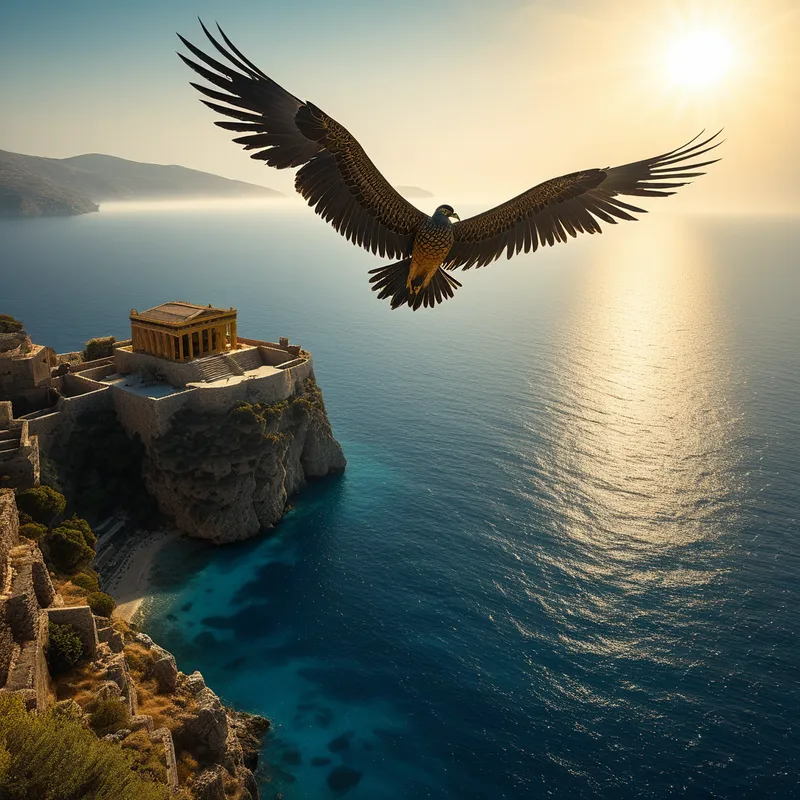
Then, with a push and a cry that was part fear, part exultation, they leapt from the tower’s edge. For a heart-stopping moment, they fell—and then the air caught them. They soared! [The labyrinth](/myths/the-labyrinth “Myth from Greek culture.”/) became a child’s toy below them, the ships mere splinters on a vast blue tablet. The prison was broken. Daedalus led, a steady, beating rhythm against [the wind](/myths/the-wind “Myth from Various culture.”/). But Icarus… Icarus was born anew. The thrill of it! The sun was not a warning; it was an invitation. It warmed his skin, gilded the feathers, filled him with a divine, intoxicating power. His father’s drone faded behind him. The middle way was dull, a tether. He beat his wings harder, climbing, climbing toward the radiant heart of the sky.
He did not feel the first softening. Then, a single feather, then a clump, loosened and spun away into the glittering void. The wax ran in golden tears down his arms. The sun’s embrace became a furnace. The glorious ascent became a terrible, silent fall. Daedalus’s scream was swallowed by the wind. He watched, helpless, as his greatest creation and his deepest love plunged, a brief, dark streak against the blue, into the sea that would forever after bear his name: the Icarian Sea. The master of labyrinths could not solve the maze of his own grief. He flew on, alone, to a lonely sanctuary, his victory ashes in his mouth.
Cultural Origins & Context
This haunting story reaches us from the fragmented brilliance of the ancient Greek world, primarily through the Roman poet Ovid in his [Metamorphoses](/myths/metamorphoses “Myth from Greek culture.”/). It is a myth that belongs to the later, more philosophical layer of Greek storytelling, less about the direct caprices of the gods and more about the inherent tensions within the human condition itself. While not a central cult myth, it functioned as a powerful paradeigma—an illustrative example or warning.
Told by bards and later written by scholars, it served a crucial societal function in a culture that prized sophrosyne (moderation, self-control) as the highest virtue. The myth was a cultural compass, dramatizing the peril of hubris—the overweening pride that seeks to transcend human limits. It was a story for fathers to tell sons, for masters to tell apprentices, and for citizens to contemplate: innovation and ambition (daedala, cunning works) are necessary for progress and escape, but they must be tempered by wisdom, respect for natural law, and heeding the guidance of experience. It is a profoundly human story set in a world of legendary craftsmen and kings, making its warning all the more intimate and universal.
Symbolic Architecture
The myth is a perfect, tragic geometry of symbols. Daedalus represents the disciplined, ingenious ego—the part of the [psyche](/myths/psyche “Myth from Greek culture.”/) that can analyze a [problem](/symbols/problem “Symbol: Dreams featuring a ‘problem’ often symbolize internal conflicts or challenging situations that require resolution and self-reflection.”/), craft solutions, and follow a rational plan. He is the [father](/symbols/father “Symbol: The father figure in dreams often symbolizes authority, protection, guidance, and the quest for approval or validation.”/), tradition, and accumulated wisdom. The [Labyrinth](/symbols/labyrinth “Symbol: The labyrinth represents a complex journey, symbolizing the intricate path toward self-discovery and understanding one’s life’s direction.”/) is the complex [prison](/symbols/prison “Symbol: Prison in dreams typically represents feelings of restriction, confinement, or a lack of freedom in one’s life or mind.”/) of our own making: a stifling job, a toxic [relationship](/symbols/relationship “Symbol: A representation of connections we have with others in our lives, often reflecting our emotional state.”/), a repetitive psychological [pattern](/symbols/pattern “Symbol: A ‘Pattern’ in dreams often signifies the underlying structure of experiences and thoughts, representing both order and the repetitiveness of life’s situations.”/), or the confines of societal expectation.
The wings are the sublime, double-edged gift of consciousness and aspiration. They are the technology of transcendence, crafted from both the natural (feathers) and the cultural (wax, skill).
Icarus is the untamed [spirit](/symbols/spirit “Symbol: Spirit symbolizes the essence of life, vitality, and the spiritual journey of the individual.”/), the impulsive libido, the youthful puer [archetype](/symbols/archetype “Symbol: A universal, primordial pattern or prototype in the collective unconscious that shapes human experience, behavior, and creative expression.”/) that yearns for absolute freedom, [ecstasy](/symbols/ecstasy “Symbol: A state of overwhelming joy, rapture, or intense emotional/spiritual transcendence, often involving a loss of self-awareness.”/), and identification with the divine (the Sun). His [flight](/symbols/flight “Symbol: Flight symbolizes freedom, escape, and the pursuit of one’s aspirations, reflecting a desire to transcend limitations.”/) is not just a physical act but a psychological one: the [inflation](/symbols/inflation “Symbol: A dream symbol representing feelings of diminishing value, loss of control, or expansion beyond sustainable limits in one’s life or psyche.”/) of [the ego](/myths/the-ego “Myth from Jungian culture.”/) that believes it can become godlike, unbound by the laws of [nature](/symbols/nature “Symbol: Nature symbolizes growth, connectivity, and the primal forces of existence.”/) ([gravity](/symbols/gravity “Symbol: The fundamental force that pulls objects toward each other, representing attraction, inevitability, and the weight of existence.”/)) and matter (wax). The sea represents the unconscious, the primal, undifferentiated state from which [life](/symbols/life “Symbol: The symbol of ‘Life’ represents a journey of growth, interconnectedness, and existential meaning, encompassing both the joys and challenges that define human experience.”/) emerged and to which it returns—a [dissolution](/symbols/dissolution “Symbol: The process of breaking down, dispersing, or losing form, often representing transformation, release, or the end of a state of being.”/) of the individual back into the whole. The “middle way” is the psychological tightrope of individuation, holding the [tension](/symbols/tension “Symbol: A state of mental or emotional strain, often manifesting physically as tightness, pressure, or unease, signaling unresolved conflict or anticipation.”/) between the [depths](/symbols/depths “Symbol: Represents the subconscious, hidden emotions, or foundational aspects of the self, often linked to primal fears or profound truths.”/) (the unconscious, inertia) and the [heights](/symbols/heights “Symbol: Represents ambition, fear, or spiritual elevation. Often symbolizes life challenges or a desire for perspective.”/) ([inflation](/symbols/inflation “Symbol: A dream symbol representing feelings of diminishing value, loss of control, or expansion beyond sustainable limits in one’s life or psyche.”/), [dissociation](/symbols/dissociation “Symbol: A psychological separation from one’s thoughts, feelings, or identity, often experienced as a journey away from the self during trauma or stress.”/)).

The Dreamer’s Resonance
When this myth stirs in the modern dreamer, it signals a critical moment of ambition and its shadow. To dream of soaring with wings may feel initially euphoric—a recognition of hard-won freedom, a project taking flight, a breakthrough. But the dream often carries an undercurrent of anxiety. The somatic feeling is crucial: the exhilarating lift in the chest, followed by a sudden lurch in the stomach, a feeling of weightlessness tipping into freefall.
Psychologically, this dream pattern emerges when one is navigating a potent escape from a personal “labyrinth”—leaving a secure but soul-crushing career, launching a creative venture, or asserting newfound independence. The Icarus in the dream is the part of [the self](/myths/the-self “Myth from Jungian culture.”/) intoxicated by possibility, ignoring the practical “wax” (resources, health, relationships) that binds the endeavor. The dream is the psyche’s urgent correction, a dramatic enactment of the consequences of inflation before they manifest in waking life. It asks the dreamer: What sun are you flying toward? What vital, grounding substance are you allowing to melt away in your ascent?

Alchemical Translation
The alchemical process mirrored here is not of base lead to gold, but of confined spirit to liberated spirit—a process that fails due to a skipped stage. The initial [nigredo](/myths/nigredo “Myth from Alchemical culture.”/) (blackening) is the imprisonment in the tower, the depression and frustration of the constrained genius. The albedo (whitening) is the crafting of the wings—the brilliant, illuminating idea, the plan for liberation. The fatal error is the attempt to jump directly to the [rubedo](/myths/rubedo “Myth from Alchemical culture.”/) (reddening), the glorious, solar union with the divine, the ultimate success.
True psychic transmutation requires the citrinitas (yellowing), the wise, solar knowledge that must temper solar desire. This is the “middle way”—the integration of the father’s caution with the son’s passion.
For the modern individual, the alchemical lesson is that individuation is not an unchecked flight into pure spirit or self-aggrandizement. It is a disciplined ascent. The Daedalus within must remain engaged, monitoring the integrity of [the vessel](/myths/the-vessel “Myth from Alchemical culture.”/) (the body, the psyche, the project). The wax—the mundane, the practical, the vulnerable, mortal stuff of life—is not the enemy of the flight; it is its necessary condition. The [triumph](/myths/triumph “Myth from Roman culture.”/) is not in touching the sun, but in navigating the sky. The myth’s enduring power lies in its tragic failure, which maps the path to a more conscious, sustainable success: to escape the labyrinth, one must honor both the feather’s lift and the wax’s bond, carrying the memory of the father’s warning as a compass, not a chain.
Associated Symbols
Explore related symbols from the CaleaDream lexicon: