
I Ching Hexagrams Myth Meaning & Symbolism
A mythic tale of Fu Xi receiving the eight primal trigrams from the cosmos, forming the sixty-four hexagrams as a sacred map of all existence.
The Tale of I Ching Hexagrams
In the time before time, when the world was a mist of unformed potential, the great sage-king Fu Xi walked the earth. He wandered the wilds, his heart heavy with the chaos he witnessed. The people lived in fear of floods and fire, of sudden storms and barren earth. They saw only the surface of things, a world of random, terrifying events. Fu Xi sought a pattern, a whisper of the underlying order. He climbed the highest mountain, Kunlun, and for days and nights, he fasted and meditated, his spirit reaching out to the heart of the cosmos.
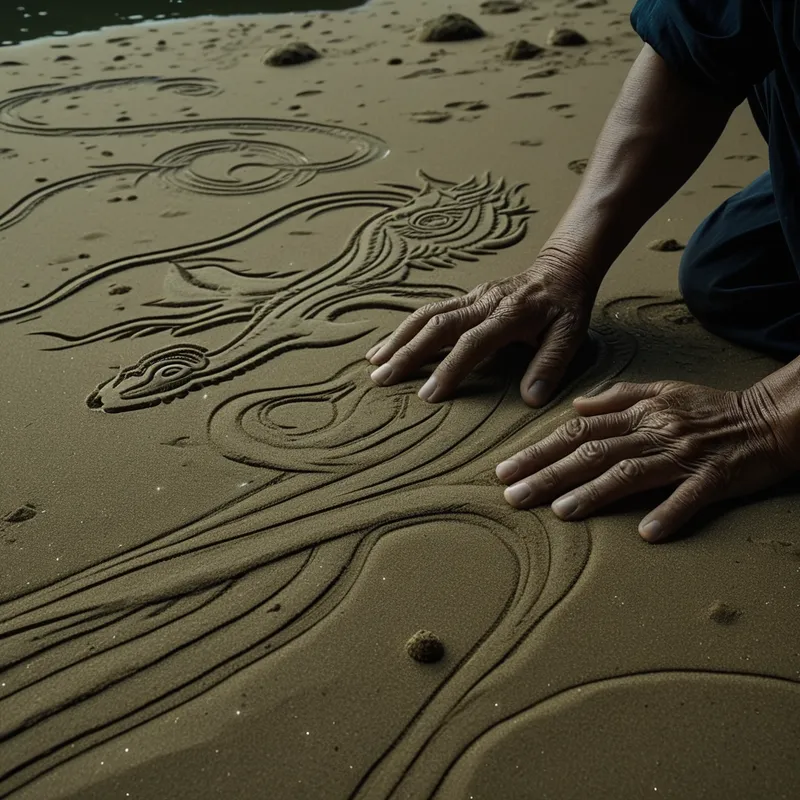
Then, on the eve of the winter solstice, the sky cracked open. From the swirling waters of the Yellow River, a being emerged. It was not a beast, nor a god, but a manifestation of cosmic geometry—a great Tortoise, its carapace a mosaic of perfect squares and circles, inscribed with patterns of dots that danced before Fu Xi’s eyes. Simultaneously, from the heavens descended the Dragon Horse, a creature of wind and cloud, its flanks bearing a different, yet harmonious, set of luminous lines.
Fu Xi did not hear words, but saw a language. On the Tortoise’s shell, he saw three solid lines, stacked: the unyielding power of Heaven. He saw three broken lines: the receptive depth of Earth. And between these poles, he saw the six other possible combinations—three lines, each either solid (yang) or broken (yin). These were the eight primal Trigrams: Heaven, Earth, Thunder, Water, Mountain, Wind, Fire, and Lake. They pulsed with meaning. He saw Thunder as the shock of awakening, Water as the perilous abyss, Fire as clinging illumination, Mountain as stillness and arrest.
In a flash of understanding that was both a gift and a burden, Fu Xi saw these eight symbols begin to move. They paired with one another, one trigram above another, creating not eight, but sixty-four possible six-line figures. This was the moment of revelation. The sixty-four Hexagrams were not invented, but received—a complete, dynamic map of every possible state of being in the universe, from the creative fury of Qian to the consummate peace of Wei Ji. The conflict was the chaos of a world without a key; the resolution was this key itself, etched not in stone, but in the very fabric of reality. Fu Xi descended the mountain, and with his new sight, he began to teach. He showed how the hexagram of Shi governed group action, and how Lu spoke to the soul in exile. The world remained unpredictable, but it was no longer meaningless.
Cultural Origins & Context
The myth of Fu Xi’s revelation anchors the I Ching in a moment of divine-human communion, framing it not as a human invention but as a discovered cosmic law. Historically, the I Ching evolved over centuries, with its core hexagrams and judgments likely coalescing during the Zhou dynasty. It was the province of kings and diviners, used to consult the will of heaven before battles, harvests, and coronations. The myth served a critical societal function: it legitimized the oracle as a sacred technology, a direct line to the Dao. It was passed down by scholar-officials, philosophers like Confucius who reportedly wished for more years to study it, and later by countless generations of literati who saw in its binary code of solid and broken lines a mirror for statecraft, ethics, and the movements of the human heart.
Symbolic Architecture
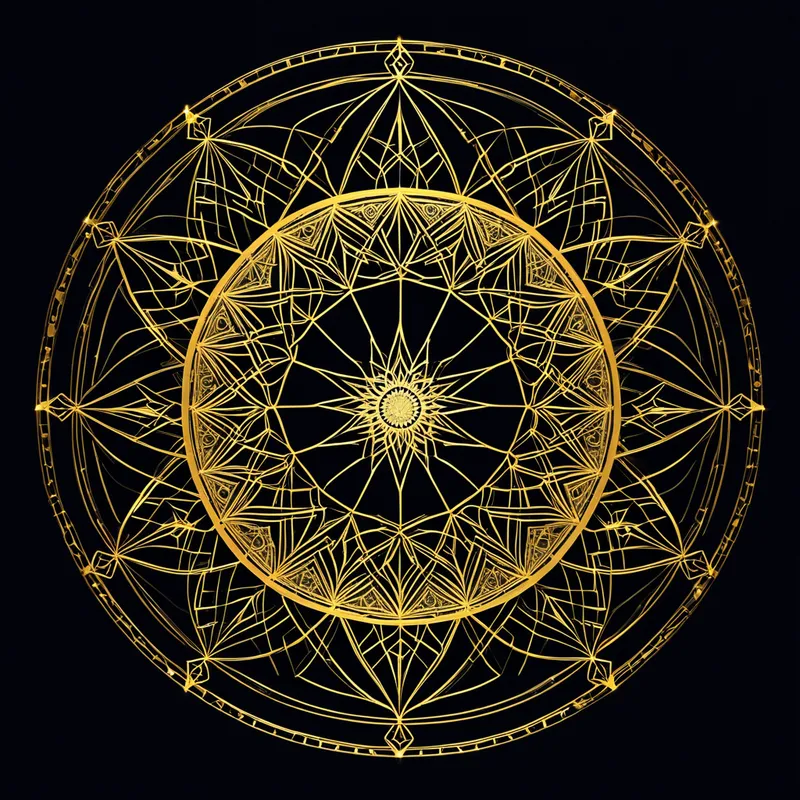
The hexagram is a symbolic architecture of breathtaking elegance. Its six lines are not static but represent a process in time, from the bottom (the beginning) to the top (the culmination). The solid line (yang) is not merely “male” or “active,” but the principle of light, assertion, and focused energy. The broken line (yin) is not merely “female” or “passive,” but the principle of darkness, receptivity, and potential space.
The hexagram is a psychic snapshot, a six-part sentence describing the dynamic relationship between the inner world (the lower trigram) and the outer situation (the upper trigram).
For instance, Hexagram 29, Kan, is Water over Water—a symbol of being surrounded by peril, of plunging into the depths. Psychologically, it represents the encounter with the shadow, with fear, with the chaotic waters of the unconscious. Yet, its judgment advises “truthfulness” and maintaining the heart-mind, suggesting that the way through the abyss is not by avoiding it, but by moving through it with conscious awareness. Each hexagram, therefore, is an archetypal situation, a fundamental pattern of energy interplay that the human psyche can recognize and navigate.
The Dreamer’s Resonance
When the pattern of the I Ching hexagrams appears in modern dreams, it rarely manifests as literal Chinese characters. Instead, one might dream of stark, binary patterns: a ladder with alternating solid and missing rungs; a barcode that shifts and breathes; a city grid where some streets are illuminated and others are dark. This is the psyche signaling a need to decode a complex life situation. The somatic feeling is often one of being at a crossroads, of sensing an underlying order beneath surface confusion.
Such a dream suggests the dreamer is in a process of “consulting the oracle” within. The unconscious is presenting the situation not as a linear story, but as a configuration of forces. A dream of constantly shifting patterns points to a state of bianhua (change), where old structures are dissolving and new ones have not yet cohered. The psyche is working to find the correct “hexagram”—the right symbolic framework—to understand the current moment of their life’s journey.

Alchemical Translation
The I Ching’s core myth models individuation as the lifelong practice of learning to read the hexagram of the present moment. The initial state is Fu Xi’s plight: consciousness faced with a seemingly chaotic, uninterpretable world (the prima materia of experience). The revelation of the trigrams is the awakening to the archetypal patterns that structure reality—the discovery of the collective unconscious itself.
The alchemical work is to hold the tension of the opposites—the solid and the broken, yang and yin—until a third, transcendent meaning (the hexagram’s judgment) emerges to guide action.
The process of casting the oracle—using yarrow stalks or coins to generate a hexagram—is a ritual of engaging the unconscious. It is a deliberate suspension of the ego’s linear planning, an invitation for the deeper Self to arrange the lines. The resulting hexagram and its changing lines provide not a fortune, but a symbolic portrait of the psychic landscape. To integrate its wisdom is to perform an alchemical translation: turning the leaden confusion of a life problem into the gold of deeper self-knowledge and aligned action. The ultimate goal is not to predict the future, but to become, like Fu Xi, a sage who can discern the pattern within the flux, and thus move in harmony with the inexorable, creative flow of the Dao.
Associated Symbols
Explore related symbols from the CaleaDream lexicon: