Hypnos and Thanatos Myth Meaning & Symbolism
The myth of twin brothers Hypnos, god of sleep, and Thanatos, god of death, exploring their shared lineage and the thin veil between oblivion and finality.
The Tale of Hypnos and Thanatos
Listen, and let the veil between worlds grow thin. In the time before memory, in the deep, silent places where even the light of Helios fears to tread, there dwelled two brothers born of the same dark womb. Their mother was Nyx, she who spins the cloak of eternity from the threads of shadow. From her, they inherited the kingdom of endings and the gateways beyond the waking world.
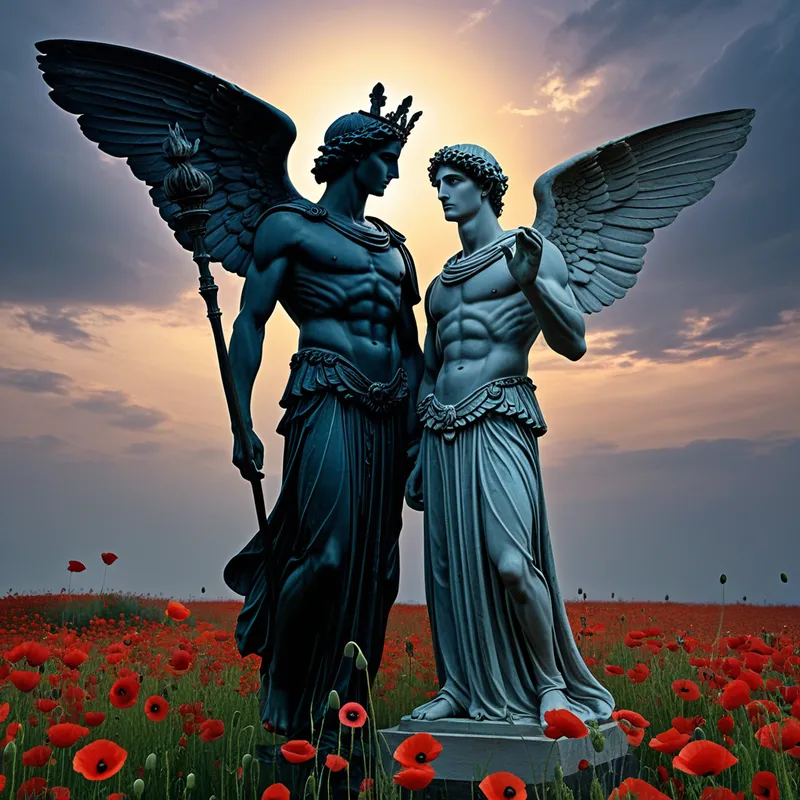
Hypnos, the elder, was a gentle sovereign. His palace was not on glittering Olympus, but in a sunless cave on the forgotten island of Lemnos. Here, the river of forgetfulness, Lethe, whispered as it seeped from the underworld. His couch was draped in the softest darkness, and around him fluttered the Oneiroi, the dream-spirits, his children. With a touch of his wing or a sprinkle of opium from the horn of a river god, he would lower his lids over the eyes of gods and mortals alike, granting respite or sending prophetic visions swirling through the mind’s theater.
But where Hypnos walked, his twin was never far behind. Thanatos, Death incarnate, was of the same essence, yet his touch was final. He was not cruel, but implacable, a bronze-clad figure with wings of a great, silent bird. His symbol was an inverted, extinguished torch. While Hypnos’s gifts were temporary, a loan of oblivion, Thanatos came to collect a soul’s final debt. He was the quiet conclusion to every story, the sculptor who releases the form from the marble of life.
The most famous tale of their intertwining duties is one of conflict and cunning. The hero Sisyphus, king of Corinth, famed for his guile, had cheated death once. When Thanatos came to chain him and lead him to Hades, Sisyphus feigned interest in the heavy manacles. “How do they work?” he asked. As the god of death demonstrated, Sisyphus swiftly trapped him in the chains. With Thanatos bound, no mortal on earth could die. Wars raged without end, the wounded writhed in unending agony, and the natural order crumbled.
The disturbance reached Olympus. Ares, furious that his battles had lost all meaning without the spice of mortality, descended. He found Thanatos, humiliated and imprisoned, and freed him. Together, they marched on Corinth. This time, Sisyphus could not trick the twins. But the cunning king had one last request for his wife: to leave his body unburied and perform no funeral rites. In the underworld, this disrespect gave Sisyphus a plea to Hades—to return to the surface just long enough to chastise his wife. Hades agreed. Sisyphus returned to the sunlight, to his wife, to his throne… and simply refused to go back. He had cheated death a second time.
His final journey was not with Thanatos, but was decreed by the king of the gods himself. For his audacity, his eternal task was not rest, but futile, ceaseless labor—a punishment that forever echoes in the space between the temporary reprieve of sleep and the finality his brother represents.

Cultural Origins & Context
The myth of Hypnos and Thanatos emerges from the earliest layers of Greek cosmogony, recorded most authoritatively in Hesiod’s Theogony. They are primordial deities, born from Nyx alone, placing them among the fundamental forces of the cosmos, older than the Olympians. This lineage is critical; they are not personifications invented by poets but are presented as actual, divine powers that predate and underpin the ordered world.
Their stories were not part of widespread public cult worship like that of Athena or Apollo. Instead, they inhabited the philosophical and poetic imagination. They were invoked in epic poetry, like Homer’s Iliad, where Hypnos is persuaded to lull Zeus to sleep. Their function was explanatory and existential. In a world without the promise of an afterlife paradise for most, the brothers framed the human condition: life is bounded on one side by the daily little death of sleep and on the other by the great, final sleep of death. They gave a face and a narrative to the two most universal, mysterious, and inevitable human experiences.
Symbolic Architecture
Hypnos and Thanatos represent the fundamental duality of release. They are not opposites, but twins—two sides of the same coin of consciousness. Hypnos symbolizes the temporary dissolution of the ego. Each night, the “I” we construct so diligently dissolves into the formless sea of the unconscious. Dreams, his children, are the messages from that deep.
Sleep is the nightly rehearsal for the soul’s final performance. In letting go of the waking self, we practice the ultimate surrender.
Thanatos symbolizes the permanent dissolution of the form. He is the principle of necessary ending, the force that makes room for new life by clearing the old. In psychological terms, he represents not just physical death, but the death of outworn identities, relationships, and stages of life. The myth of Sisyphus is the ego’s desperate, clever, and ultimately futile rebellion against this natural law. His punishment—eternal, conscious toil—is the image of a psyche that refuses all transformation, stuck forever in a cycle of effort without release or meaning.
Their shared mother, Nyx (Night), is the womb of all potential from which differentiated forms emerge and to which they return. The brothers, therefore, are the twin gates of that womb: one revolving, one sealing.

The Dreamer's Resonance
When this myth stirs in the modern psyche, it often manifests in dreams of profound liminality. You may dream of standing at a threshold, of doors that are both entrance and exit. You may encounter a comforting, yet eerily familiar figure who offers a draught of something sweet—the embrace of Hypnos, signaling a deep need for psychic rest, for a retreat from conscious striving to allow unconscious processing.
Conversely, or intertwined, you may dream of a silent, inevitable presence—a figure waiting patiently at the end of a hall, or the closing of a final, heavy door. This is not necessarily a premonition of physical death, but the somatic recognition of a Thanatos process at work within: the ending of a career, the close of a relationship, the death of a long-held self-image. The body in the dream may feel a chilling peace or a resistant terror, mirroring the psyche’s struggle to accept this necessary ending. These dreams ask: What in your life has reached its natural conclusion? What are you being asked to release, so that you may truly rest and be reborn?
Alchemical Translation
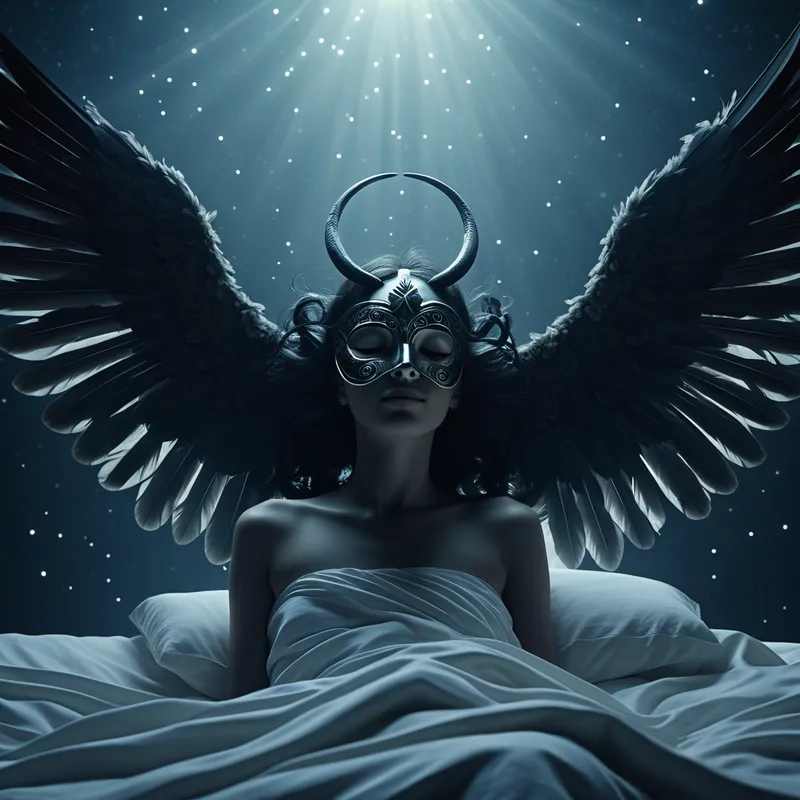
The individuation process, the journey toward psychic wholeness, requires a right relationship with both brothers. The modern seeker must learn the wisdom of Hypnos: the conscious, willing descent into the unconscious. This is active imagination, dream work, meditation—the disciplined practice of temporarily suspending the ego’s tyranny to listen to the deeper Self. It is the “sleep” from which one returns refreshed and re-oriented.
But one must also make peace with Thanatos. Individuation is a series of deaths—the death of the persona, the death of childish dependencies, the death of inflationary fantasies. Each stage of growth requires the sacrifice of the previous stage.
The alchemical gold is forged in the grave of the old lead. To become who we are, we must cease being who we were.
The Sisyphus complex is the neurosis of modern life: the relentless, ego-driven pursuit of goals without integration, without pause, without acceptance of limits or endings. It is burnout masquerading as heroism. The healing is found in the twin embrace: first, to willingly enter the cave of Hypnos (rest, introspection, non-doing), and second, to honor the quiet arrival of Thanatos when an inner chapter ends, allowing it to be sealed with dignity rather than with futile struggle. In their dance, we find the rhythm of a soulful life: the gentle surrender of sleep, the courageous acceptance of endings, and the mysterious space between where transformation is seeded.
Associated Symbols
Explore related symbols from the CaleaDream lexicon: