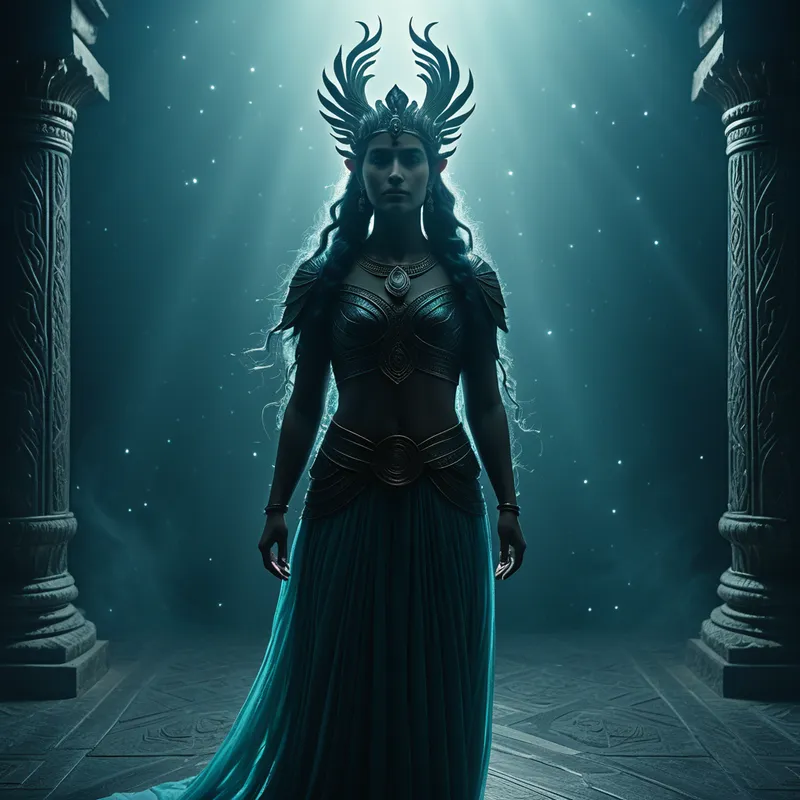
Hun Hunahpu Father of the Hero Twins
The decapitated father of the Maya Hero Twins whose underworld defeat became the catalyst for his sons' epic journey to restore cosmic balance.
The Tale of Hun Hunahpu Father of the Hero Twins
In the green, humming world of the First Dawn, before the true sun had risen, there lived a great lord of the ballcourt, Hun Hunahpu. With his brother, Vucub Hunahpu, he played the sacred game that echoed the movement of stars and the turning of seasons. Their play was thunderous and beautiful, but it was also a profound disturbance. The sound of their bouncing rubber ball, their shouts of triumph, their very vitality, penetrated the silent, stagnant layers of the world below—Xibalba.
The lords of that dark place, One Death and Seven Death, heard this noise from the world above and were incensed. It was an affront to their quiet dominion, a reminder of a life they could not possess. In their jealousy and cunning, they sent a summons, crafted as an invitation to a grand ballgame. It was a trap woven with the threads of pride. Hun Hunahpu and his brother, though wary, could not refuse a challenge to their divine craft. They descended the steep stairs into the underworld, leaving behind the world of light and air.
Their journey was a procession of failures against the deceptive tests of Xibalba. They failed to recognize the carved wooden lords as effigies and greeted them, revealing their ignorance. They were given cigars and torches that were to be kept lit all night, but the Xibalbans had enchanted them to burn out. Defeated by these tricks, the brothers were sentenced to sacrifice. In a dark chamber, they were given the honor they had come for—a ball. But it was not a ball of rubber; it was a blade-sharpened head of stone. In the game that followed, they were defeated and decapitated.
The head of Hun Hunahpu was placed in the fork of a barren calabash tree that stood near the ballcourt of the underworld. And here, the myth turns from death toward a strange, miraculous life. The tree, which had never borne fruit, suddenly swelled and grew. The severed head of the lord became one with the tree, indistinguishable from a round, ripe calabash fruit. It was not a rotting trophy, but a seed of potential.
Word of this wonder reached the ear of a maiden of Xibalba, Lady Blood Moon, daughter of a lord of death. Drawn by curiosity, she approached the miraculous tree. The head of Hun Hunahpu spoke to her, commanding her to stretch out her hand. He spat into her palm. This was no mere spittle, but the vital essence, the seed of life itself. Through this act, he impregnated her with his spirit and his destiny. When the lords of Xibalba discovered her pregnancy, they ordered her sacrifice, but she escaped, fleeing upwards to the world of light, to the house of Hun Hunahpu’s mother.
There, in the world above, she gave birth to twins: Hunahpu and Xbalanque. These were the Hero Twins, conceived in the heart of darkness from the seed of a decapitated father. They grew under the scorn of their half-brothers, Hunbatz and Hunchouen, but their destiny was far greater. They would become master ballplayers, tricksters, and ultimately, avengers. Their entire epic quest—to descend into Xibalba, outwit the lords, avenge their father and uncle, and finally ascend as the sun and the moon—was set in motion by that single, tragic defeat. Hun Hunahpu’s death was not an end, but the necessary planting of a seed. His sacrifice was the womb of their heroic necessity.
Cultural Origins & Context
The story of Hun Hunahpu is central to the Popol Vuh, the K’iche’ Maya “Book of Counsel,” transcribed in the mid-16th century but containing mythology of profound antiquity. He exists in the narrative layer of gods and heroes before the creation of the current, human world. His identity is deeply intertwined with maize agriculture and the cycle of life, death, and regeneration. As a ballplayer, he participates in the central Mesoamerican ritual that re-enacted cosmic struggle, often linked to solar movement and fertility.
Hun Hunahpu is not a solitary figure but part of a generational drama. He is the son of the aged divinities Xpiyacoc and Xmucane, and father to both the failed first set of twins (Hunbatz and Hunchouen, transformed into monkeys) and the triumphant Hero Twins. This places him in the pivotal position of the failed generation, the necessary precursor whose defeat provides the conditions for the heroes’ success. His story reflects a Maya worldview where failure, sacrifice, and death are not finalities but integral, fertile phases in a cosmic process. The ballgame itself was a ritual often culminating in decapitation, symbolizing the harvesting of maize—the head severed like a ripe ear of corn, its seed ensuring future life.
Symbolic Architecture
Hun Hunahpu’s myth is an intricate blueprint of psychic and cosmic processes. He represents the father principle that must be broken for the new consciousness of the sons to emerge. His is not a failure of weakness, but a sacrificial defeat that contains the blueprint for future victory.
His decapitation is not merely a killing; it is a transplantation. The head, the seat of consciousness and identity, is placed in the tree, the axis of life. Consciousness is fused with the vegetative soul, creating a new mode of being—one that is generative rather than merely active.
His story is a profound allegory of the creative act that follows a period of sterility or defeat. The ballgame is the ego’s contest in the world, played by the rules of pride and prowess. Defeat in the underworld is the inevitable consequence when the conscious self encounters the autonomous, shadowy powers of the psyche (the Lords of Xibalba). The ego is “decapitated”—its controlling, singular viewpoint is shattered. Yet, from this shattering, a different kind of potency is released. The spittle that impregnates Lady Blood Moon is the distilled, essential wisdom from the ordeal, a seminal insight that can only be born from the confrontation with death.
The Dreamer's Resonance
To encounter Hun Hunahpu in the inner landscape is to meet the spirit of the sacrificed father, the one whose dreams were cut short to make space for our own. He is the patron of those who feel their efforts have ended in humiliating defeat, their ambitions left rotting in some psychic Xibalba. He speaks to the experience of a life path that seems abruptly terminated—by loss, failure, or trauma—leaving one feeling like a disembodied head, a consciousness severed from its vital connection to the world.
Yet, his myth insists that this very state of rupture is pregnant with potential. The dream of Hun Hunahpu asks: What has been “decapitated” in you? And what miraculous, life-giving fruit might that severed part now bear if tended to, not as a corpse, but as a seed? He represents the painful but necessary transition from being the active hero of one’s own story to becoming the fertile ground for the next generation—whether that be literal children, creative projects, or a renewed phase of the psyche. He is the bridge between the old order that fails and the new order that must be born from its essence.
Alchemical Translation
The alchemy of Hun Hunahpu is the solve et coagula of the father archetype. First, the solve: the dissolution of the intact, playing father into his constituent parts—the head (mind, identity), the body (vitality, action), and the seed (essence, potential). These are violently separated in the underworld crucible.
The spittle is the philosopher’s stone of this myth—the prima materia extracted through immense pressure and humiliation. It is the concentrated elixir of experience, the volatile spirit made tangible, capable of impregnating the void (the maiden of the underworld) to conceive a new, hybrid life.
Then, the coagula: the recombination. The head coagulates with the tree (becoming part of the organic, growing world). The seed coagulates with the maiden’s blood (becoming new life). The father does not return as himself; he is transformed into the condition that makes the Hero Twins possible. His alchemy is one of catalytic sacrifice. He is the lapis that is broken so that the gold of the sons can be manifested. In psychological terms, he is the complex that must be dismantled and its energy redirected for individuation to proceed. His defeat is the nigredo, the blackening, from which the filius philosophorum—the heroic consciousness of the twins—emerges.
Associated Symbols
Explore related symbols from the CaleaDream lexicon:
- Father — The archetypal progenitor whose fate, often one of sacrifice or absence, sets the foundational challenge and destiny for the next generation.
- Sacrifice — A voluntary or enforced offering of a valued part of the self or another, intended to generate a greater power or enable a cosmic transition.
- Rebirth — The emergence of new life, consciousness, or form from a state of dissolution, decay, or symbolic death.
- Seed — The concentrated essence of potential, often planted in darkness, containing the complete pattern for a future form of life or understanding.
- Head — The seat of consciousness, identity, and rationality; its separation from the body signifies a radical shift in being or the harvesting of wisdom.
- Tree — The world axis and connector of realms; a symbol of life, growth, and the bearing of fruit that contains transformative knowledge or spirit.
- Blood — The vital fluid of life and lineage, carrying both the curse of mortality and the power of magical conception and covenant.
- Hero's Journey — The archetypal pattern of departure, initiation, and return, where the hero confronts darkness to win a boon for the renewal of their world.
- Ballgame — The ritual contest representing cosmic struggle, fate, and the cyclical sacrifice required to sustain the order of the world.
- Underworld — The realm of the dead, shadows, and forgotten potentials; a crucible for testing, dissolution, and the paradoxical discovery of life.
- Twin — The symbol of duality, complementary forces, and the psychic pair whose combined efforts are required to navigate a profound challenge.
- Bridge — A structure spanning a chasm; the mediating principle or sacrificed entity that allows passage from an old state of being to a new one.