Hud and the People of Ad Myth Meaning & Symbolism
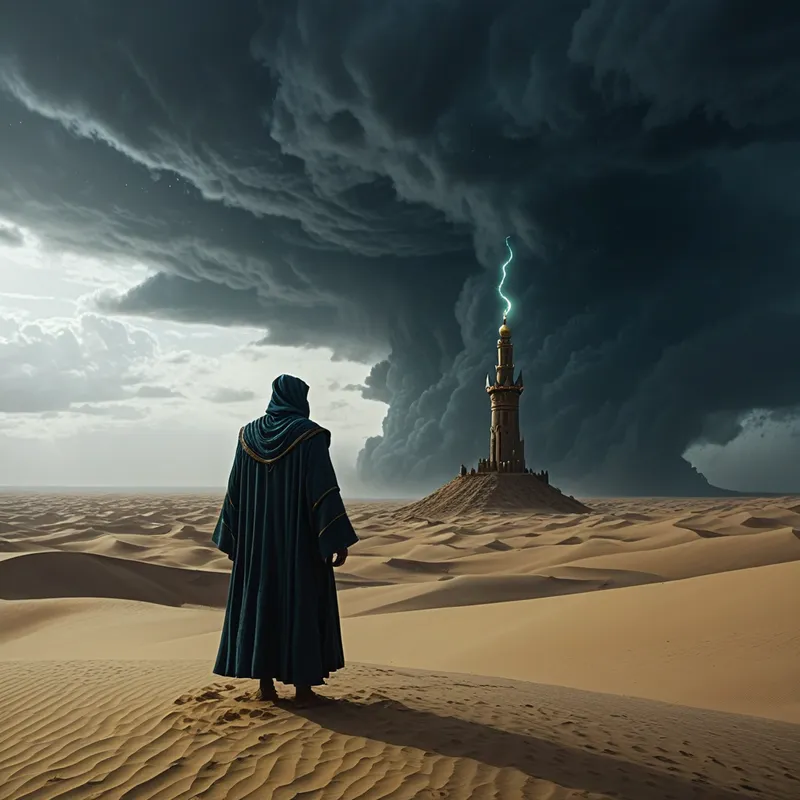
A prophet warns his arrogant, towering people to abandon their false gods, but they scorn him, bringing upon themselves a devastating, purifying wind.
The Tale of Hud and the People of Ad
Listen, and hear the tale whispered on the desert wind, a story etched not in stone, for no stone of that people remains, but in the very breath of the emptiness that followed them.
There was a people, the People of Ad, who dwelled in the land of Al-Ahqaf, a place of dunes that once knew rain. They were not like other men. They were giants in stature and in pride, masters of their world. With mighty hands, they carved mountains into dwellings and raised pillars into the sky, building the fabled, many-columned Iram, a city meant to defy time itself. Their strength was a legend, their wealth a blinding sun. They looked upon their works and saw only their own glory, forgetting the source of all strength.
To them, they worshipped idols carved from stone—Wadd, Suwa', Yaghuth, Ya'uq, and Nasr—believing these silent stones granted them dominion over the earth. The air grew thick with arrogance, a mirage of invincibility that clouded their hearts.
Then, from among them, rose a man named Hud. He was one of their own, yet his eyes saw differently. He did not see pillars reaching for heaven, but souls sinking into earth. He did not hear the clamor of markets, but a profound silence where gratitude should have been. And he was given a message, a clear, piercing truth that cut through the desert haze: "O my people! Worship Allah; you have no deity other than Him. You are but inventors [of falsehood]."
His voice was the first cool wind in a long, parched age. "Remember the blessings poured upon you," he cried. "He made you successors after the people of Nuh and increased you in stature and power. So remember the favors of Allah that you might succeed."
But the People of Ad heard only a challenge to their sovereignty. They mocked him in their great halls. "You have brought us no clear proof," they sneered, their voices echoing off their proud pillars. "We will not abandon our gods on your mere word. We say you are a liar, a fool led astray." They saw his simplicity as poverty, his faith as weakness. "It is all the same to us whether you advise us or not," they said, their hearts hardened like the idols they cherished. "This is but the custom of the ancients, and we are not to be punished."
Hud stood firm, a solitary rock in a sea of scorn. "I call Allah to witness," he declared, "and you too bear witness, that I am free from what you associate with Him. So plot against me all together; then give me no respite. Indeed, I have relied upon Allah, my Lord and your Lord. There is no creature but that He holds its forelock. Truly, my Lord is on a straight path."
The conflict hung in the air, heavier than the desert heat. The people demanded a sign, a punishment if he spoke the truth. And the sign came. The sky, once a clear bowl of blue, began to change. A cloud appeared, small and innocent, rising from the horizon. Seeing it, the people rejoiced, thinking it a bringer of merciful rain to their parched lands. "This is a cloud bringing us rain!" they exclaimed.
But Hud knew its true nature. "Rather, it is that for which you were impatient," he said, his voice grave with a terrible knowing. "A wind, within which is a painful punishment, destined to destroy everything by the command of its Lord."
Then the wind came. It was not a natural wind. It was the Rih Sarsar, a furious, roaring, violent wind. Allah subjected them to a wind screaming and violent, commanded upon them for seven nights and eight days consecutively. You would see the people lying fallen, as if they were hollow trunks of palm trees. So do you see of them any remnant?
It scoured the land with a sound like a thousand thunders. It lifted the mighty and the lowly alike. It did not merely knock down their towering pillars; it erased them, grinding the proud city of Iram into dust, stripping flesh from bone until nothing remained but hollow forms, like the rotten trunks of fallen palm trees. The punishment seized them by the roots of their arrogance.
And Hud, and those few who had heeded his call with him, were taken to safety. They were led away from the place of annihilation, spared by their submission. The prophet and the believers watched from a place of peace as the wind of divine command performed its terrible, purifying work. Then silence returned. A vast, empty silence, where once there had been the clamor of a civilization. Only the shifting sands remained, a grave for giants, a warning for ages to come.
Cultural Origins & Context
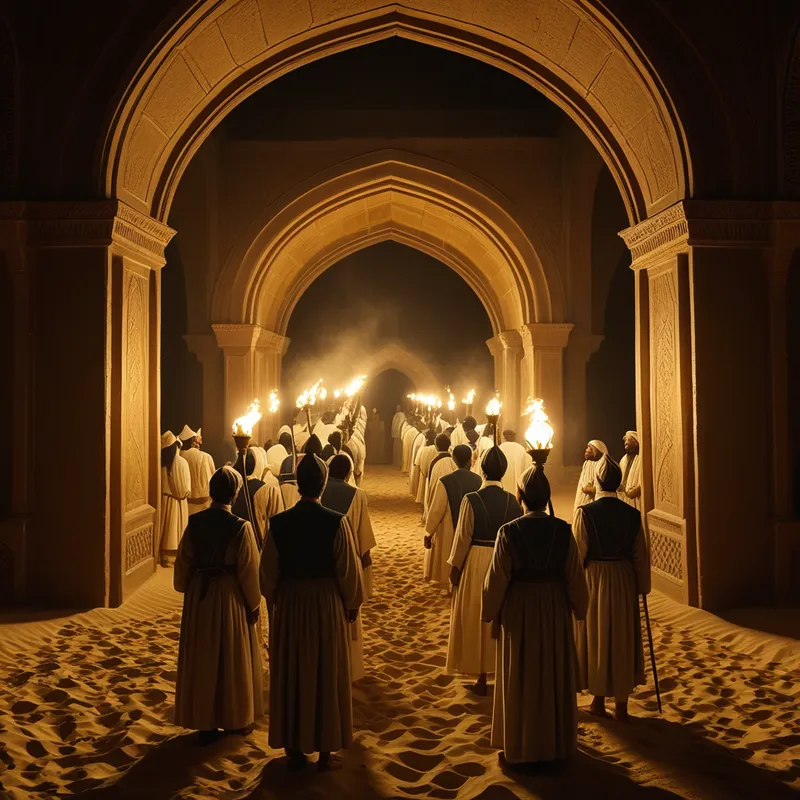
This narrative is primarily preserved and conveyed through the Quran, where the story of Hud is recounted in several chapters as a powerful moral and theological lesson. He is considered one of the line of prophets sent to specific nations before Muhammad. While the Ad are understood within Islamic tradition as an actual historical civilization in southern Arabia, their story has been mythologized into a foundational parable.
The societal function of this myth is multifaceted. It served as a potent proof of Tawhid (monotheism) for the early Muslim community, directly challenging the polytheistic beliefs of pre-Islamic Arabia. It was a story told to illustrate the consequences of shirk (idolatry) and istikbar (arrogance). Furthermore, it functioned as a narrative of comfort and vindication for a persecuted early community; like Hud, they were a minority delivering an unwelcome message to a powerful, entrenched establishment. The myth asserts that temporal power and material grandeur are utterly meaningless before divine truth and moral consequence.
Symbolic Architecture
The myth presents a stark symbolic landscape of psychic inflation and its inevitable, catastrophic correction. The People of Ad represent the ego in a state of identification with its own achievements. Their towering pillars are not just buildings; they are monuments to the ego, attempts to build a permanent identity upon the shifting sands of material prowess and social dominance.
The wind does not argue with the tower; it simply reminds the tower it is made of sand.
Hud symbolizes the neglected voice of the Self—the transcendent, guiding center of the psyche in Jungian terms. He is the call to remember one's source, to acknowledge a reality larger than one's own constructed persona. His message is an invitation to humility (Islam, in its root meaning), which the inflated ego experiences as a deadly insult.
The Rih Sarsar is the archetypal symbol of the necessary catastrophe. Psychologically, it represents the devastating, often painful, process of enantiodromia—where an extreme conscious position inevitably generates its unconscious opposite and collapses under its own weight. The wind is not merely punishment; it is a brutal, purifying return to essence. It strips away all that is non-essential, all the grand identifications, until only the hollow, true form—the potential for a new, grounded being—remains.
The Dreamer's Resonance
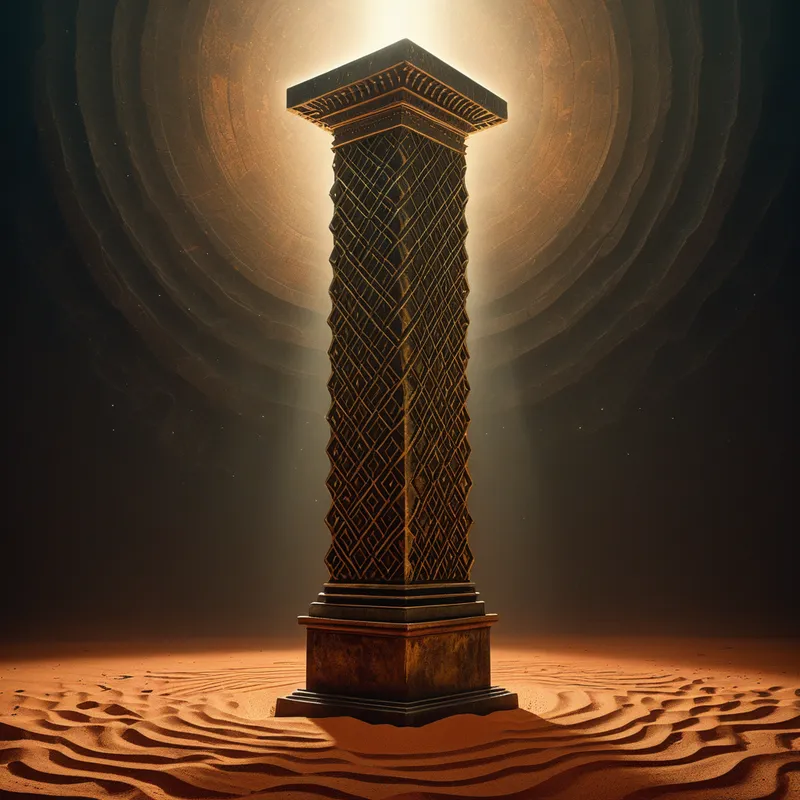
When this myth stirs in the modern dreamer, it often manifests as dreams of profound architectural hubris and sudden, elemental dissolution. One might dream of being in a gleaming, impossibly tall skyscraper of one's own making that begins to crack and sway in a silent wind. Or of trying to shout a warning to a crowd at a lavish, deafening party, but no sound emerges from one's mouth as the walls start to stream with sand.
Somatically, this can correlate with a feeling of unsustainable tension—a "tower" in the shoulders or chest, a rigid pride held at great cost. The psychological process is one of confronting a long-held, grandiose self-image or life structure that has become alienated from the soul's truth. The dream is the unconscious initiating the "wind," the deconstructive process that feels like a personal apocalypse: the loss of a career built on false values, the collapse of a relationship sustained by pride, the crumbling of an identity founded on others' approval. The terror in the dream is the ego's terror of its own annihilation, yet the myth promises that the core self, the "Hud" within, is not destroyed but saved through the storm.

Alchemical Translation
The alchemical journey modeled here is the solve et coagula—dissolve and coagulate—applied to the psyche. The first stage, the reign of Ad, is a failed coagulation: a solid identity has been formed, but it is brittle, arrogant, and based on "false gold" (materialism, pride, idolatry of the persona).
Hud’s call represents the introduction of the solvent, the philosophical truth that begins to destabilize the hardened structure. The ego's violent rejection is a necessary part of the process; the tension must reach its peak for the transformation to be total.
The alchemical vessel is not the towering city, but the hollowed-out self that remains after the storm.
The devastating wind is the solve in its most dramatic form: the complete dissolution of the old, corrupt form. This is the dark night of the soul, the nigredo, where all seems lost. The individual feels scoured, reduced to a hollow trunk. Yet this hollow state is crucial. It is the state of humility and emptiness required for a genuine reception of the Self.
The salvation of Hud and the believers is the promise of the new coagulatio. From the hollow, cleaned vessel, a new consciousness can be born—one that is grounded not in its own pillars, but in submission to a reality greater than itself. The individuation process completes not with the building of a taller tower, but with the quiet, resilient integrity of one who has weathered the wind and knows what is truly unshakable.
Associated Symbols
Explore related symbols from the CaleaDream lexicon:
- Tower — The grandiose, rigid structure of the ego built by the People of Ad, representing ambition divorced from spirit and destined for a fall.
- Wind — The purifying, destructive force of divine command or psychic truth that scours away all that is false and inflated.
- Sand — The shifting, insubstantial foundation upon which arrogance is built, and the agent of its eventual erosion and burial.
- Prophet — The inner voice of conscience and the Self, delivering an unwelcome but necessary truth to the dominant conscious attitude.
- Stone — The hardened heart of the people and the false, lifeless idols they worship, symbolizing spiritual petrification.
- Pride — The core sin of the Adites, the inflation of the ego that severs connection to the source and invites catastrophe.
- Destruction — The necessary, apocalyptic deconstruction of a corrupt psychic system, making way for potential renewal.
- Thunder — The terrifying sound of the approaching divine judgment or unconscious correction, heralding the end of an era.
- Mountain — The raw, unshaped material the Adites arrogantly carve into dwellings, representing nature subjugated by hubris.
- Desert — The landscape of aridity and testing, both the physical setting and the spiritual emptiness resulting from idolatry.
- Warning — The core function of Hud's message, representing the psyche's attempt to self-correct before a more violent enantiodromia occurs.
- Grief — The inevitable emotional consequence for the believer (Hud) who witnesses the necessary destruction of his people and their world.