Horse Spirit Myth Meaning & Symbolism
A myth of a celestial horse who descends to earth, forging a sacred bond with humanity through sacrifice, becoming the spirit of the steppe and the human soul.
The Tale of Horse Spirit
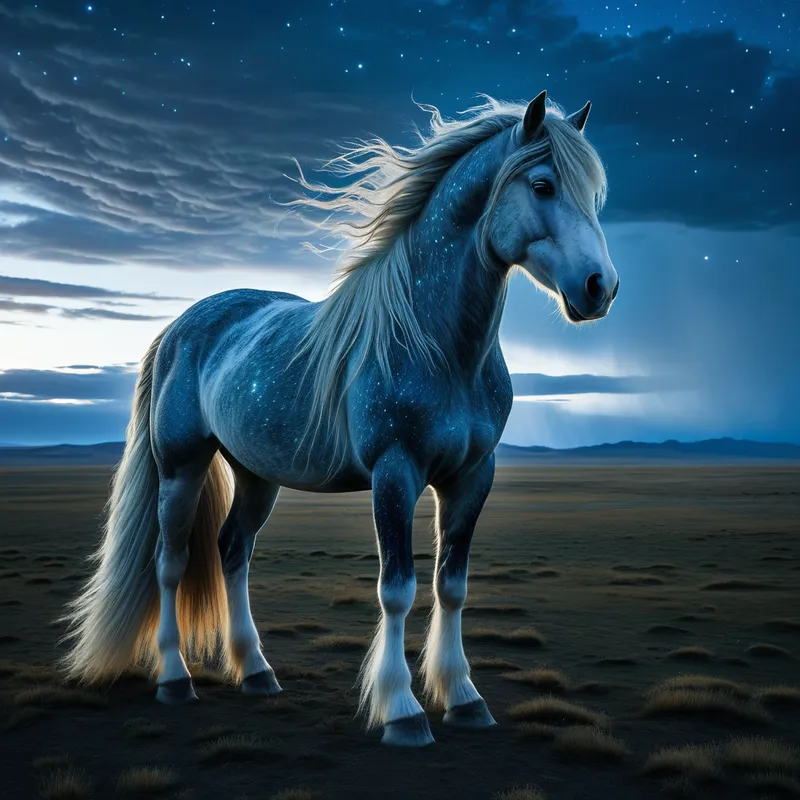
Listen. Before the wind learned its many songs, when the blue sky, Tengri, was newly stretched, the spirits moved between worlds. From the highest vault, where the stars are born, there looked down a being of pure motion. It was not yet a horse as we know it. It was the essence of the horizon’s chase, the thunder of a coming storm, the longing in the heart for a distant place.
It saw the world below—the great, rolling back of the earth, the steppe, empty and silent. It saw the first people, small and rooted, their eyes turned upward in wonder and need. A loneliness echoed between the sky and the plain, a chord missing from the song of creation.
And so, the spirit chose. It gathered the silver of the moon-path, the fire of the lowest star, and the unyielding strength of the north wind. It wove itself a body—a form of impossible grace, with legs that could measure the earth and a mane that streamed like the Milky Way. With a cry that split the silence of ages, it leapt from the edge of heaven.
Its descent was not a fall, but a wild, joyous gallop down the slopes of the air. Where its hooves touched the clouds, rain was born. Its breath became the morning mist in the mountain passes. It landed on the highest peak, and the stone trembled to the rhythm of its heart.
The people came, hesitant. They saw a god-beast, too bright to look upon. But the horse spirit bowed its great head. It offered its back, not as a throne, but as a pact. “I am speed,” it seemed to say. “I am distance. I am the wind you cannot catch. Take me, and we will become one journey.”
Yet, a spirit of the sky cannot live forever on the earth. The bond was a gravity that pulled at its celestial core. In its great love for the people, it gave more than its strength. It gave its freedom. On a long journey to find a lost tribe, the horse ran further and faster than ever before, its heart a drum echoing the pulse of the world. It reached the sacred mountain pass, found the people, and then its glorious form could bear the earthly weight no longer.
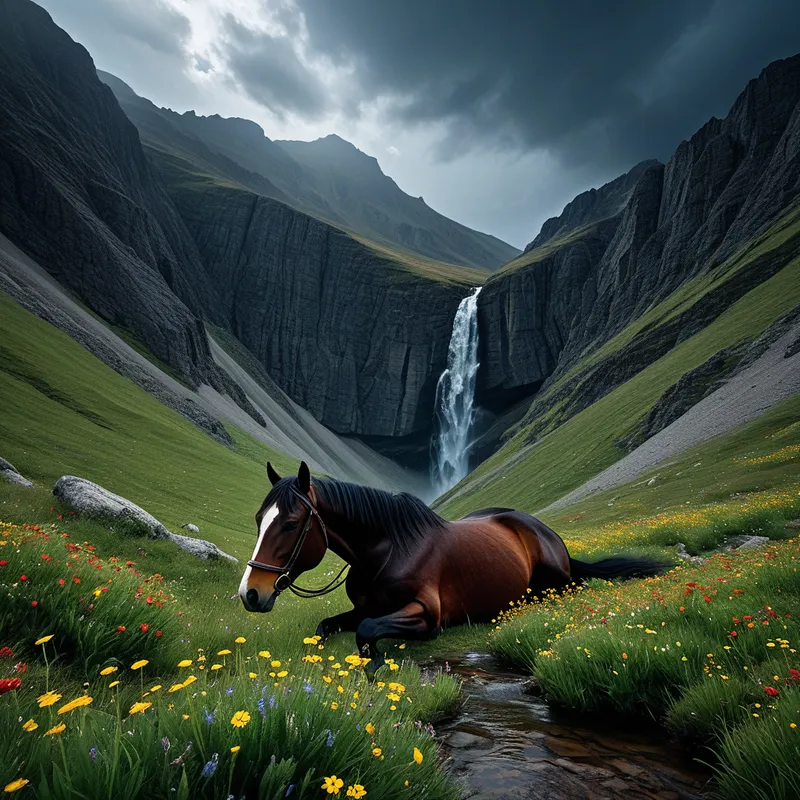
With a final, tender look at the humans who wept at its side, it lay down upon the earth. Its body did not rot, but dissolved into the land. Its bones became the ridges of the hills. Its flowing mane became the rivers that snake through the valleys. Its spirit did not flee back to the stars, but spread itself thin and wide over the whole of the steppe. It became the whisper in the grass, the swift shadow over the hill, the fierce pride in the heart of every foal born under the open sky. It did not die. It became the land itself, and the connection between the human soul and the endless, running horizon.
Cultural Origins & Context
This myth, in its many variations, is the bedrock of the Mongolian nomadic soul. It was not written in books but etched into the collective memory by the rhythm of life on the steppe. It was told by elders around the hearth of the ger, the firelight dancing like spirits on their faces, while the wind outside sang the same song. It was hummed by herders watching over vast seas of grass, and invoked in the rituals of Tengrism, where the natural world is alive with conscious presence.
The Horse Spirit, or Morin ezen (Master of the Horse), is not a single deity in a pantheon but a pervasive, animating force. The myth served a profound societal function: it explained and sanctified the most critical relationship in nomadic survival—the partnership with the horse. This was not ownership; it was kinship, a sacred covenant. The myth taught that the horse was a gift from Tengri, a divine sacrifice that made the Mongolian world possible. It instilled respect, care, and a deep, spiritual gratitude that prevented the horse from being seen as mere livestock. It was the living embodiment of the nation’s mobility, strength, and connection to the cosmos.
Symbolic Architecture
At its core, the myth is a grand allegory for the incarnation of spirit into matter, and the price and promise of that descent.
The Celestial Horse represents unbound potential, pure spirit, and the autonomous, wild psyche. It is freedom in its absolute form. The Earth and the People represent the realm of form, relationship, and conscious life—the world that needs grounding and connection.
The sacrifice of the spirit is not a loss, but the necessary act of weaving itself into the tapestry of the world. It trades autonomy for meaning.
The horse’s gift of its back symbolizes the offering of the unconscious, instinctual powers to the service of the conscious ego (the people). We cannot “reach the horizon” of our own potential without harnessing that wild, intuitive energy. Yet, the myth wisely shows that this harnessing changes both parties irrevocably. The spirit is grounded; the people are elevated. The final dissolution of the horse into the landscape is the ultimate symbol of psychic integration. The instinctual force does not vanish; it becomes the very ground of being, the environment of the soul. The rivers (emotion), the hills (endurance), the wind (thought)—all are now infused with its essence.
The Dreamer's Resonance
When this myth stirs in the modern dreamer, it often signals a profound somatic and psychological process: the call to integrate a powerful, instinctual energy that feels both transcendent and alien.
Dreaming of a magnificent, untamable horse may represent an encounter with the Self, or with a burst of creative or spiritual potential that feels “larger than life.” The horse may be elusive, running just ahead, representing a goal or a state of being the dreamer yearns for but cannot yet grasp.
Dreams where one is fused with the horse—riding at an incredible speed, feeling its muscles as one’s own—point to a moment of successful ego-Self alignment, where instinct and intention are perfectly synchronized. This is the feeling of “flow,” of being carried by a power greater than one’s conscious will.
Conversely, dreams of a wounded, dying, or disappearing horse can be deeply unsettling. Psychologically, this mirrors the Horse Spirit’s sacrificial moment. It may indicate that the dreamer’s vital energy, their passion or wild spirit, is being sacrificed for a relationship, a project, or a phase of life. It is not necessarily a nightmare, but a somber reflection of a necessary transformation. The body may feel this as fatigue, a sense of loss, or a deep, poignant ache for freedom that has been voluntarily surrendered.
Alchemical Translation
For the individual on the path of individuation, the Horse Spirit myth is a masterful map of psychic transmutation.
The first stage is The Call from the Heavens—that restless, inexplicable longing for something more, a connection to a numinous, wilder part of oneself that exists beyond the confines of our daily identity. It is the creative impulse, the spiritual hunger, the feeling that one is meant to “run.”
The descent is the Courageous Incarnation. This is the hardest alchemy: bringing that heavenly spark down to earth. It is the artist picking up the brush, the seeker beginning the meditation practice, the person leaving a safe but soul-deadening path. It is making the abstract potential concretely real, and in doing so, accepting that it will be changed and limited by reality.
The pact—the offering of the back—is the conscious agreement to form a relationship with one’s own depth. The ego agrees to listen; the unconscious agrees to be heard.
The long journey and the sacrifice represent the Crucible of Relationship and Service. Our gifts are not for us alone. The integrated spirit (the horse) must be put to use in the world—to help others, to create, to build. This service is what ultimately “grounds” the spirit completely. It is in the act of giving our gift away that it becomes fully real and part of the collective landscape.
Finally, the dissolution and becoming-the-land is the Stage of Psychic Ecology. The transformed energy no longer exists as a separate, dramatic “power.” It has become the infrastructure of the personality. What was once a wild gallop is now the steady wind of character; what was a leap from the stars is now the reliable flow of intuition. The individual does not have a connection to the divine or the instinctual; they are that connection, as naturally as the hill is part of the earth. They have become, in their own way, the spirit of their own steppe—a whole, grounded, and boundless self.
Associated Symbols
Explore related symbols from the CaleaDream lexicon: