Horn of Plenty Myth Meaning & Symbolism
The myth of the mead of poetry, a divine elixir born from a god's sacrifice, symbolizing the hard-won wisdom that flows into the world as inspiration.
The Tale of the Horn of Plenty
Listen, and hear the tale not of a horn that spills fruit, but of one that overflows with the very mead of creation itself. It begins not with a harvest, but with a truce. The war between the tribes of gods, the Æsir and the Vanir, had ground to a weary halt. To seal their peace, they spat into a vast vat. From that mingled spittle, born of oath and exhaustion, they fashioned a being of surpassing wisdom: Kvasir. He wandered the nine worlds, and no question posed to him went unanswered. His wisdom was a clear, deep well from which all could drink.
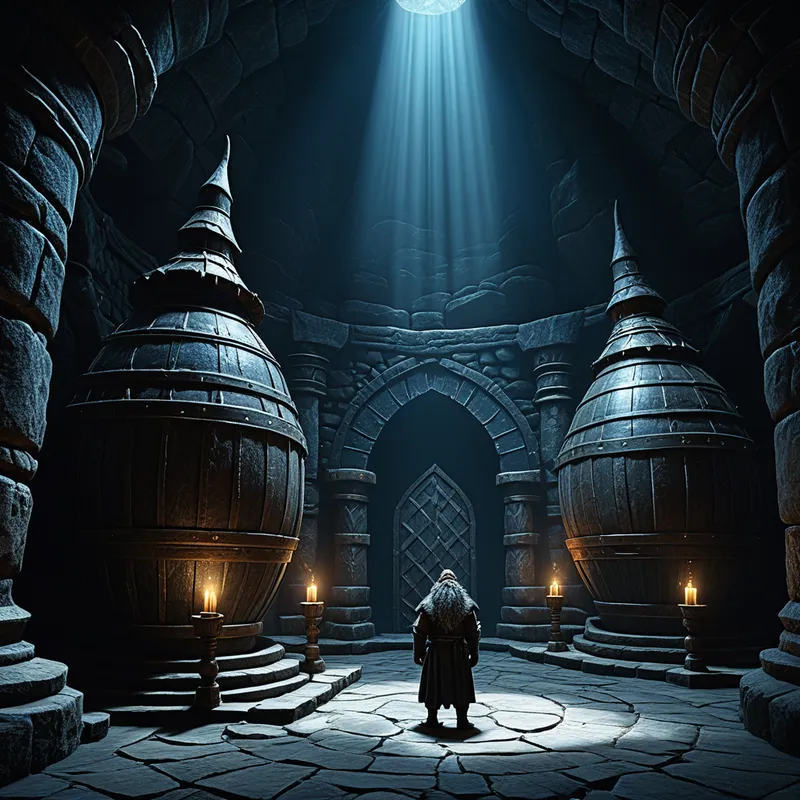
But in the shadowed places of the world, where stone gnaws at the roots of mountains, dwelled the dwarves Fjalar and Gjalar. Their hearts were caverns of envy and cunning. They invited Kvasir into their deep-delved halls, and with false courtesy, they slew him. They did not bury him. They brewed him. They drained his blood into three great vats—Óðrœrir, Bodn, and Són—and mixed it with honey. Thus was born the Mead of Poetry, a liquor so potent that whoever drank it would become a skald or a sage.
The dwarves’ treachery spiraled. They drowned a giant, Gilling, and his wife’s wailing drove them to murder her too. Their crime called for a reckoning. Suttungr, the son of the slain, seized the dwarves and threatened to maroon them on a reef to drown. To buy their lives, they surrendered their precious, stolen mead. Suttungr carried it deep into the heart of the mountain Hnitbjörg, and set his daughter, Gunnlöð, to guard it.
Yet a thirst greater than any giant’s stirred in the heavens. Odin, the seeker, the sacrificer, heard whispers of this mead. He would have it. Donning a disguise, he traveled to the world of men and tricked the brothers of a slain farmhand into killing each other for his favor. He then took the form of a serpent and slithered through a tiny bore-hole drilled by a thrall, deep into the mountain’s stone heart. For three nights, he lay with Gunnlöð in that dark chamber, and for his companionship, she granted him three draughts from the vats.
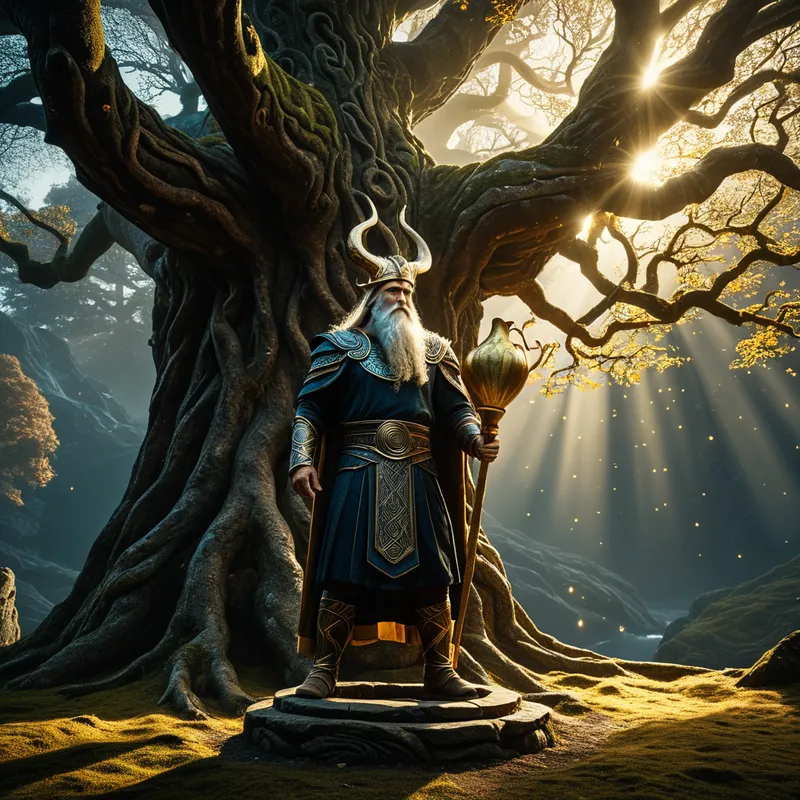
Odin did not sip. He drank. In three immense gulps, he consumed all the mead of poetry. Transforming into an eagle, he burst from the mountain, the stolen wisdom a raging fire in his gut. Suttungr, in eagle-form, gave furious chase across the sky. As Odin neared the walls of Asgard, the gods saw him coming and set out great vats. Odin, straining, spewed the mead into the vessels. But in his frantic haste, some drops fell backwards, out into the world of men. That is the poets’ portion, scattered and haphazard. The rest, the true Óðrœrir, was secured in the god’s hall. And from it, Odin now dispenses inspiration—the true Horn of Plenty—to gods and chosen mortals alike.
Cultural Origins & Context
This myth, primarily preserved in the Prose Edda by Snorri Sturluson, is not a simple folktale of abundance. It is a foundational narrative about the origin of cultural capital itself: poetry, wisdom, and inspired speech (óðr). In the harsh, honor-based society of the Norse, the skald (poet) held immense power, capable of immortalizing a king or destroying a reputation with a well-crafted verse. This myth provided a divine etiology for that power.
The story was likely told in halls by skalds themselves, a form of mythological credentialing. By invoking this tale, the poet was implicitly claiming to partake in Odin’s hard-won gift, to have tasted the mead that fell to Midgard. It framed inspiration not as a gentle muse, but as something seized through sacrifice, cunning, and peril—a fitting metaphor for the Viking Age ethos. The myth also reflects the complex relationship between the gods (Æsir), the dwarves (master crafters and amoral hoarders), and the giants (chaotic forces of nature), illustrating how cosmic order extracts its most precious resources from a cycle of violence, betrayal, and transformation.
Symbolic Architecture
At its core, the myth maps the alchemical journey of wisdom from raw, unconscious potential into a distilled, conscious resource. Kvasir, born from a truce, represents potential unity and pure, unintegrated knowledge. His murder is the necessary "death" of this potential—the idea must be broken down, sacrificed, to be transformed into something usable.
The mead is not found in the light; it is brewed in the dark vats of betrayal and processed through the gut of experience.
The three vats (Óðrœrir, Bodn, Són) symbolize the stages of this transformation: excitation, deepening, and integration. Odin’s role is that of the psychopomp, the one who willingly descends into the underworld of the unconscious (the mountain, the giant’s domain) to retrieve the treasure. His seduction of Gunnlöð is not mere trickery but a symbolic union with the guardian of the treasure, the anima figure who holds the key to the deep self. His flight and regurgitation represent the brutal, often inelegant, process of bringing unconscious content (the mead) into the light of consciousness (Asgard).
The Dreamer's Resonance
When this myth stirs in the modern psyche, it may manifest in dreams of consuming potent, forbidden liquids; of being chased after stealing something precious; or of transforming into a bird to escape a confined, rocky place. Somatically, one might feel a burning in the gut or a constriction in the throat upon waking.
These dreams often signal a profound psychological process: the assimilation of a hard-won insight. The "mead" is a piece of self-knowledge or creative inspiration that has cost the dreamer dearly—perhaps requiring the "death" of an old self-concept (Kvasir) or a perilous journey into shadowy, repressed aspects of the psyche (the mountain). The chase by the giant (Suttungr) represents the ego’s resistance or the looming consequences of integrating this powerful new content. The dream is the psyche’s dramatization of the theft, flight, and eventual, messy containment of a transformative truth.

Alchemical Translation
For the individual on the path of individuation, the Horn of Plenty myth is a master narrative of psychic transmutation. The first step is the recognition of one’s own "spittle of truce"—the conflicted, mingled aspects of the self that, when acknowledged, can give birth to an inner Kvasir, a nascent, holistic wisdom.
Individuation demands the dwarf-work: the shadowy, often "treacherous" parts of ourselves must be allowed to dismantle this naive wholeness to distill its essence.
The hero’s journey is internalized. One must become Odin: the part of the self willing to engage in cunning, to drill into the mountain of one’s own defenses (Hnitbjörg), and to relate to the inner guardian (the Gunnlöð complex, often a feeling-toned cluster of memories or emotions that holds a key). The drinking of the mead is the courageous, even greedy, act of fully owning this insight. The flight and regurgitation are the critical, often difficult, phase of bringing this raw, internal wisdom into one’s life in a usable form—creating art, making a decision, changing a pattern. The spilled drops are the imperfect, shared expressions of this process. The secured vat in Asgard is the ego’s strengthened capacity to hold and consciously dispense this hard-earned wisdom, becoming a true horn of plenty for the integrated self.
Associated Symbols
Explore related symbols from the CaleaDream lexicon: