Holy Spirit as Tongues of Fire Myth Meaning & Symbolism
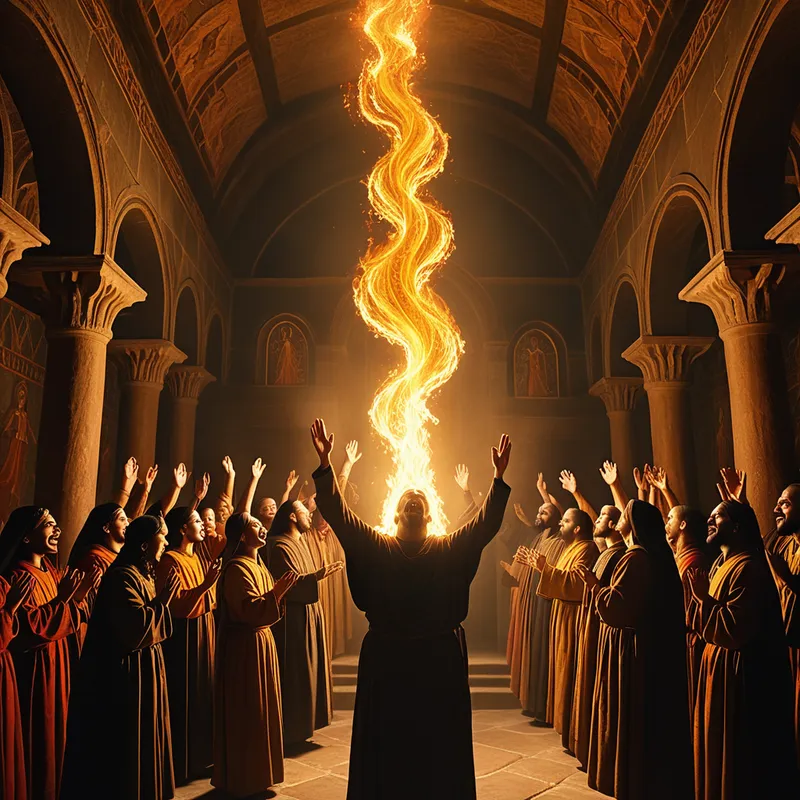
Apostles are visited by a rushing wind and tongues of fire, igniting them with divine speech and birthing a new spiritual community.
The Tale of Holy Spirit as Tongues of Fire
Listen. [The world](/myths/the-world “Myth from Tarot culture.”/) held its breath.
Fifty days had passed since the unthinkable—since [the earth](/myths/the-earth “Myth from Hindu culture.”/) had shaken and a tomb stood empty. The followers of the crucified rabbi were huddled together, a flock of frightened sparrows, in an [upper room](/myths/upper-room “Myth from Biblical culture.”/) in [Jerusalem](/myths/jerusalem “Myth from Biblical culture.”/). The air was thick with memory—of betrayal, of agony, of a fragile, dawning hope they dared not name. They were waiting, but for what, they could not say. The teacher had spoken of a Paraclete, a promise from the Father. It was a word, a whisper. It was not enough to fill the cavern of their fear.
Then, the sound began.
It did not come from the street or [the sky](/myths/the-sky “Myth from Persian culture.”/). It came from everywhere at once—a roar like a mighty, rushing wind that filled the entire house. It was not a wind that touched the skin, but one that vibrated in the bones, that swept through the chambers of the heart. The very stones of the room seemed to hum. And as the sound crescendoed, the light changed.
It descended from the unseen. Not a single pillar of fire, but divided tongues, as of fire. Each one a living, dancing spear of light and warmth. They rested, one upon each person gathered there. The flame did not consume; it crowned. It did not burn hair or cloth; it ignited something else entirely. A heat spread from [the crown](/myths/the-crown “Myth from Various culture.”/) of the head down into the chest, into the belly—a liquid, golden warmth that dissolved the knot of fear.
And they began to speak.
But not in the familiar, guttural Aramaic of home. Words, melodies, praises, and proclamations poured forth in languages they had never learned. The sound was a cascade, a waterfall of human utterance. Compelled, driven by the fire upon them, they spilled out into the streets.
A crowd gathered, pilgrims from every corner of the empire—Parthians, Libyans, visitors from Rome itself. And each one heard the wonders of God declared in their own native tongue. Some were amazed. Others, clutching at the familiar, sneered. “They are filled with new wine,” they muttered.
But [Peter](/myths/peter “Myth from Biblical culture.”/), standing with the fire still gleaming in his eyes, lifted his voice. “These are not drunk, as you suppose. This is what was spoken by the prophet Joel: ‘In the last days, I will pour out my Spirit on all flesh.’” The tongue of fire had become a tongue of testimony. The frightened flock had become fearless heralds. The waiting was over. The speaking had begun.
Cultural Origins & Context
This narrative is the foundational myth of the [Pentecost](/myths/pentecost “Myth from Christian culture.”/), found in the second chapter of the Acts of the Apostles in the Christian New Testament. Its setting is deeply Jewish, occurring during the pilgrimage feast of Shavuot. The author, traditionally Luke, writes for an early Christian community likely grappling with its identity: was it a Jewish sect or a new, universal movement?
The story functions as a decisive answer. The giving of [the Law](/myths/the-law “Myth from Biblical culture.”/) (Torah) at Sinai was accompanied by thunder and fire (Exodus 19-20). Here, at Pentecost, a new covenant is inaugurated with wind and fire, not carved on stone but written on human hearts. The miracle of tongues reverses the curse of Babel—where prideful unity led to fractured communication. Here, humble, gathered diversity experiences a spiritual unity that transcends and honors linguistic difference. It was a myth told to explain the explosive, cross-cultural missionary zeal of the early church and to authorize its radical claim: the Spirit of God was now democratically available to all, not just prophets and kings.
Symbolic Architecture
The myth’s power lies in its potent [triad](/symbols/triad “Symbol: A grouping of three representing spiritual unity, divine completeness, and cosmic balance across many traditions.”/) of symbols: Wind, Fire, and [Tongue](/symbols/tongue “Symbol: Represents communication, self-expression, and the power of words.”/).
The Wind ([Pneuma](/myths/pneuma “Myth from Greek culture.”/)) is the invisible, animating force. It is the [breath](/symbols/breath “Symbol: Breath symbolizes life, vitality, and the connection between the physical and spiritual realms.”/) of [life](/symbols/life “Symbol: The symbol of ‘Life’ represents a journey of growth, interconnectedness, and existential meaning, encompassing both the joys and challenges that define human experience.”/) from Genesis become a [hurricane](/symbols/hurricane “Symbol: A hurricane symbolizes overwhelming chaos, transformation, and the inevitable forces of nature impacting one’s life.”/) of spiritual [presence](/symbols/presence “Symbol: Presence in dreams often signifies awareness or acknowledgment of something significant in one’s life.”/). It represents the uncontrollable, pervasive [nature](/symbols/nature “Symbol: Nature symbolizes growth, connectivity, and the primal forces of existence.”/) of the divine [impulse](/symbols/impulse “Symbol: A sudden, powerful urge or drive that arises without conscious deliberation, often linked to primal instincts or emotional surges.”/) that fills all available [space](/symbols/space “Symbol: Dreaming of ‘Space’ often symbolizes the vastness of potential, personal freedom, or feelings of isolation and exploration in one’s life.”/)—especially the inner space of the [human](/symbols/human “Symbol: The symbol of a human represents individuality, complexity of emotions, and social relationships.”/) [soul](/symbols/soul “Symbol: The soul represents the essence of a person, encompassing their spirit, identity, and connection to the universe.”/).
The Fire is the visible, transformative signature. Fire purifies, illuminates, and energizes. As non-consuming flames, these tongues symbolize a divine [energy](/symbols/energy “Symbol: Energy symbolizes vitality, motivation, and the drive that fuels actions and ambitions.”/) that empowers without destroying the essential self. It is the light of understanding and the heat of [passion](/symbols/passion “Symbol: Intense emotional or physical desire, often linked to love, creativity, or purpose. Represents life force and deep engagement.”/) descending upon the individual mind, the caput or head, the seat of intellect and [identity](/symbols/identity “Symbol: Identity represents the sense of self, encompassing personal beliefs, cultural background, and social roles.”/).
The Tongue of Fire is the alchemical wedding of illumination and expression; the moment understanding becomes proclamation, and inner truth demands an outer voice.
The Tongue is the [organ](/symbols/organ “Symbol: An organ symbolizes vital aspects of life and health, often representing one’s emotional or physical state.”/) of the [word](/symbols/word “Symbol: Words in dreams often represent communication, expression, and the power of language in shaping our realities.”/) made flesh—or in this [case](/symbols/case “Symbol: A case often signifies containment, protection of personal matters, and the need for organization in one’s life.”/), made fire. It symbolizes communication, but of a sacred, inspired kind. This is not [the ego](/myths/the-ego “Myth from Jungian culture.”/)’s speech of [defense](/symbols/defense “Symbol: A protective mechanism or barrier against perceived threats, representing boundaries, security, and resistance to external or internal challenges.”/) or [strategy](/symbols/strategy “Symbol: A plan of action designed to achieve a long-term or overall aim, often involving competition, resource management, and foresight.”/). It is glossolalia—speech emerging from the [depths](/symbols/depths “Symbol: Represents the subconscious, hidden emotions, or foundational aspects of the self, often linked to primal fears or profound truths.”/), bypassing the conscious censor. It represents the [ability](/symbols/ability “Symbol: In dreams, ‘ability’ often denotes a recognition of skills or potential that one possesses, whether acknowledged or suppressed.”/) to communicate the [heart](/symbols/heart “Symbol: The heart symbolizes love, emotion, and the core of one’s existence, representing deep connections with others and self.”/)’s [truth](/symbols/truth “Symbol: Truth represents authenticity, honesty, and the quest for knowledge beyond mere appearances.”/) in a way that bridges profound divides, speaking to the “[native](/symbols/native “Symbol: The term ‘native’ represents an intrinsic connection to one’s heritage or origin, often symbolizing identity and belonging.”/) [language](/symbols/language “Symbol: Language symbolizes communication, understanding, and the complexities of expressing thoughts and emotions.”/)” of another’s deepest need.
Psychologically, the trio represents the full circuit of inspiration: the unconscious drive (Wind) rises, is shaped into conscious [insight](/symbols/insight “Symbol: A sudden, deep understanding of a complex situation or truth, often arriving unexpectedly and illuminating hidden connections.”/) and passion (Fire upon the head), and must ultimately be expressed and related to the world (Tongue).
The Dreamer’s Resonance
To dream of tongues of fire is to dream of a psychic ignition. It often appears during periods of intense intellectual [ferment](/myths/ferment “Myth from Alchemical culture.”/) or on the cusp of a breakthrough that requires courageous expression.
The somatic sensation in such a dream might be a surprising warmth at the crown of the head, a feeling of being “lit up” or “on fire” with an idea, or a pressure in the throat (Vishuddha chakra) as if words are struggling to be born. The dreamer may find themselves speaking fluently in a forgotten or fantastical language, symbolizing the emergence of content from a pre-verbal layer of the [psyche](/myths/psyche “Myth from Greek culture.”/)—the personal or collective unconscious offering a message the conscious mind has not yet formulated.
This dream pattern signals a “Pentecost of [the Self](/myths/the-self “Myth from Jungian culture.”/).” The disparate, often conflicted, internal “crowd” of one’s subpersonalities (the inner critic, [the child](/myths/the-child “Myth from Alchemy culture.”/), the sage) is being visited by a unifying, animating spirit. The conflict is the ego’s resistance to this new, overwhelming energy. The resolution is the surrender to inspired speech—perhaps through creative work, a difficult conversation, or finally giving voice to a long-held truth. The dream cautions against the “drunkenness” of misinterpreting this powerful influx as mere personal euphoria or mania, and calls for the “Peter” within to stand and interpret its meaning responsibly to the world.

Alchemical Translation
The Pentecost myth is a perfect map for the alchemical stage of Albedo, following the dissolution ([Nigredo](/myths/nigredo “Myth from Alchemical culture.”/)) of the old, fixed identity represented by the disciples’ despair after the crucifixion.
The process begins in the sealed vessel—the upper room. This is the introverted state of contemplation, of holding one’s confusion and hope in a contained space. The rushing wind is the influx of the collective unconscious, breaking into the sterile isolation of the ego. The fire is the individuation impulse itself, the Self, descending to claim and empower each distinct aspect of the personality.
The miracle is not that all spoke one language, but that the One Spirit found expression through all languages. Individuation is not about becoming the same as everyone else, but about becoming uniquely capable of articulating the universal in your own native tongue.
The “speaking in other tongues” is the alchemical goal: the [Lapis Philosophorum](/myths/lapis-philosophorum “Myth from Alchemical culture.”/). It is the integrated psyche’s new capacity. The ego, now in service to the Self, becomes a conduit. Its speech is no longer purely personal but transpersonal—it can “translate” inner, archetypal truths into forms that can be heard and understood by the diverse “foreigners” within one’s own soul and in the outer world. The inner critic, the inner child, [the shadow](/myths/the-shadow “Myth from Jungian culture.”/)—all hear their condition addressed in a language they comprehend.
For the modern individual, the struggle is to stay in the upper room long enough to let [the wind](/myths/the-wind “Myth from Various culture.”/) fill the house, to allow the fire to alight without brushing it away as irrational emotion, and then to have the courage to step into the public square of one’s life and speak the truth that has been given—even, and especially, when part of the crowd will dismiss it as intoxication. It is the myth of psychic empowerment for the purpose of profound, bridge-building communication. The flame is given not for private ecstasy, but for the creation of a new community, starting within.
Associated Symbols
Explore related symbols from the CaleaDream lexicon: