Holy Oil Myth Meaning & Symbolism
A sacred substance for anointing kings, priests, and prophets, signifying divine election, spiritual empowerment, and the consecration of a sacred purpose.
The Tale of Holy Oil
In the deep, resonant silence before the world of clocks, when the divine breath still stirred the dust of the desert, there existed a secret known only to the earth and the sky. It was not a secret of words, but of substance—a golden, fragrant unguent, thick as honey and alive with the scent of crushed myrrh, of cinnamon bark, of fragrant cane and cassia. This was the Holy Oil.
It did not flow from any common spring. Its making was a covenant, a whispered recipe passed from the Most High to the hands of a trembling prophet. The ingredients were gathered with reverence: five hundred shekels of liquid myrrh, half as much of sweet cinnamon, of aromatic cane, of cassia, all measured by the sacred shekel of the sanctuary, mingled with a hin of olive oil, pressed from trees kissed by the sun of the promised land. The blending was an act of high priesthood, performed in the tent of meeting, where the air itself was thin with presence. To use this oil for common purpose, to smear it on one’s own skin for mere pleasure, was to invite a severing from the people—a spiritual exile.
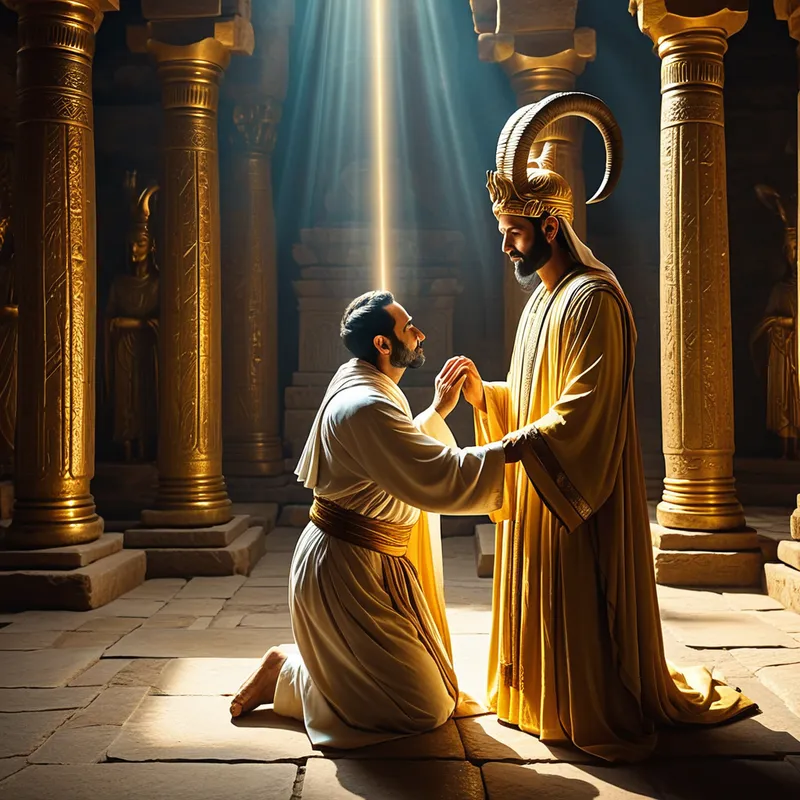
This oil was reserved for the touch of destiny. It was poured, not dabbed. A horn, carved from a ram that had once been caught in a thicket, held the chrism. The prophet’s hand, often old and veined with the memory of visions, would lift it high. The one chosen—a shepherd boy smelling of the field, a reluctant fugitive from the royal court, a young man hiding by the winepress—would kneel in the dust. They felt the weight of the moment before the coolness of the horn touched their brow.
Then, the flood. The oil, heavy and fragrant, would stream over the crown of the head, tracing the lines of the face, dripping onto the beard and the shoulders, soaking into the rough tunic. It was a drowning in purpose. In that moment, the Ruach of the Lord would rush upon them. The shepherd felt the stone of his sling grow heavy with kingdom. The fugitive felt his stammering tongue loosen with the law. The man by the winepress felt his fear transmute into a terrible, beautiful strength. They were anointed. Marked. Set apart. No longer merely themselves, but vessels for a sacred charge, consecrated to a path that would lead through wilderness, through battle, through betrayal, and toward a throne not made by human hands.
Cultural Origins & Context
The mythos of Holy Oil, or Christ, is rooted deeply in the priestly and royal traditions of ancient Israel, a culture situated at the crossroads of empire and desert. Its primary documentation is in the Torah, specifically in the book of Exodus, where its precise formulation is given as divine command. This was not folklore, but sacred law and ritual technology.
The myth was carried and performed by specific societal pillars: the priests of the Tabernacle and later the Temple, and the prophets—figures like Samuel, Nathan, and Elijah. Its societal function was threefold. Firstly, it was a tangible sacrament of divine election, legitimizing the authority of kings and high priests in a theocratic society. The oil was the visible seal of an invisible contract between the deity, the leader, and the people. Secondly, it served as a boundary marker, rigorously defining the holy from the profane. Its restricted use reinforced a cosmic and social order. Finally, it created a living narrative of identity. Every anointed king was a successor to Saul and David, weaving individual destiny into the grand tapestry of the people’s covenant story.
Symbolic Architecture
The Holy Oil is perhaps the most potent symbol of mediated grace and transformative purpose within its tradition. It represents the point where the transcendent touches the immanent, where spirit consecrates matter.
The vessel does not choose the anointing; it is chosen, filled, and its very nature is redefined by what it contains.
Psychologically, the oil symbolizes the numinous charge—the sudden, often overwhelming influx of meaning, vocation, or destiny that breaks into an individual’s life. It is not earned by merit but conferred by a reality beyond the ego. The one anointed (the Christos) represents the human ego or conscious self suddenly confronted with a transpersonal mandate. The act of anointing is a symbolic death of the old, purely personal identity (“the shepherd,” “the farmer”) and a rebirth into a role of cosmic significance (“the king,” “the prophet,” “the priest”). The oil itself, a blend of many costly spices, symbolizes the synthesis of diverse elements—suffering (myrrh was used for embalming), sweetness, and vitality—into a unified, sacred purpose.
The Dreamer's Resonance
When the motif of Holy Oil surfaces in modern dreams, it rarely appears as a biblical scene. Instead, the dreamer may find themselves in a mundane setting—an office, their childhood home—where a significant figure (a mentor, a stranger, sometimes a part of themselves) approaches and anoints them with a strange substance: light, water that feels thick, or a peculiar ointment. Alternatively, they may dream of discovering a vial of iridescent liquid and feeling a compulsive, sacred duty to protect it or use it correctly.
Somatically, this can correlate with a feeling of pressure or warmth on the crown of the head, a sense of being “poured into,” or a profound, calming heaviness. Psychologically, this dream pattern signals a critical juncture in the process of individuation. The psyche is announcing that a new level of responsibility, authenticity, or spiritual authority is being conferred upon the conscious personality. There is often an accompanying anxiety—the “fugitive by the winepress” fear—of being inadequate for the task. The dream is the unconscious anointing, a recognition from the deep Self that the ego is being called to integrate a greater portion of its potential and to serve a principle larger than its own comfort.

Alchemical Translation
The alchemical process mirrored in this myth is the consecratio—the sacred making. For the modern individual, the journey is not about becoming a literal monarch, but about the inward recognition and embodiment of one’s own sovereign authority and authentic purpose.
The first stage is the gathering of the spices: the often-painful collection of life experiences, talents, wounds, and insights that seem disparate and unrelated. The myrrh of our suffering, the cinnamon of our passion, the cassia of our groundedness. The ego, like the priest, must learn to hold these raw materials without prematurely judging their worth.
The second is the blending with oil: the base substance of our everyday life and vitality. This is the work of reflection, therapy, art, or meditation—the slow, careful process of mixing our deepest essence with our conscious existence, often in the “tent of meeting,” the quiet, sacred space we create for inner work.
The final, critical operation is the anointing: the moment of acceptance. The ego must kneel, must consent to be drenched by this synthesized Self. It is a surrender to one’s own destiny, a willing bearing of the weight of the crown.
This psychic transmutation turns the lead of a life lived by default into the gold of a life lived by design—a life consecrated. One becomes both the anointed and the anointer, the vessel and the sacred substance, realizing that the Holy Oil was never outside, but the latent, luminous potential of the soul itself, awaiting the prophetic moment of its own recognition and release.
Associated Symbols
Explore related symbols from the CaleaDream lexicon: