
Hinemoa and Tutanekai Myth Meaning & Symbolism
A chieftain's daughter defies her tribe to swim a dark lake, guided by the sound of a flute, to claim her destined love, a warrior of lower rank.
The Tale of Hinemoa and Tutanekai
Listen, and hear the whisper of Rotoatua, whose steaming waters hold a memory of fire and longing. On its shores lived Hinemoa, a chieftainess of the iwi of Rotorua, whose beauty was like the morning star upon the water. Her heart, however, was no longer her own. It had been given, secretly and irrevocably, to Tutanekai.
Tutanekai was a warrior, skilled and brave, but he was a pōriro, a son of a secondary wife. He lived not on the mainland with Hinemoa’s people, but on the sacred motu of Mokoia, a place lifted from the depths by the ancestor Māui. Though they met at tribal gatherings, a chasm of custom lay between them. Hinemoa’s people forbade the match. Love, they said, must bow to tikanga.
But Tutanekai’s love was a song without words. Each evening, as the sun fled and the mist rose from the warm lake, he would take his kōauau, carved from bone, and play. His melodies were threads of sorrow and desire, woven on the night air, carried across the black water to the shore where Hinemoa waited, her soul aching in time with each note.
Her family, suspecting her resolve, hid all the canoes. The lake, Rotoatua, wide and deep, became her prison wall. But the heart, when it truly knows its counterpart, cannot be imprisoned. One night, when the moon was a sliver and the world was drowned in darkness, the song came again. It pierced her like a physical pain, a summons she could no longer deny.
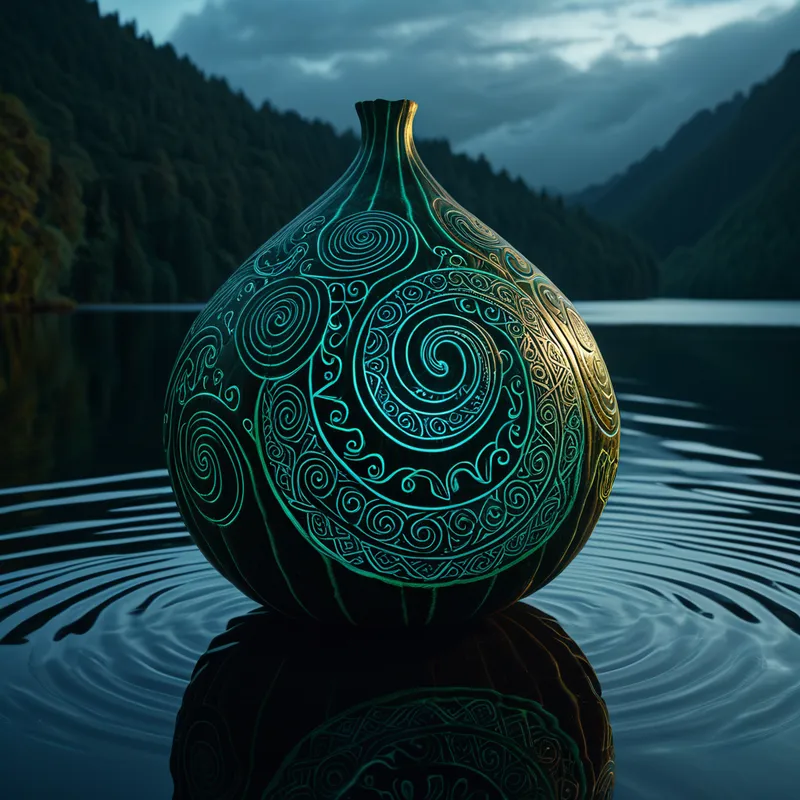
With a courage that turned her from a daughter of the land into a creature of the depths, she acted. She gathered empty, dried hue gourds, tying them to her body for buoyancy. Then, with only the distant, plaintive flute to guide her, she stepped into the cold, dark embrace of the lake. For hours she swam, the gourds knocking softly like hollow heartbeats, her arms cutting through the inky water towards the single firelight on Mokoia. Exhausted, freezing, she finally dragged herself ashore near a steaming waiariki.
There, in the concealing steam, she shattered one of the gourds against the rocks to disguise her arrival as an accident. When Tutanekai’s servant came to draw water, he found a shivering, noble stranger. Thinking her a man, he reported to his master. Tutanekai, curious, went to the pool himself. In the mist, he did not see the high-born chieftainess, but a figure of mystery. He spoke. She replied. And in the cadence of her voice, in the shape of her silence, he knew. He had not drawn a stranger from the pool, but had found his own heart, returned to him across an ocean of separation. The lover had swum to the beloved, and the beloved, in that moment of recognition, made her his wife. The song was answered, and the lake itself became the witness to their union.

Cultural Origins & Context
This story is a foundational pūrākau of the Te Arawa confederation of iwi in the Rotorua region. It is not merely a romance but a narrative deeply embedded in the landscape—Rotoatua, Mokoia Island, and the hot pools are all real, tangible places that anchor the myth in the lived reality of the people. The story was and is an oral treasure, passed down through generations by kaumātua and skilled orators. Its function was multifaceted: it explained the enduring connections between specific lineages, it encoded values of courage, determination, and fidelity, and it served as a powerful whakataukī for the triumph of profound personal truth over rigid social convention. It reminds the listener that mana can be claimed, not just inherited, through acts of incredible will.
Symbolic Architecture
At its core, the myth is an exquisite map of the soul’s journey towards its own completion. The lake is the great unconscious, the vast, unknown medium that separates the conscious ego (Hinemoa on the known shore) from its animus counterpart, the inner other who holds the key to wholeness (Tutanekai on the island). The social prohibition is the superego, the internalized voice of collective order that warns against such a perilous, individuating quest.
The true journey begins not when the path is clear, but when the familiar shore becomes a prison, and the only map is a song heard in the dark.
The kōauau is the call of the Self, the unique, haunting melody of one’s own destiny that persists beneath the noise of daily life. Hinemoa’s swim is the ultimate act of faith—entering the cold, dark depths with only the most fragile support (the hollow gourds, symbols of temporary, borrowed buoyancy). She must release her identity as the cherished daughter and become anonymous, a swimmer in the night, to reach her destination. The hot pool where she hides is the liminal space of rebirth, where she is stripped of her old status before being truly seen and claimed.
The Dreamer's Resonance
When this myth stirs in the modern psyche, it often manifests in dreams of crossing vast waters, hearing compelling but distant music, or finding oneself unprepared yet compelled to undertake a monumental journey. Somatically, one might feel the chill of the water, the ache in the limbs, or the profound relief of warmth. Psychologically, this signals a critical point in what Jung called the individuation process. The dreamer is experiencing the "call" from a neglected or forbidden aspect of their own personality—perhaps a creative passion, a deep relational need, or an authentic way of being that society or family has discouraged. The dream is the psyche’s affirmation that the journey, though terrifying and conducted in darkness, is necessary. The exhaustion felt is the cost of repressing this call; the determination is the emerging strength of the Self.
Alchemical Translation
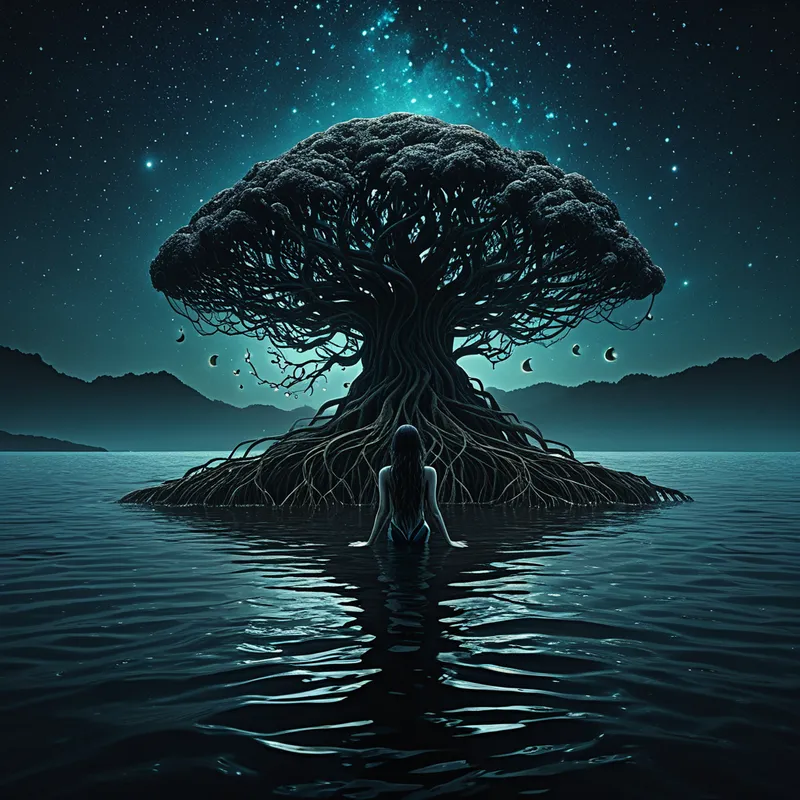
The alchemy here is one of solve et coagula. First, the solve: Hinemoa’s old identity, her social persona as the obedient chieftain’s daughter, must be dissolved in the waters of the unconscious. She is literally dissolved into the element, becoming unknown. The gourds she breaks are the deliberate fracturing of her old containers of life and status.
Then, the coagula: from the steaming, amorphous pool of transformation, a new union is formed. She is not "rescued" by Tutanekai; she arrives, and he recognizes her. This is the coagulation of a new, more complete psyche. The lower-status warrior and the high-status chieftainess integrate. The conscious mind, having braved the depths, now integrates the valuable, once-"inferior" aspects of the soul (the artist, the lover, the outsider). Their union on Mokoia—an island, a separate, sacred totality—symbolizes the establishment of the Self as the new governing principle, separate from but connected to the mainland of collective life.
The ultimate treasure is not the beloved waiting on the island, but the unconquerable will forged in the swimmer who dares the lake to reach them.
For us, the myth instructs that wholeness requires a nocturnal journey. We must listen for our own unique flute song, even—especially—when it leads us away from the safe fires of the known shore. We must be willing to use whatever makeshift buoyancy we have (faith, hope, a fragment of a dream) and enter the cold, where guidance comes not from sight, but from sound, from intuition. The promised land is always an island, a place of integrated being that we must swim to alone, so that we may arrive there ready to be truly seen, and to truly see.
Associated Symbols
Explore related symbols from the CaleaDream lexicon:
- Water — The vast, unconscious medium of the journey, representing the emotional and unknown depths that must be traversed to reach a new state of being.
- Journey — The central archetypal action of the myth, a perilous passage from a state of lack to a state of wholeness, undertaken alone and in darkness.
- Love — The irresistible force that motivates the entire quest, representing not merely romance, but the soul's pull towards its necessary counterpart for completion.
- Flute — The call of destiny, the unique, haunting melody of the Self that guides the seeker through darkness when all other landmarks are lost.
- Island — The achieved state of individuation, a separate, sacred totality where the integrated Self resides, distinct from the mainland of collective consciousness.
- Night — The time of the unconscious, when rational sight fails and the deeper, intuitive faculties must guide the way.
- Swim — The active, embodied struggle of the individuation process, requiring sustained effort, courage, and faith without guarantee of success.
- Gourd — A symbol of temporary, borrowed support and resourcefulness; the fragile vessels that aid the journey but must ultimately be broken to conceal one's arrival in a new state.
- Pool — The liminal, transformative space of rebirth, where one is stripped of old identity (the cold swimmer) before emerging into a new union (the recognized beloved).
- Sound — The primary guidance system in the myth, representing intuition, the call of the anima/animus, and the connective thread that binds separated halves of the soul.
- Separation — The initial, necessary condition of lack and longing that creates the tension and motivation for the entire transformative journey.
- Recognition — The climactic moment of psychic integration, where the conscious ego recognizes and accepts the once-alien aspect of the Self, completing the circuit of wholeness.