
Hine-titama Myth Meaning & Symbolism
The story of the first woman who, upon learning her husband is also her father, flees to the underworld to become the guardian of the dead.
The Tale of Hine-titama
In the time when the world was young and the names of things were still being whispered into being, there was a light that did not come from the sun. It was Hine-titama. She was formed from the sacred red earth by Tane, who breathed life into her and took her as his wife. Her skin held the blush of the first morning, her eyes the clarity of the sky just before daybreak. Together, they dwelt in the upper worlds, and from their union, the first daughters of humanity were born.
Hine-titama lived in the radiance of creation, tending to her children, bathing in the light of her own being. Yet, as the years wheeled on, a shadow began to grow in the corners of her heart—a question without a name. She noticed how Tane would sometimes look at her not with the gaze of a husband, but with the distant, proprietary look of a maker. A chill would touch her dawn-warm skin.
One day, as her daughters played, she turned to Tane and asked the question that had taken root in her soul: “Who is my father?”
The world held its breath. The rustling leaves stilled. Tane, caught in the web of his own making, did not speak. Instead, in a gesture of unbearable confession, he simply lifted his hand and pointed to the woven wall of their house. It was a sign, a direction. But Hine-titama understood with a lightning-strike of horror. He was not pointing through the wall. He was pointing at it. At the posts and beams, the very structure of their world, all fashioned by him. He, Tane, was the father. He, Tane, was the husband.
The light that was Hine-titama shattered. The dawn curdled into a scream of anguish and shame that echoed through the twelve heavens. The sacred bond was a terrible knot. The creator was the progenitor; the husband, the father. The foundation of her reality crumbled into dust. In that moment of catastrophic knowing, she could not remain in the world of light. The upper realms, built upon this hidden fault, became a prison of unbearable truth.
“You have woven this cloak of darkness for me,” she cried to Tane, her voice now the sound of tearing silk. “I will descend to Rarohenga, to the House of Great Night. I will dwell there, and henceforth, all your children—my children—will journey to me. I will draw them down, I will welcome them into the long darkness. You, Tane, will remain above to weave them into life, and I will wait below to gather them in death.”
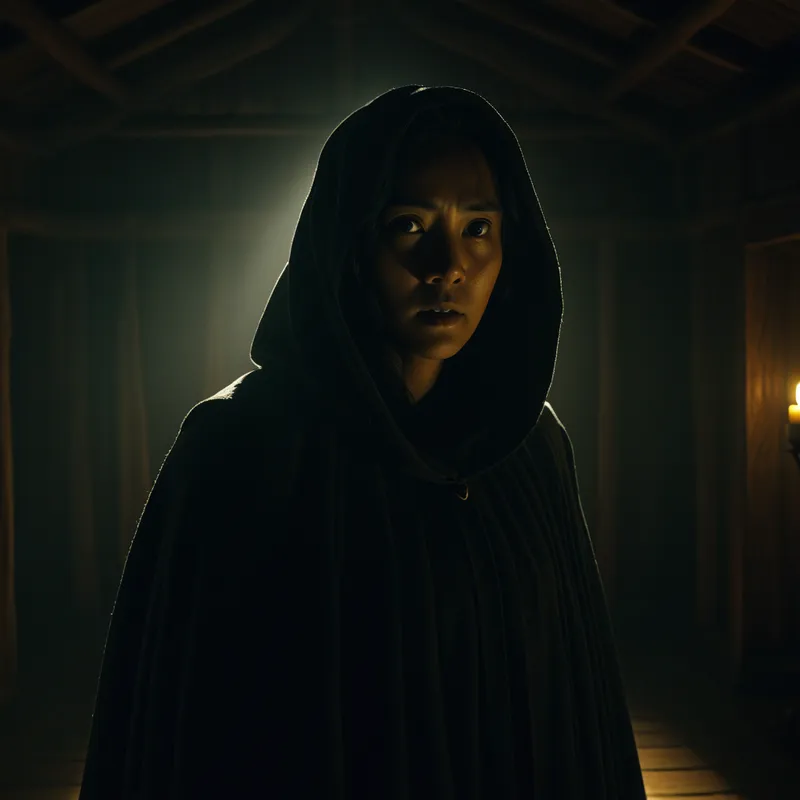
And so she turned. She fled from the world of sun and growth, down, down through the layers of existence. She passed Whiro in the deep places, her light now a grim torch. She did not stop until she reached the ultimate depths, the root of all things. There, she cast off her name of dawn. The light was extinguished, transformed. She became Hine-nui-te-po. Her form grew vast and terrible, her eyes like black pools holding the stars of the forgotten sky, her embrace the final peace. The Dawn Maiden was no more. In her place stood the Sovereign of Night, the guardian at the final threshold, where all journeys end and all shame is finally, silently, absorbed into the eternal dark.
Cultural Origins & Context
This myth is part of the foundational whakapapa that structure the Maori cosmological view. It was not merely a story but a sacred narrative recited by tohunga during rituals of life, death, and initiation. Its transmission was oral, precise, and performed, ensuring the continuity of cosmic order and social law.
Functionally, the myth of Hine-titama serves multiple crucial roles. It explains the origin of death, not as a punishment, but as a necessary separation instituted by the first mother herself. It establishes the complementary realms of life (Te Ao Mārama, the World of Light, governed by Tane) and death (Rarohenga, governed by Hine-nui-te-po). Societally, it reinforced the immense cultural weight of whakapapa. Knowing one’s lineage was to know one’s place in the universe; to be ignorant or to violate these bonds, as the myth tragically illustrates, leads to cosmic dislocation. The story is a profound ethical compass, outlining the catastrophic consequences of hidden truths and the misuse of creative power.
Symbolic Architecture
At its core, this is a myth about the birth of consciousness through the shattering of innocence. Hine-titama begins as a being of pure, unreflective existence—the “Dawn” state of the psyche, where everything is illuminated but nothing is examined. The question “Who is my father?” is the archetypal moment of self-reflection, the ego’s first turn inward to seek its own source.
The most profound trauma is also the initiation into reality. The wound that cannot be healed becomes the gateway to one’s true domain.
Tane represents the creative, life-giving, but ultimately naive masculine principle. He acts from instinct (creation, procreation) but without the foresight of consequence or the wisdom of revealed relationship. He is the father who does not declare himself, the builder who forgets he lives within his own construction. Hine-titama’s transformation is the psyche’s necessary response to foundational betrayal. She cannot “un-know” what she has learned. The only possible movement is downward, into the depths of what has been repressed and denied—the shadow realm of the personal and collective unconscious.
Her new name, Hine-nui-te-po, is not a diminishment but an enlargement of being. She integrates the light (her former self) into a vast, containing darkness. She becomes the ultimate kaitiaki (guardian), not against death, but of the sacred process of ending. Her journey models the soul’s descent into its own underworld to reclaim authority from the figures who shaped it.
The Dreamer's Resonance
When this myth stirs in modern dreams, it often manifests as dreams of shocking discovery: uncovering a hidden family secret, realizing a trusted partner has a double life, or suddenly seeing a parent or authority figure in a devastating new light. The somatic experience is one of a visceral drop—the stomach lurching, a feeling of the floor vanishing. It is the dream of the “orphan” archetype being activated in its most primal form.
The dreamer may find themselves in a beautiful, familiar house that suddenly reveals a hidden, dark basement or a concealed door. They may be fleeing from a luminous landscape into a forest or cave, pursued not by a monster, but by a profound, silent shame. The figure of Hine-nui-te-po herself might appear not as terrifying, but as a immense, sorrowful, yet comforting feminine presence in the darkness, offering not answers, but an end to the flight. These dreams signal a psychological rupture where a core identity narrative has been falsified. The psyche is initiating its own necessary descent, compelling the dreamer to confront what has been foundational yet hidden, and to begin the slow, painful work of re-orienting their entire being around a new, more difficult truth.

Alchemical Translation
The alchemical journey mirrored in Hine-titama’s myth is the nigredo, the blackening. It is the first, non-negotiable stage of individuation where the prima materia of the self—our inherited identity, our familial and cultural programming—is dissolved by the acid of traumatic truth.
Individuation begins not with seeking light, but with the courageous acceptance of the descent that light forces upon us. The goal is not to return to dawn, but to become the night that can hold the dawn within it.
For the modern individual, this myth models the process of psychic transmutation through several stages:
- The Innocent Construction: Living within an identity fashioned by others (parents, society, tradition), experiencing life as given.
- The Catalytic Question: An event or insight that challenges the foundational story of the self. This is often experienced as betrayal, crisis, or breakdown.
- The Shattering and Flight: The conscious ego cannot integrate this new knowledge. The old “house” of the self becomes uninhabitable. The psyche’s instinct is to flee downward—into depression, withdrawal, obsession, or the “underworld” of the unconscious.
- The Metamorphosis in Darkness: This is the crucial, transformative period. In the darkness of Rarohenga, away from the old sources of light and validation, a new authority is forged. Hine-titama does not seek revenge or reconciliation; she claims a kingdom. Psychologically, this is the slow, often painful, integration of shadow material and the development of a self-authority divorced from parental or external validation.
- The New Sovereignty: The emergence as Hine-nui-te-po represents the establishment of a new psychic function: the ability to hold endings, to accept the limits of life, to be the compassionate witness to one’s own and others’ suffering. The transformed self becomes a guardian of thresholds, finding power not in creation, but in sacred containment and ultimate meaning.
The triumph is not in returning to the sunlit world, but in becoming the necessary counter-weight to it. The individuated soul learns to say, as Hine-nui-te-po does, “My domain is here, in the truth of endings, and from this place, I offer a different kind of peace.”
Associated Symbols
Explore related symbols from the CaleaDream lexicon:
- Dawn — The initial state of unconscious innocence and beauty that Hine-titama embodies, a light that is radiant but not yet self-aware, destined to be transformed.
- Father — Represents the creative source and the hidden, structuring authority whose undisclosed truth becomes the catalyst for catastrophic awakening and descent.
- Mother — Transforms from the nurturing life-giver in the upper world to the ultimate Mother who receives all life back into her dark embrace in the underworld.
- Descent — The central, non-negotiable movement of the myth, symbolizing the journey into the unconscious, the facing of shadow, and the necessary withdrawal from a falsified reality.
- Threshold — The liminal space between the World of Light and Rarohenga; Hine-nui-te-po becomes the living threshold herself, the guardian of the ultimate passage.
- Shame — The overwhelming emotion that fuels the flight, representing the psychic pain of violated taboo and the shattered self-image that must be carried into the depths.
- Darkness — Not merely absence of light, but the fertile, containing realm of transformation where true sovereignty is forged and the fragmented self is made whole in a new form.
- Guardian — The ultimate role Hine-titama assumes, shifting from a passive creation to the active, sovereign protector of the sacred cycle of life and death.
- Truth — The devastating, catalytic knowledge that cannot be unknown, which acts as the sword that cuts the soul from its moorings and initiates its necessary journey.
- Name — Symbolizes identity and essence; the casting off of "Hine-titama" and the taking of "Hine-nui-te-po" marks the complete death and rebirth of the self.
- Journey — The myth is the archetypal journey from naive consciousness through traumatic revelation to a hard-won, integrative wisdom in the deepest places of being.