
Hina-keha Myth Meaning & Symbolism
A goddess of light descends into the underworld, her luminous sacrifice creating the moon's phases and the tides of the human soul.
The Tale of Hina-keha
Listen. The world was younger then, and the boundaries between realms were thin as morning mist. In the high, bright realm of Wākea, there lived a goddess of such radiance they named her Hina-keha. She was light made flesh, sister to the sun, and her laughter was the sparkle on the wave-crest. Yet, for all her brilliance, a profound loneliness grew within her—a longing for a depth her luminous world could not provide. The sky was endless, but it was empty.
Her eyes turned downward, past the green islands and the coral reefs, to the deep, silent realm of Milu. It was a place spoken of in whispers, the domain of Maui-of-the-depths, a being of ancient shadow and potent stillness. While her kin danced in the ceaseless day, Hina-keha felt a pull, a tide in her soul, drawing her to that which was not light.
One evening, as she bathed in a secluded pool, she saw her own reflection—not just her luminous form, but a deeper echo in the dark water beneath. The call became a resolve. She would not stay in the unending brightness. She would descend.
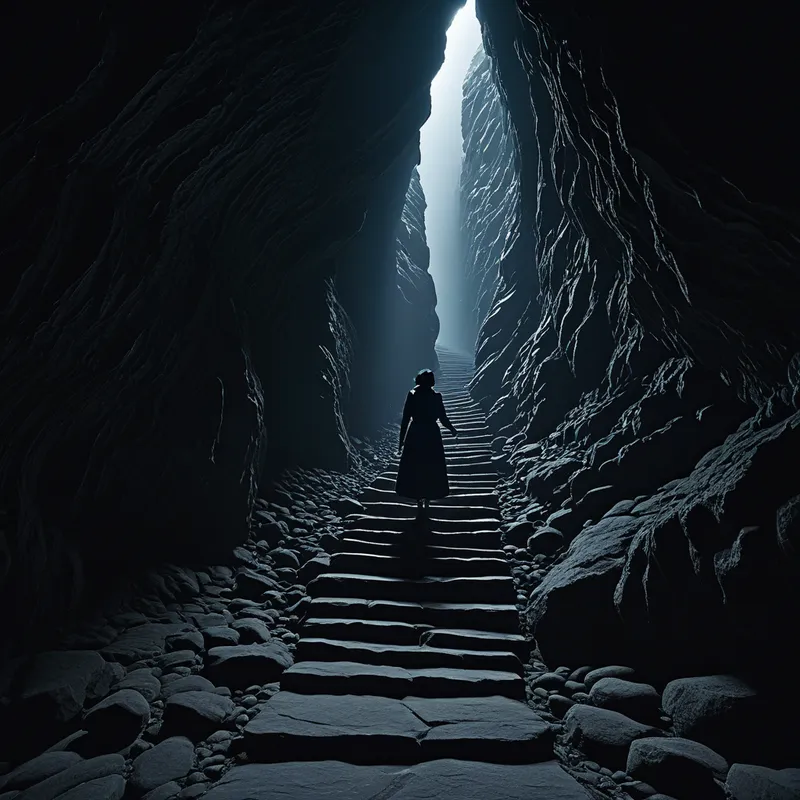
She left the realm of her birth, her light dimming to a soft, silver glow as she sought the entrance to the underworld. She found it in the roots of the great ʻAumakua tree, a crack in the foundation of the world that breathed out the cool, damp air of earth’s interior. Down she went, into the belly of stone. The path was treacherous, a labyrinth of dripping rock and echoing chambers where her light was not a beacon, but a fragile candle. The shadows here were not mere absences of light; they were living presences, old and watchful.
Finally, she entered the great hall of Milu. There was no fire, yet it was not cold. There was no sun, yet it was not formless. In the profound quiet, she met its lord. He was not a monster of teeth and flame, but a presence of immense, grounded potency, like the deep ocean floor or the heart of a mountain. He saw not just her light, but the courage it took to bring it into his domain. And she saw not just his darkness, but the profound peace and fertile potential within it.
A union was forged there, in that silent realm—a marriage of light and depth, of sky and earth. But such a union alters the constituents. Hina-keha could not remain entirely as she was; part of her luminous essence was willingly given, mingling with the dark substance of the underworld. This sacred exchange had a consequence that rippled through all the worlds.
She could not return to the bright, careless sky of Wākea. A part of her soul was now forever wedded to the depths. And so, she found her new home not in the sky nor fully in the underworld, but in the space between—the night sky. Transformed, she became the moon. Her luminous sacrifice is why the moon waxes and wanes; it is the visible rhythm of her presence in both realms. When she is full, she shines with all her remaining light upon the world. When she is dark, she is dwelling with her beloved in Milu, tending the roots of life unseen. And her longing pull, the tension between her two homes, is what draws the ocean itself into the great, breathing rhythm of the tides.
Cultural Origins & Context
The myth of Hina-keha is part of the vast and intricate Hina cycle found across Polynesia, from Hawaiʻi to Tahiti to Aotearoa (New Zealand). Hina is not a single goddess but a multifaceted archetype, appearing as Hina-of-the-sea, Hina-the-weaver, and here, as Hina-the-luminous. This specific narrative is deeply rooted in Hawaiian tradition, passed down not through written texts but through the sacred channels of oli and moʻolelo, recited by kahuna and storytellers.
Its societal function was multifaceted. On a practical level, it was a cosmological explanation for the phases of the moon and the tides, crucial knowledge for navigators and fishermen. On a spiritual level, it mapped the relationship between the seen and unseen worlds (ao and pō), affirming that darkness was not evil but a necessary, fertile counterpart to light. It served as a metaphor for the journey of the soul after death, descending to Milu, and perhaps being transformed. Most importantly, it modeled a profound truth: that true power and understanding come not from purity in one state, but from the sacred negotiation between opposites.
Symbolic Architecture
At its core, Hina-keha’s story is an allegory of consciousness venturing into the unconscious. She represents the egoic self—the identified “I” that knows itself as bright, distinct, and separate. Her realm, Wākea, is the conscious mind, illuminated but ultimately limited in its perspective.
The journey toward wholeness begins not with an ascent into greater light, but with a courageous descent into the unlit portions of the self.
The underworld, Milu, is the personal and collective unconscious—the repository of all that is repressed, unknown, instinctual, and potent. It is not a hell to be feared, but a dark womb containing latent life. Maui-of-the-depths symbolizes the animus, the deep masculine principle not as warrior, but as the structuring, grounding, containing force of the unconscious. The marriage is the crucial coniunctio oppositorum—the conjunction of opposites. It is not a conquest, but a sacred union where both parties are altered. Hina does not defeat the darkness; she weds it. She does not illuminate it away; she learns to shine within it.
Her transformation into the moon is the ultimate symbol of this integrated state. The moon does not generate its own light but reflects the sun’s while being governed by the hidden pull of the earth (the depths). It is the celestial body of rhythm, flux, and reflection—a perfect image for a consciousness that has made peace with its own cycles of clarity and obscurity, activity and receptivity.
The Dreamer’s Resonance
When this myth stirs in the modern psyche, it often manifests in dreams of descent: finding a basement in one’s home one never knew existed, climbing down a ladder into a dark pool, or following a path into a deep forest at night. The somatic feeling is one of gravity, a pulling downward, often mixed with awe and trepidation.
Psychologically, this signals a movement away from identification with the persona—the bright, socially acceptable self—and an initiation into a process of shadow-work. The dreamer is being called to acknowledge and engage with their personal Milu: the rejected traits, the unlived life, the grief, rage, or longing stored in the somatic and psychic depths. This is not a pathological process, but a natural, archetypal one of maturation. The figure met in the depths (often a mysterious, powerful, or alluring stranger) represents the aspect of the Self that can hold and transform this shadow material. The dream may feel unsettling because it involves a necessary loss of the old, purely “luminous” identity.

Alchemical Translation
The alchemical process mirrored in Hina-keha’s journey is the nigredo, followed by the albedo. Her voluntary descent into the dark cave is the nigredo—the dissolution of the bright, solar ego. This is the painful but essential first step in individuation, where one’s certainties are broken down.
The moon is born from the marriage of light to its own absence. So too, the authentic self is forged in the conscious embrace of all we are and all we have tried not to be.
Her sojourn and union in Milu represent the hidden fermentation, the citrinitas, where the opposites interact in the dark. The final transformation into the moon, a body that governs the tides of life on earth, is the albedo and the emerging rubedo. This is the creation of a new, more complex psychic structure: the conscious ego now in a dynamic, rhythmic relationship with the unconscious Self.
For the modern individual, the myth teaches that healing and wholeness are not found in bypassing our darkness with positive thinking, nor in being consumed by it. It is found in the courageous, respectful descent—the intentional engagement with our inner depths. We must, like Hina, be willing to have our original light changed by the encounter. The goal is to become like the moon: a reflective, rhythmic presence that accepts its phases, whose influence is gentle, pervasive, and essential to the rhythm of life itself. Our “tides”—our emotions, creativity, and intuitions—become not problems to solve, but sacred evidence of our own married nature, luminous and deep.
Associated Symbols
Explore related symbols from the CaleaDream lexicon: