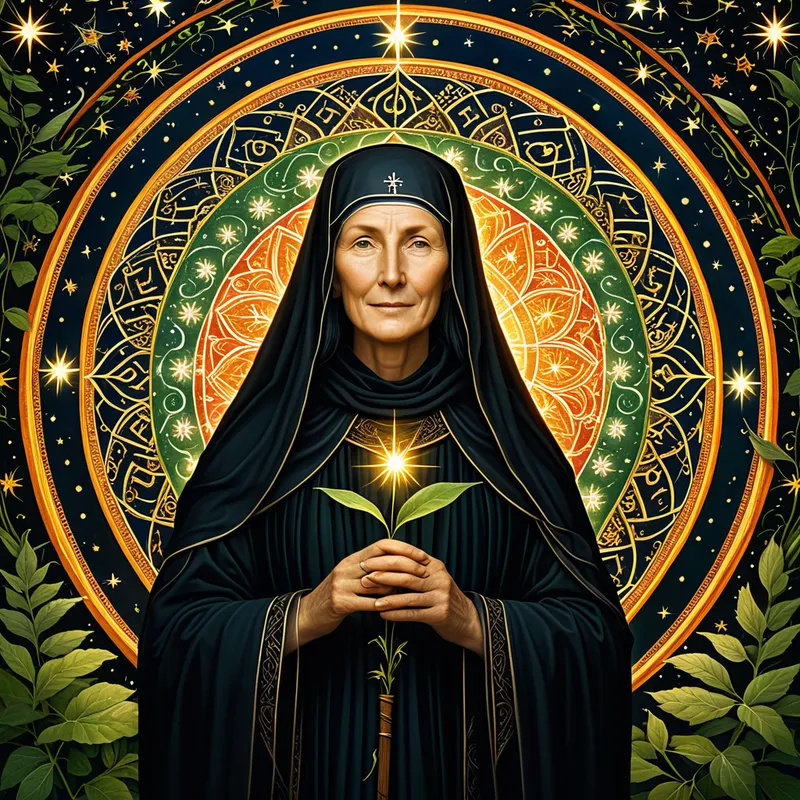
Hildegard of Bingen Myth Meaning & Symbolism
A 12th-century abbess, mystic, and polymath who channeled divine visions into art, music, and medicine, embodying the sacred marriage of heaven and earth.
The Tale of Hildegard of Bingen
In the deep, green heart of the Rhineland, where the river cut valleys like sacred wounds into the earth, a child was born under a sky heavy with portent. From her first breath, Hildegard was a vessel too small for the ocean within. She saw what others could not: the living light in the sap of a tree, the fiery wheel of the cosmos turning behind closed eyelids. These were not daydreams, but visitations—a <abbr title="The divine, radiant presence">Lux Vivens</abbr> that pressed upon her soul, a weight of glory that made her frail body tremble.
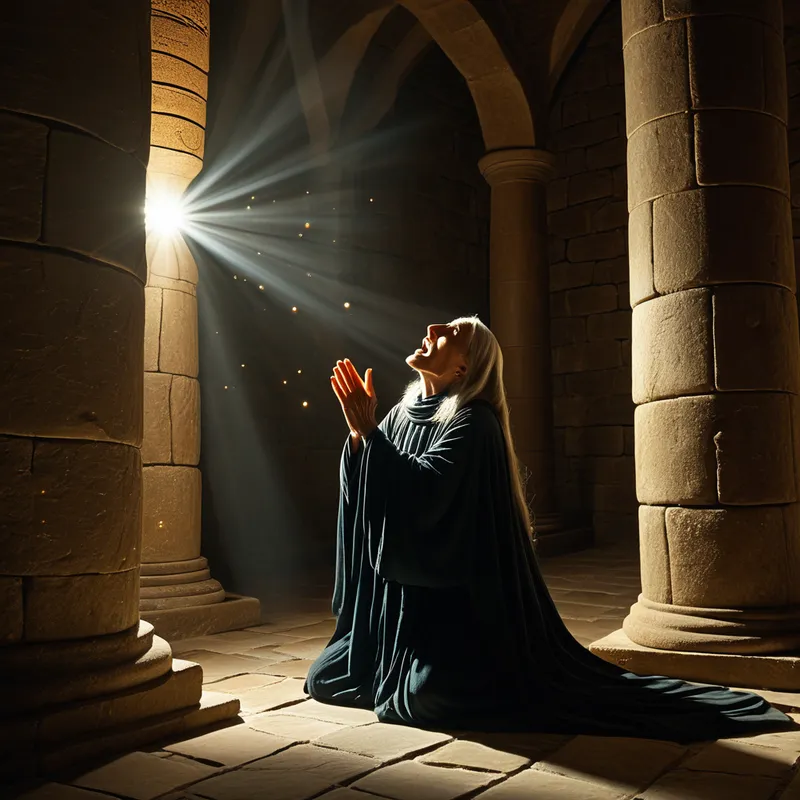
She was given to the church, a tithe of spirit, walled within the abbey of <abbr title="A Benedictine monastery at Disibodenberg">Disibodenberg</abbr>. The stone cloister was meant to be a cage for her wild visions, but it became a crucible. For decades, the <abbr title="The living light, her term for the divine presence">Lux Vivens</abbr> spoke in silence. It was a secret fire she carried, a torrent of understanding about the weave of the universe—how the stars kiss the herbs, how the soul is a sapphire in the mountain of the body. The pressure built until, in her forty-third year, the heavens tore open. A blast of fiery light threw her to the cold floor. A voice, not of sound but of meaning, commanded: “Cry out and write!”
And so the sealed vessel broke. From her flowed not water, but a river of revelation: the <abbr title="Know the Ways, the title of her first major visionary work">Scivias</abbr>. With a loyal scribe, the monk Volmar, as her anchor, she transcribed the cosmos. She drew mandalas of breathtaking terror and beauty—the <abbr title="The Cosmic Egg, a central image in her visions">Egg of the Universe</abbr>, the <abbr title="The Pillar of the Trinity, a complex symbolic figure">Pillar of the Trinity</abbr>—populated with watchful eyes and wings of flame. She heard the music of the spheres and composed antiphons for <abbr title="The personification of Divine Wisdom in Christian theology">[Sophia](/myths/sophia "Myth from Gnostic culture.")</abbr>, songs that were architecture for the soul.
The world, a world of powerful bishops and skeptical monks, heard the rumor of this whispering nun and her divine mandate. They demanded proof. Summoned before a synod, the small woman in black stood. The <abbr title="The living light">Lux Vivens</abbr> spoke through her then, not with meekness, but with the authority of the cosmic order itself. Her words, rooted in orthodox soil yet blooming with unprecedented color, silenced the doubt. The Pope himself granted his blessing. The vision was validated, but its true work had just begun.
With her newfound authority, she performed the ultimate act of creation: she built. She led her sisters from the crowded cloister to a raw, empty hill at <abbr title="The location of her own founded monastery">Rupertsberg</abbr>. There, from vision alone, she designed a sanctuary of harmony. She turned to the earth itself, studying the veins of plants and the humors of stones, writing of <abbr title="The greening power, the divine life-force in all creation">Viriditas</abbr>—the sacred greening force. She became a healer, a composer, a poet, a scientist of the soul. In her final years, even in conflict with earthly powers, she remained a conduit. The fire that once frightened the child now warmed a world. She died not as a extinguished flame, but as a seed falling back into the great green earth from which all <abbr title="The greening power">Viriditas</abbr> springs.
Cultural Origins & Context
This is not a myth from the misty pagan past, but one born in the very specific crucible of 12th-century Christian Europe. Hildegard’s story emerged from the lived reality of Benedictine monasticism, a culture of liturgy, obedience, and lectio divina (divine reading). Her “myth” was recorded primarily in her own prolific writings—the three visionary volumes (Scivias, Liber Vitae Meritorum, Liber Divinorum Operum), her scientific and medical texts, her letters to emperors and popes, and her music—and in the saint-making document, the Vita compiled after her death.
The societal function was multifaceted. For the church, she was a powerful validation of divine authority channeled through orthodox (and female) piety. For her monastic community, she was a mater (mother) and founder, a source of identity and protection. For the broader medieval world, she became a polymathic authority on everything from theology to medicine. Her myth was passed down not by wandering bards, but by scribes, illuminators, and the sisters who sang her chants. It functioned as a template for the possibility of direct, experiential knowledge of God (gnosis) within the bounds of institutional religion, and as a powerful testament to the sacredness of the natural world—a critical counterpoint to purely ascetic world-denial.
Symbolic Architecture
At its core, Hildegard’s myth is about the integration of profound opposites. She is the human vessel for the divine fire, the frail body that contains the cosmic diagram.
The ultimate act of spiritual courage is not to escape the body, but to become the precise instrument through which the cosmos sings its own melody.
The central symbol is the <abbr title="The greening power">Viriditas</abbr>. It represents the divine life-force, the moist, verdant, creative power of God that animates all creation—from the sprouting seed to the inspired mind. Its opposite is <abbr title="Aridity, spiritual dryness">Ariditas</abbr>, the state of spiritual and physical decay. Hildegard’s entire life’s work was an operation of <abbr title="The greening power">Viriditas</abbr>: healing, composing, writing, building, gardening. Psychologically, <abbr title="The greening power">Viriditas</abbr> represents the libido or life energy in its most creative, connective, and nourishing form. Her debilitating illnesses, followed by explosive creativity, symbolize the necessary containment and pressure required to alchemize raw psychic energy into a coherent work of the Self.
Her visions—often structured as mandalas (the Egg, the City of God)—symbolize the <abbr title="The Self, the central archetype of wholeness in Jungian psychology">Self</abbr> archetype, the innate human drive toward order, balance, and totality. The fact that she wrote them down and illustrated them is crucial. It represents the process of giving form to the formless contents of the unconscious, making the invisible visible, and thus integrating them into conscious life.

The Dreamer's Resonance
When a modern dreamer encounters the pattern of Hildegard’s myth, they are likely in a profound process of psychic incubation and emergent voice. The somatic experience might be one of pressure—a tightness in the chest, a sense of being overwhelmed by a feeling or insight that has no words. The dreamer may see themselves in a sterile, confined space (the modern cloister: an office, a routine) while miraculous lights or living plants burst through the walls.
To dream of being commanded to “write” or “speak” what one sees signals a critical moment where the unconscious is demanding expression. The figure of the supportive scribe (Volmar) might appear as a helpful colleague, therapist, or even an inner resource of disciplined focus that can help channel the chaos. Dreaming of designing a new building or garden from scratch points to a deep restructuring of the psyche, a move from a borrowed life to a self-authored one. The struggle is often between the inner authority of the vision and the outer “synod” of societal expectations, internalized critics, or imposter syndrome. The myth manifests in dreams as the imperative to honor the visionary self, however unconventional, and to ground its revelations in tangible, creative work.

Alchemical Translation
The alchemical process modeled here is the Individuation journey par excellence. It begins with the nigredo: Hildegard’s childhood visions and lifelong illness—the initial immersion in the unconscious, the “divine illness” that feels like a burden. This is the raw, unintegrated psychic material.
The albedo is the long period of containment within the monastic rule. The structure of the Benedictine horarium (daily schedule) acts as the alchemical vessel, providing the discipline that prevents the psyche from dissolving into psychosis. It is during this white, purifying stage that the material is silently worked on.
The vessel of tradition is not a prison for the spirit, but the retort that allows the prima materia of vision to be distilled into wisdom.
The citrinitas, the yellowing or dawning of enlightenment, is the explosive moment of command: “Cry out and write!” This is the emergence of the transcendent function, the new symbol (her entire corpus) that bridges the unconscious and conscious worlds.
Finally, the rubedo, the red stage of completion, is her life as abbess, healer, and founder. The gold of the vision is now circulated in the world. She becomes a Senex figure, but one fused with the creative <abbr title="The greening power">Viriditas</abbr> of the *Puer Aeternus`. For the modern individual, the alchemy is this: to recognize the “divine pressure” of one’s unique calling (however secular it may seem), to find or create the necessary vessel of discipline for its gestation, to courageously give it form through one’s own unique language (art, code, care, craft), and finally, to build a life structure—a “Rupertsberg”—that is an authentic embodiment of that integrated truth. The goal is not sainthood, but wholeness: becoming a conduit for the greening power in one’s own corner of the world.
Associated Symbols
Explore related symbols from the CaleaDream lexicon: