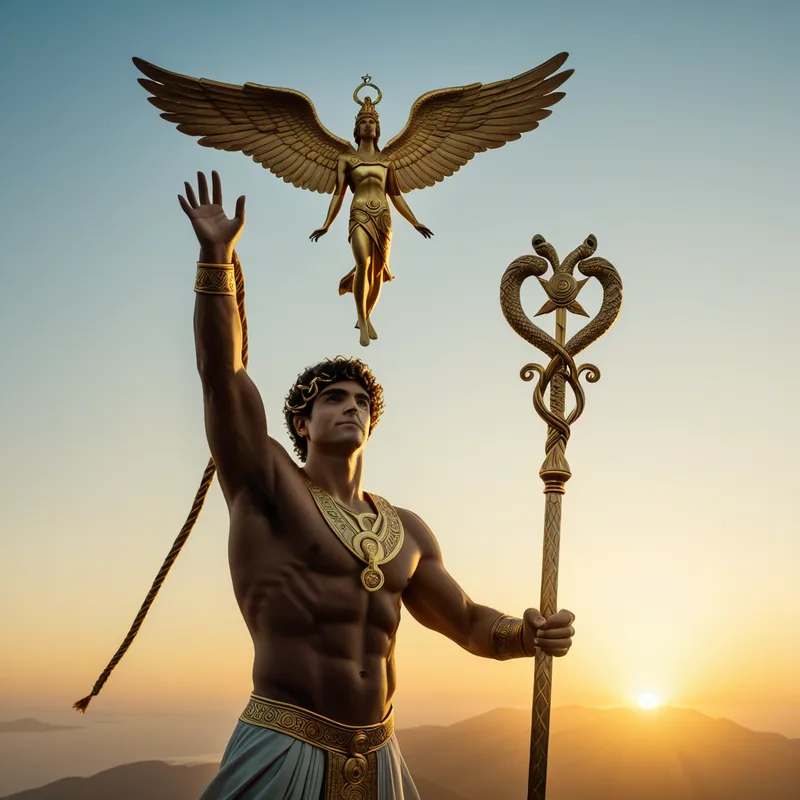
Hermes' Herald's Staff Myth Meaning & Symbolism
The myth of Hermes' staff, the Caduceus, tells of a god's cunning and a symbol's birth, embodying communication, boundaries, and the alchemy of opposites.
The Tale of Hermes' Herald's Staff
Before the first word was spoken, before the first message crossed the space between minds, there was only potential. Then came the rustle in the reeds, the swift shadow on the mountain path. He was born at dawn, in a cave on Mount Cyllene, to the starry Maia. Before his first day was done, the infant god had slipped from his cradle. Not to wail, but to wander. His eyes, old as the sky, saw not a world of things, but a world of motion, of gaps to be bridged, of silences begging to be filled.
He found a tortoise, a slow, patient creature of the earth. With a laugh that held the sound of wind chimes, he hollowed its shell, strung sinews across it, and invented the lyre. But music was only one kind of message. His spirit, a darting mercury, craved more. He ventured forth and beheld the sun-cattle of his brother, the mighty Apollo. A plan, swift and cunning as thought itself, unfolded. He stole the herd, driving them backwards to confuse the trail, a trickster’s signature written in the dust.
When the furious Apollo finally confronted him, the infant god did not cower. He offered the lyre. The moment Apollo’s fingers touched the strings, anger dissolved into awe. The conflict was transmuted into an agreement: the lyre for the cattle, theft transformed into trade. But a deeper pact was forged. Apollo, recognizing a kindred spirit of a different order, bestowed upon Hermes a symbol of his new office: a simple shepherd’s staff, a rod of power.
Yet, a staff alone is just a stick. Its true nature was revealed on a journey. As Hermes, now the appointed herald, strode between the worlds, he came upon two mighty serpents, locked in a furious, coiling combat. Hiss filled the air, scales flashed in the sun—a perfect image of discord. Hermes did not flee nor fight. He stood at the threshold of their strife and thrust his staff between them.
A miracle of mediation occurred. The serpents, sensing a new axis, a central truth, ceased their battle. Not in defeat, but in recognition. They released each other and instead began to wind their bodies up the length of the staff, not in conflict, but in a dynamic, mirrored embrace. They rose, meeting at the top, their heads facing each other in eternal, attentive dialogue. Wings, perhaps gifted by Apollo or born from the very act of resolution, sprouted above them. The simple rod was no more. In its place was the Caduceus—the herald’s staff, a born symbol of boundary-crossing, of conflict alchemized into conversation, of the space where opposites meet and find a higher form.

Cultural Origins & Context
The myth of the Caduceus is woven into the earliest strands of Greek poetic tradition, most famously in the Homeric Hymn to Hermes. This was not a story confined to temple scrolls; it was performed, a rhythmic narrative sung by bards at festivals and gatherings. Hermes, as Psychopompos (Guide of Souls) and divine herald, was a god of the practical and the profound. His myth explained the origin of a symbol every Greek recognized: the staff carried by heralds, ambassadors, and messengers. This staff granted its bearer inviolability; to harm a herald was to transgress a sacred, Hermetic law of communication itself.
The myth served a crucial societal function. In a world of often-warring city-states, the herald was the essential link, the guarantee of parley. The Caduceus was his passport and his shield, a visible reminder that the space of dialogue is a sacred, neutral ground established by the gods. The story of its creation—born from trickery, resolved through artful exchange, and finalized in the pacification of primal conflict—perfectly modeled the delicate, often cunning, art of diplomacy and the hope that even entrenched opposition could be guided into a state of balanced, if watchful, peace.
Symbolic Architecture
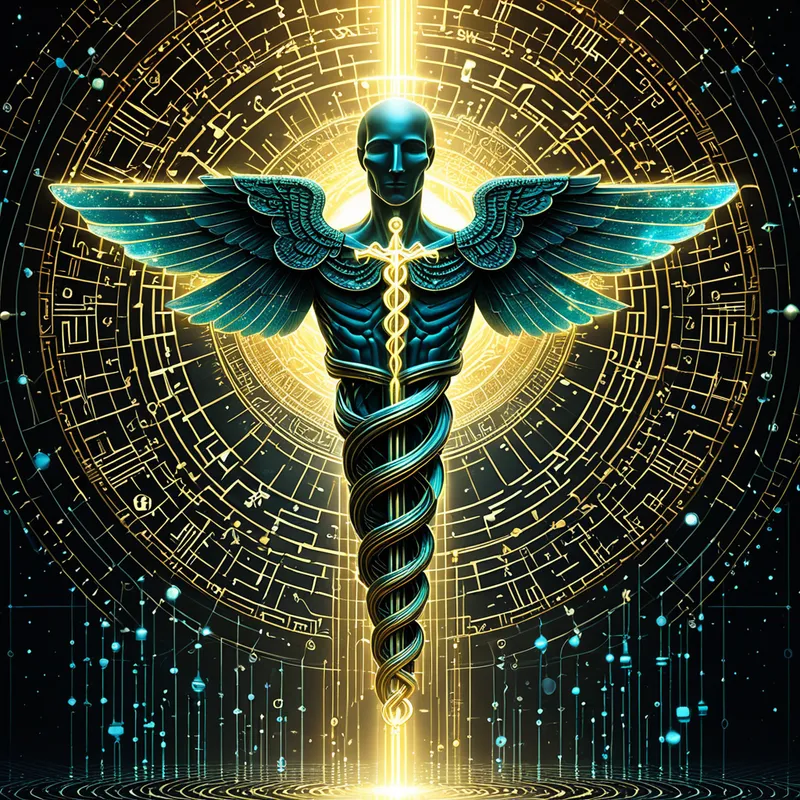
The Caduceus is a compact map of psychic reality. The central staff is the axis mundi, the world-pillar, representing the spine of consciousness, the path one must walk, or the immutable law (the logos) that structures reality. It is the firm ground of the self amidst flux.
The staff is the path; the serpents are the journey.
The two serpents are the primal pair of opposites that define earthly experience: conscious and unconscious, self and other, life and death, aggression and passivity, the known and the unknown. Their initial state is combat, representing the inner and outer conflicts that tear at the individual and society.
Hermes’ act of intervention is the critical moment of consciousness. He does not take a side but introduces a third thing—the mediating principle. The serpents’ transformation into symmetrical coils around the staff symbolizes the integration of opposites. They are not eliminated; they are organized, elevated, and brought into a dynamic, living relationship with the central principle. This is not a static peace but an active, energetic balance—the tension that creates life and consciousness.
The wings at the apex signify the transcendence achieved through this integration. They represent the liberation of spirit, the flight of insight, and the divine perspective that becomes possible when conflict is alchemized into dialogue. The entire symbol is thus a blueprint for individuation: navigating inner conflict (serpents) via a steadfast core (staff) to achieve a higher state of being (wings).
The Dreamer's Resonance
When the motif of the Caduceus or its components appears in modern dreams, it signals a profound somatic and psychological process of mediation. Dreaming of two fighting snakes often points to an internal civil war—perhaps between duty and desire, logic and emotion, or a part of the self that seeks change and a part that clings to safety. The body may feel this as tension, a knot in the stomach, or a literal pain in the neck (the realm of the spine/staff).
To dream of finding or being given a staff suggests the dream-ego is being presented with, or is searching for, its own central authority—a core principle or truth to hold onto amidst chaos. The most potent dream is witnessing the serpents entwining the staff or seeing the completed Caduceus. This is the psyche’s powerful depiction of resolution in progress. It indicates the dreamer is in the active, often uncomfortable, but ultimately healing phase of integrating conflicting forces. The dream is a somatic reassurance: the nervous system itself is learning to hold tension differently, transforming chaotic arousal into organized energy. It is the image of the psyche moving from a state of war to a state of nuanced, self-aware complexity.

Alchemical Translation
The myth of the Caduceus is a precise manual for psychic alchemy. The prima materia, the base matter, is raw, undifferentiated conflict—the stolen cattle (unintegrated instincts), the fighting serpents (internal opposites). Hermes, the Magician archetype, acts as the alchemist within.
The first operation is separatio: Hermes distinguishes himself from the fray. He doesn’t become one of the fighters; he observes and intervenes from a meta-position. Psychologically, this is the act of gaining awareness, of stepping back from identifying with one side of our inner conflict.
The second is coniunctio oppositorum (the conjunction of opposites): This is not a mere compromise, but a mystical marriage. The staff is thrust between the serpents, providing a sacred space for encounter. In our inner work, this is the creation of a conscious container—through journaling, therapy, art, or mindful reflection—where opposing feelings, thoughts, or impulses can be safely acknowledged and confronted.
The alchemical gold is not the end of conflict, but the capacity to hold it creatively.
The final transmutation is the ascent. The integrated serpents, now part of a greater whole, facilitate the sprouting of wings. The energy once wasted in internal warfare is liberated and sublimated. The individual gains the "herald’s" gift: the ability to communicate fluently between different parts of the self, to navigate the boundaries between inner and outer worlds with agility, and to carry messages from the depths of the unconscious to the heights of consciousness. The struggle is not erased; it is redeemed as the very structure of one’s wisdom and the source of one’s flight. One becomes, like Hermes, a guide for one’s own soul and a mediator in the world.
Associated Symbols
Explore related symbols from the CaleaDream lexicon: