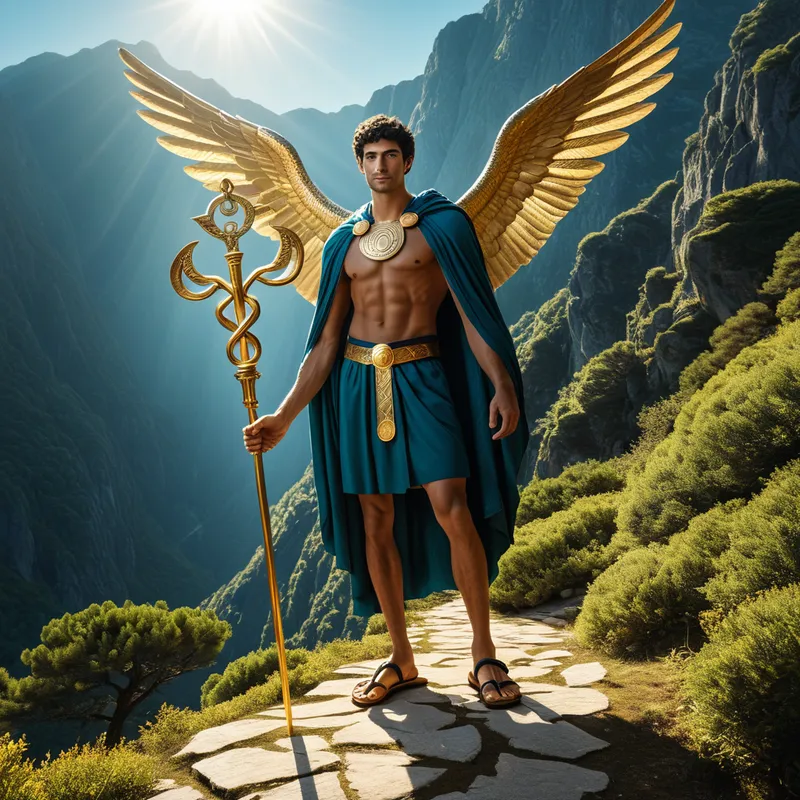
Hermes' Caduceus Myth Meaning & Symbolism
The story of how the trickster god Hermes transformed a violent serpentine conflict into the iconic staff of healing, negotiation, and divine communication.
The Tale of Hermes' Caduceus
The dawn was still a pale rumor on the peaks of Mount Cyllene. In a grove sacred to no one yet, where the air hummed with the first insects and the scent of crushed thyme, a disturbance rippled through the stillness. It was not the wind. It was a hiss that split the world in two—a sound of pure, ancient rivalry.
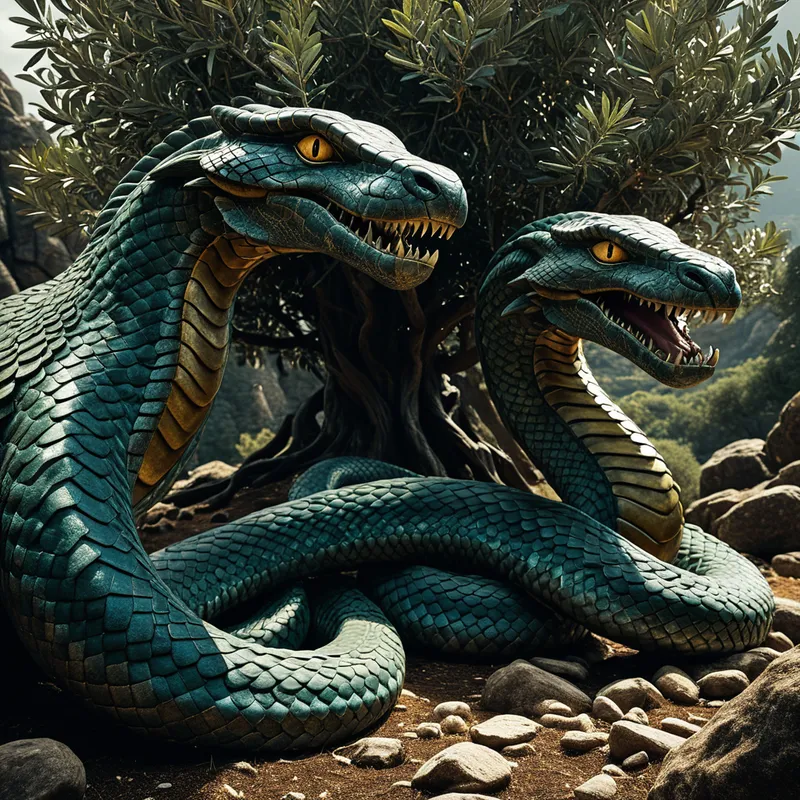
Two serpents, embodiments of the earth’s raw, untamed power, had found each other. They were not mere snakes; their scales held the sheen of polished bronze and deep jade, their eyes were chips of obsidian lit from within. One was the color of a storm cloud, the other the hue of sun-baked clay. They circled, a tightening spiral of muscle and intent, the very dust rising in a slow vortex around their coiling forms. The conflict was primal, a battle for territory, for dominance, for the sheer fury of being. Jaws gaped, fangs gleamed with a venom that promised not just death, but a dissolution back into chaos.
Into this charged arena stepped a figure who was barely more than a breath himself. Hermes, newborn and yet ancient, watched from the shadow of a twisted olive tree. His eyes, the color of a shifting sky, missed nothing. He felt no fear of the serpents’ dance; he saw its pattern. The violence was not an end, but a language—a desperate, twisting argument. As the serpents lunged, finally striking not at each other but in a furious, tangled knot, Hermes moved.
He did not run. He stepped forward, a sapling wand of olive wood suddenly in his hand. It was a simple thing, cut that very morning. With a motion that was neither attack nor defense, but an insertion of a third principle, he thrust the staff into the heart of the conflict.
A miracle of mediation occurred.
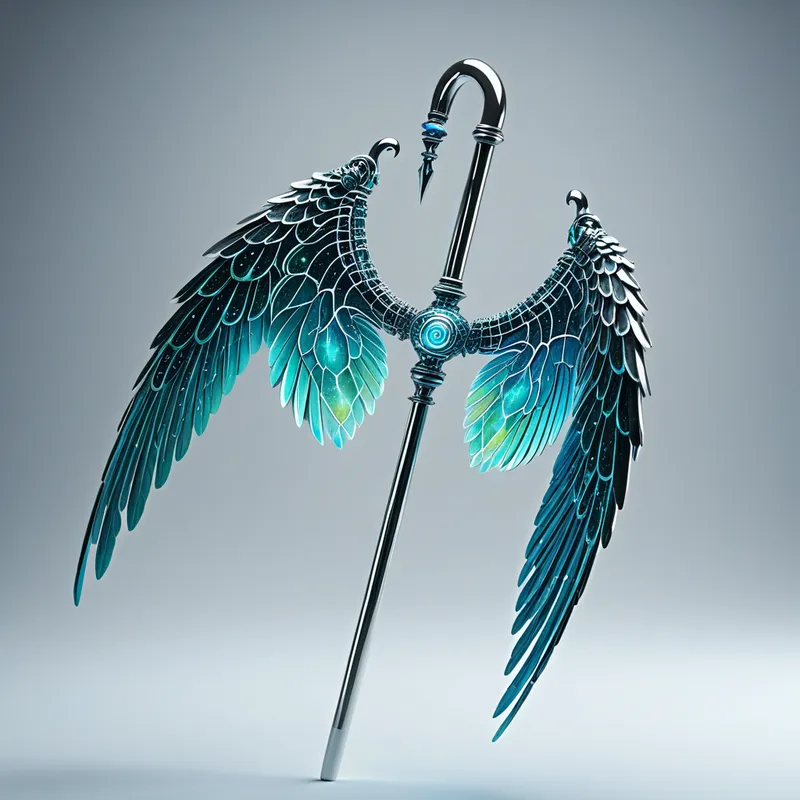
The serpents, locked in their lethal embrace, did not turn on the wand. Instead, as if recognizing a axis more compelling than their hatred, they began to unwind from each other. Slowly, sinuously, they wrapped themselves around the olive wood. Their furious hissing softened to a sibilant whisper. Their heads, once bent on destruction, rose along the staff until they met at its apex, not to strike, but to regard one another across a new, sacred space. The violence was suspended, frozen in a dynamic equilibrium. Hermes lifted the staff, and where there had been two forces of chaos, there was now a single, potent symbol. He touched the top, and in a flash of divine whim, a pair of wings sprouted there—a promise that this reconciled power could now travel, could carry messages between realms.
The first light of the true sun broke over the mountain, glinting off the now-sacred staff. The conflict was not erased; it was alchemized. The Caduceus was born, not from peace, but from the graceful, cunning arbitration of war.
Cultural Origins & Context
This myth, primarily recounted in the Homeric Hymn to Hermes, was not a temple dogma but a story told by bards and poets. It traveled with merchants and shepherds, for Hermes was their patron. The Caduceus was his signature, a badge of office for the divine herald. In a culture that saw the world as a conversation between competing forces—chaos and order, earth and sky, mortal and divine—the symbol served a vital societal function.
It was the sign of the diplomat, the guarantor of safe passage for envoys. It marked the boundary-crosser, the one who could navigate the dangerous spaces between: between city-states, between war and peace, between the living and the dead (for Hermes Psychopomp). The myth explained the origin of this powerful tool not as a gift from another god, but as Hermes’ own creation through an act of ingenious intervention. It cemented his role as the divine trickster whose cleverness (metis) could bring order from disorder, not by force, but by introducing a transformative third element.
Symbolic Architecture
The Caduceus is a map of reconciled opposites, a frozen moment of dynamic balance. Its symbolism is layered like the coils of its serpents.
The central staff is the axis mundi, the world-pillar. It represents the mediating principle, the stable core of consciousness or the Self around which psychic conflict swirls. It is the unwavering wand of Hermes’ intent.
The two serpents are the primal dualities: conscious and unconscious, light and shadow, life and death, ascent and descent. Their conflict is necessary; it is the friction that generates energy and awareness. Their reconciliation around the staff is not a negation of their nature, but a channeling of it. They become complementary forces in a helical dance of evolution.
The true mediator does not choose a side, but provides the axis upon which both sides may turn.
The wings at the apex symbolize the transcendence achieved through this reconciliation. They represent the liberation of spirit, the swiftness of insight, and the ability of the reconciled psyche to communicate between different levels of reality—to carry messages from the depths of the unconscious to the heights of conscious understanding.
The Dreamer's Resonance
When the Caduceus appears in a modern dream, it is rarely as a clear, heraldic symbol. More often, one dreams of being caught between two irreconcilable forces—a feud at work, a torn loyalty in love, a war between a logical plan and a wild intuition. The somatic feeling is one of being twisted, pulled in two directions at once, a tension in the gut or the spine.
To then dream of finding a staff, a rod, or a central path through this chaos is the Caduceus pattern emerging. The dream-ego is being invited to become the Hermes of its own psyche: to not flee the conflict or be destroyed by it, but to step into its center with a discerning intelligence. The dream signals a critical point of potential integration. The serpents of one’s inner opposition are ready to be witnessed, not fought, and in that witnessing, to find a new pattern of co-existence. It is the psyche’s intuition that a higher synthesis is possible.

Alchemical Translation
The myth of the Caduceus is a precise blueprint for psychic alchemy, the individuation process. We all harbor our own “serpents”—opposing complexes, values, or drives that seem locked in eternal combat. The neurotic solution is to try to slay one, leading to one-sidedness and repression. The Hermetic solution is the alchemical coniunctio oppositorum, the sacred marriage of opposites.
First, one must observe the conflict (Hermes watching) with curiosity rather than panic. Then, one must introduce the mediating principle—the staff of conscious attention, perhaps through journaling, active imagination, or dialogue. This is not about taking sides, but about holding the tension. As the opposing energies are acknowledged and given a stable center to relate to, they begin to transform their relationship. The raw, antagonistic life-force (the serpents) is redirected into a creative, encircling motion around the developing Self (the staff).
The Caduceus teaches that healing is not the absence of conflict, but the divine art of weaving it into a higher order.
The final stage is the emergence of the wings—the newfound freedom, insight, and communicative power that arises from this integration. The individual is no longer paralyzed by inner civil war but can move with agility between different parts of themselves and the world. They become a messenger of their own wholeness, a guide who can navigate the liminal spaces because they have made peace with the duality within. The Caduceus, born from a trickster’s insight on a mountainside, thus becomes an eternal emblem of the most profound magic: the transmutation of inner chaos into a symbol of sacred, soaring balance.
Associated Symbols
Explore related symbols from the CaleaDream lexicon: