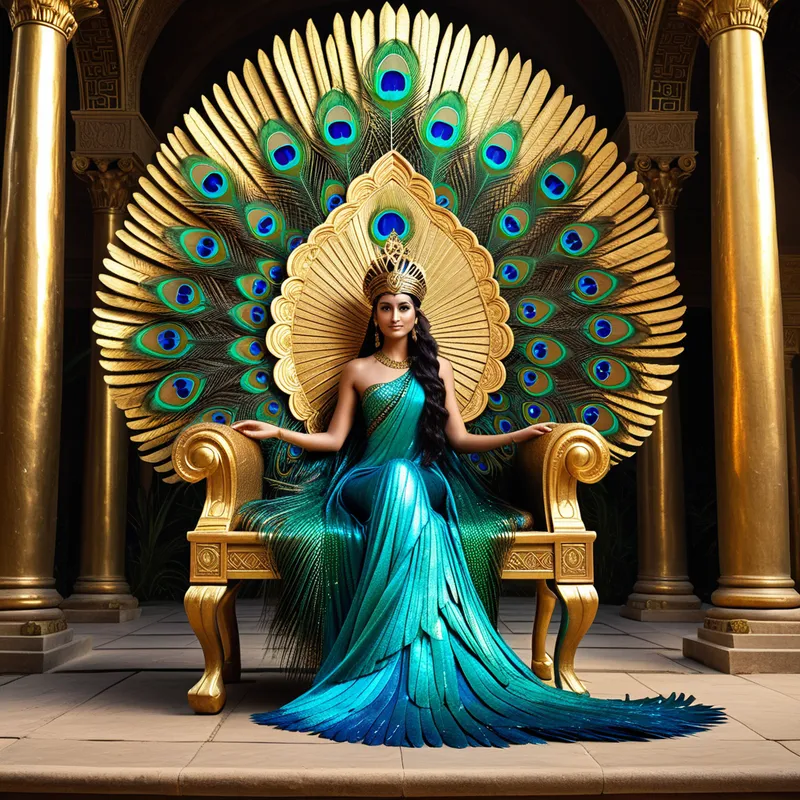
Hera's Peacocks Myth Meaning & Symbolism
The story of how Hera transformed her loyal watchman Argus, whose hundred eyes became the jewel-like plumage of her sacred peacocks.
The Tale of Hera's Peacocks
Listen, and hear a tale woven from starlight and jealousy, a story that begins not with a hero, but with a secret. High on Mount Olympus, where the air tastes of ambrosia, the Queen of Heaven, Hera, nurses a wrath as cold and deep as the cosmic night. Her husband, the Thunderer Zeus, has strayed again, this time capturing his heart—and more—with a lovely river nymph named Io. Furious, Hera descended from the clouds, intent on catching her husband in the act. But Zeus, ever cunning, shrouded the world in a thick, impenetrable mist and transformed his beloved Io into a beautiful, bewildered heifer.
Hera was not fooled. With a smile that did not touch her eyes, she praised the creature and asked for it as a gift. Trapped by his own ruse, Zeus could not refuse. The heifer was Hera’s. And Hera had a perfect guardian for her prize: Argus Panoptes. He was a giant, but his true power lay in his hundred eyes, which glittered like stars across his body. These eyes slept in shifts; while fifty rested, fifty remained watchful, making escape for Io impossible. Day after day, the heifer Io lowed in despair on a lonely hillside, under the unblinking, starry gaze of her jailer.
But the cry of the imprisoned reached the ears of her father, the river god, and he appealed to Zeus. The king of gods, moved by pity and perhaps guilt, summoned his swift son, Hermes. His command was simple: slay Argus and free Io.
Hermes, the master of boundaries and sleep, descended. He disguised himself as a shepherd, left his winged sandals and cap, and took up a simple syrinx, the panpipes. He sat near Argus and began to play. The melody was not of this world—it was the sound of whispering reeds, of distant, lazy bees, of a stream gently coaxing stones to sleep. He told stories with his music, tales of the nymph Syrinx, from whom the pipes were made. One by one, the brilliant eyes of Argus grew heavy. The relentless vigilance softened. The fifty waking eyes began to droop, then the fifty sleeping ones remained shut. Under the divine lullaby, all one hundred eyes closed at once. In that moment of total surrender, Hermes drew a sickle-shaped harpē and struck, ending the watch that had known no end.
When Hera learned of this, her grief for her loyal servant was immense. She descended to the bloody hillside where Argus lay. Gathering his essence, his unwavering service, and his countless sightless eyes, she performed an act of divine remembrance. She took those eyes and set them, not into the earth, but into the very fabric of life. She placed them upon the tail feathers of her most cherished bird, the peacock. Where there was death and failure, now there was eternal, watchful beauty. The peacock’s train became a living tapestry of stars, a monument to fidelity and a warning that the eyes of the Queen see all. And the spirit of Argus? It found a new, lesser form in the common peacock moth, forever drawn to the light it can never truly possess again.
Cultural Origins & Context
This myth is primarily preserved in the epic compendium of Hesiod and, most vividly, in the Roman poet Ovid's Metamorphoses. It functioned as an aetiological myth, explaining the spectacular appearance of the peacock, a bird sacred to Hera and often depicted alongside her in art and temple iconography. The tale was not merely a divine soap opera; it served to articulate the immense power and pervasive awareness of the goddess of marriage and social order. In a culture where xenia (guest-friendship) and marital fidelity were sacred pillars, Hera’s relentless vigilance—embodied first in Argus, then in her birds—was a potent symbol of the consequences of breaking oaths. The story reinforced that no transgression, not even by Zeus himself, could escape the ultimate gaze of cosmic law and retribution, a concept the Greeks called Nemesis.
Symbolic Architecture
At its heart, this is a myth about the transformation of raw function into transcendent form. Argus represents pure, undiluted vigilance—a psychic function of the conscious ego tasked with guarding a boundary (here, the boundary of Hera’s wounded sovereignty and Zeus’s infidelity). He is consciousness itself, fractured into a hundred points of awareness, exhausting itself in the service of control. His death is the necessary collapse of a rigid, exhausting psychological structure.
The eyes that see everything see nothing of themselves; true vision requires a moment of closed eyes, of surrender.
Hermes, the psychopomp, is the agent of this necessary dissolution. His music symbolizes the lure of the unconscious—the stories, dreams, and melodies that can soften the hardest defenses and put the tyrannical watchman to sleep. His act is not one of malice, but of liberation, forcing a stagnant situation to move.
Hera’s final act is the core alchemy. She does not resurrect Argus in his old form. She translates him. The eyes—the tools of paranoid observation—become the jewels of the peacock’s tail, an emblem of majestic display, pride, and numinous beauty. The function of surveillance is transfigured into the symbol of awe-inspiring sovereignty.
The Dreamer's Resonance
When this myth pattern stirs in the modern dreamer, it often manifests as dreams of being watched by countless eyes, of trying to hide a secret “beast” (a heifer, a strange animal), or of encountering iridescent, eye-covered surfaces. Somatically, this can correlate with feelings of chronic anxiety, a stiff neck or shoulders (“carrying the weight of watching”), or insomnia—the body itself playing Argus.
Psychologically, this signals a phase where a part of the psyche is over-invested in a vigilant, exhausting defense. The dreamer may be guarding a vulnerable part of themselves (Io), hiding a creative spark or true feeling for fear of a punitive authority (Hera/Zeus). The dream is the Hermes-function, the unconscious attempting to lull this rigid guard to sleep, to force a crisis that allows for movement and transformation. The appearance of peacock feathers in dreams often follows such a crisis, hinting that the energy bound in vigilance is ready to be reclaimed as personal beauty and dignified display.
Alchemical Translation
The individuation process modeled here is the transmutation of paranoid vigilance into embodied sovereignty. We all have an inner Argus—a complex born of betrayal or insecurity that insists on hyper-vigilance, on seeing every potential threat. This complex guards our inner Io, our innocent, instinctual nature that has been shamed or trapped by circumstance.
The work is not to strengthen Argus, but to first acknowledge his exhausting service, and then to allow the Hermes principle—curiosity, storytelling, connection to the liminal—to soften his gaze. This is the “slaying,” the conscious dissolution of an old, rigid ego structure. The grief that follows is Hera’s grief: the recognition of what we have sacrificed to our own defenses.
The alchemy occurs in the act of sacred reclamation. We take the “eyes”—the acute perceptions, the painful awareness born of our wounds—and we do not discard them. We weave them into our new form.
We integrate those watchful insights not as tools for fear, but as jewels in our crown of self-knowledge. The peacock’s display is not vanity, but the rightful manifestation of a hard-won totality. The modern individual undergoing this process moves from a state of defensive watching (“What might hurt me?”) to one of dignified showing (“This is the beauty forged from what I have witnessed”). The tail is fanned not in threat, but in a declaration: I have seen, I have grieved, and from that material, I have created something worthy of a goddess.
Associated Symbols
Explore related symbols from the CaleaDream lexicon: