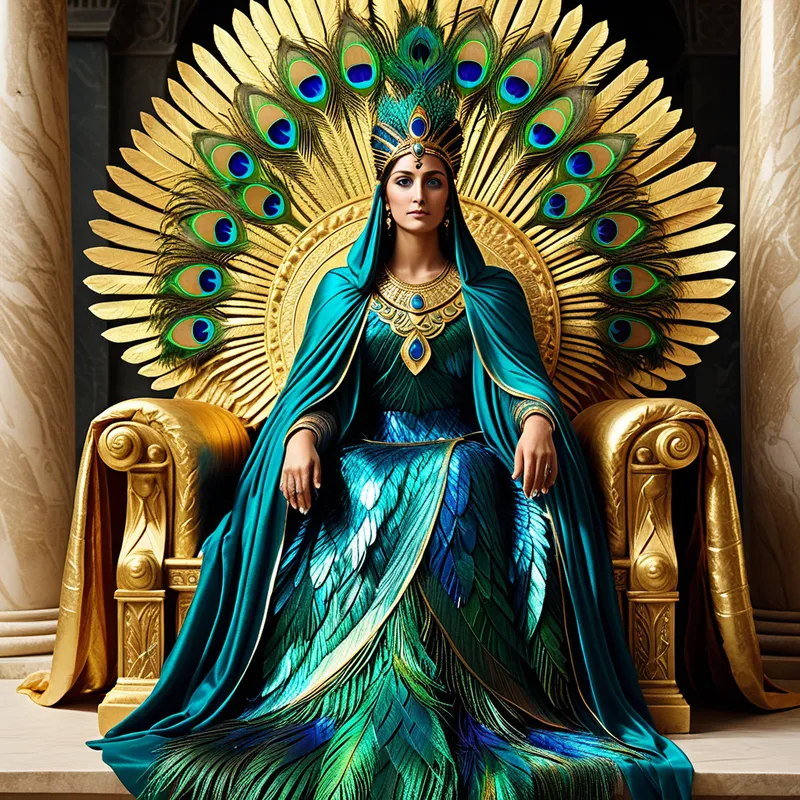
Hera's Peacock Mantle Myth Meaning & Symbolism
A myth of divine betrayal where Hera transforms her slain watchman, Argus, into a peacock, weaving his hundred eyes into her mantle of sovereignty.
The Tale of Hera's Peacock Mantle
Hear now a tale not of glorious heroes, but of a queen’s wrath, a god’s trickery, and the silent witness who saw too much. The air on Olympus was thick with the scent of ambrosia and the cold fire of jealousy. Hera, Queen of Heaven, her heart a storm cloud, had discovered her husband’s latest infidelity. Zeus, to hide his mortal lover Io, had transformed the maiden into a beautiful, bewildered white heifer. A pitiful disguise, transparent to the eyes of a wronged wife.
But Zeus, ever cunning, presented the heifer as a simple, splendid gift. Hera, her smile a blade of ice, accepted it. “A fine creature,” she said, her voice like polished marble. “I shall set a most singular guardian to keep her safe.” And she summoned Argus Panoptes.
Argus was a creature of profound vigilance. A hundred eyes stared from his colossal form, set in his flesh like jewels in a living tapestry. No more than fifty ever slept at once; the rest remained open, watchful, an unblinking sentinel network. He led the heifer-Io to a secluded, sun-drenched meadow, and there he stood, a mountain of observation. Io grazed on bitter herbs, her lowing a mournful song of a stolen self. Argus watched. He watched the grass bend, the clouds scud, the shadows lengthen. He watched for the subtle interference of gods.
Zeus, chafing under this perfect prison, called upon his son, the messenger Hermes. “Go,” he commanded. “Lull the watcher. Free what is mine.”
Hermes, donning his traveler’s cloak and sandals, descended. He did not come as a warrior, but as a shepherd, carrying a syrinx—pan pipes of hollow reed. He sat near Argus and began to talk—idle tales of nymphs and rivers. Then he lifted the pipes to his lips.
The music that flowed forth was not grand or heroic. It was the sound of a lazy afternoon, of bees humming in clover, of water trickling over smooth stones. It was the very essence of drowsy, profound peace. One by one, the eyes of Argus began to flutter and close. The giant fought, his consciousness a flickering lighthouse, but the melody was a soft, irresistible tide. Tale followed tale, note followed note, until the last brilliant eye dimmed and shut. In that moment of complete, vulnerable slumber, Hermes, swift as thought, drew a sickle-sword and struck. The watchman fell, his hundred lights extinguished forever.
When Hera learned of this, her fury was a silent, cosmic cold. She descended to the mortal plane, to the meadow now stained and still. She looked upon the fallen form of her most faithful servant, his sight stolen in sleep. This betrayal was twofold: her husband’s deceit, and the murder of her chosen guardian. But Hera’s grief did not manifest in tears. It manifested in transformation.
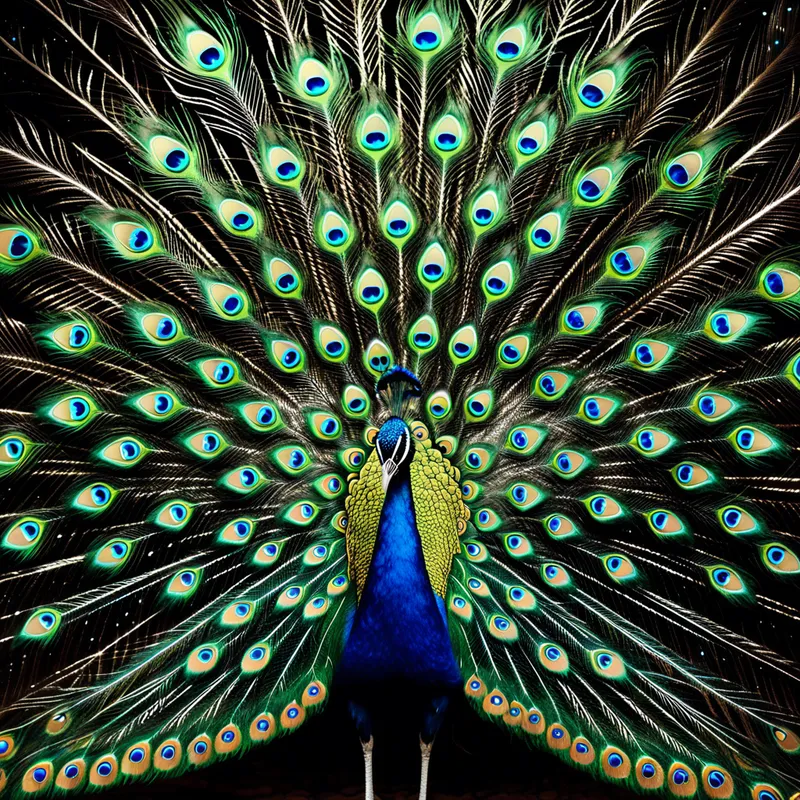
She knelt beside Argus. With a touch both tender and terrible, she gathered his essence—not his body, but his seeing. From his lifeless form, she plucked the hundred eyes, not as gore, but as spheres of pure, captured perception. She breathed upon them, and they shimmered, changing their nature. Then, with a sweep of her arm, she cast them into the air, where they settled upon the long, trailing feathers of a magnificent bird that had not existed until that very moment—a bird of impossible blue and green, with a fan of a tail like a starry night. The eyes became the glorious, iridescent ocelli of the peacock’s train. The bird, proud and mournful, let out a cry that echoed Io’s lament.
Hera then took the bird as her own sacred animal. She wove its feathers into a new mantle for her shoulders. When she wore it, the eyes stared out from the fabric of her divinity, a permanent, beautiful testament to Argus’s service and her own loss. The peacock’s cry became the sound of her lament, and its dazzling display, the armor of her remembered wrongs. Io, eventually freed, would wander the earth, but Hera’s mantle was forever.

Cultural Origins & Context
This myth, primarily preserved in Ovid’s Metamorphoses and referenced by earlier sources, is a quintessential aition—a story explaining the origin of something in the natural world. It answers the question: why does the peacock have eyes on its feathers, and why is it sacred to Hera?
In the highly social and honor-based world of ancient Greece, the myth functioned on multiple levels. For the everyday Greek, it explained a striking natural phenomenon through divine drama. More profoundly, it reinforced the complex nature of Hera herself. She was not merely a jealous shrew, as simplistic readings suggest, but the fierce guardian of the sacred oath of marriage (hieros gamos) and the social order it underpinned. Her actions—setting a guard, and then eternally memorializing that guard—spoke to a deep cultural value: loyalty must be honored, and its violation, even by the king of gods, has lasting consequences. The myth was likely told in religious contexts honoring Hera, serving as a reminder of her power, her sanctity, and the high cost of betraying her domain.
Symbolic Architecture
At its heart, this is a myth about the transformation of perception through violation. Argus represents pure, undifferentiated awareness—consciousness itself, in its raw, observational state. He is the “all-seeing” eye, but without an integrated self. He is a tool of the Queen’s will, a fragmented witness.
His murder by Hermes, the god of boundaries, thieves, and transitions, symbolizes the inevitable violation of this pristine awareness. Consciousness is put to sleep by enchantment (the stories, the music) and then shattered. This is the traumatic moment when our innocent watching of the world is broken by betrayal, deceit, or profound loss.
Hera’s act is not revenge, but reclamation. She does not resurrect the servant; she transmutes the function of his service.
The eyes are not discarded. They are alchemized. The somatic, flesh-bound vigilance of Argus becomes the aesthetic, radiant display of the peacock. The mantle is the key symbol: it is the integration of this traumatic seeing into the identity of the Sovereign. The eyes are no longer vulnerable on a body that can be put to sleep and slain; they are now part of an imperishable, divine garment—a crown of vision born of pain. The peacock’s scream mirrors Io’s, binding the victim, the watchman, and the queen in a single chord of suffering transformed into majesty.

The Dreamer's Resonance
When this myth pattern stirs in the modern unconscious, it often surfaces in dreams of being watched by many eyes, or of discovering beautiful yet unsettling patterns covered in eyes (wallpaper, fabric, skin). One might dream of a beloved pet or guardian being harmed, only to have its essence appear later in a dazzling, unfamiliar form.
Somatically, this can correlate with a period of hyper-vigilance following a betrayal—a feeling of being “on guard” in all directions, like Argus. The psychological process is the beginning of integration. The dream ego is grappling with a recent violation of trust or a shattering of a previously held worldview (the “slaying” of naive perception). The appearance of the eyes transforming into something beautiful signals the psyche’s innate movement toward making meaning out of the violation. It is the first hint that the exhausting state of fragmented watchfulness can be woven into a new, more resilient aspect of the self. The dream is an invitation to move from being a victim of the betrayal (Io) or a slain witness (Argus) toward becoming the sovereign who wears the history of their sight as a mantle of strength.
Alchemical Translation
The individuation process modeled here is the alchemy of painful insight into sovereign identity. We all have our “Argus” moments—times when our trust, our watchful care, or our honest perception is brutally disregarded by another (the Zeus/Hermes principle of disruptive, boundary-crossing energy). The initial response is often Hera’s wrath: a righteous, freezing anger that seeks to control and punish.
But the myth shows us the next, crucial stage. Individuation demands we go to the site of the psychic slaughter. We must kneel, as Hera did, with the raw material of our pain—the “hundred eyes” of our disillusionment, our seen-but-unacknowledged truths, our vigilant anxiety.
The peacock mantle is the symbol of the conscious personality that has digested betrayal and made it a part of its regalia, not its wound.
The alchemical work is the weaving. It is the active, creative process of taking those shattered pieces of perception and fashioning them into something that enhances our stature. Instead of the eyes being a source of paranoia (constantly watching for the next betrayal), they become a source of discernment and awe-inspiring presence. The transformed pain grants panoramic vision—the ability to see patterns, consequences, and beauty that were invisible before. We become the ruler of our own inner kingdom, not by denying the betrayals we have witnessed and endured, but by wearing them as the iridescent, undeniable proof of our endurance and our hard-won, all-seeing wisdom. The cry of the peacock remains—the acknowledgment of the pain—but it is now framed by breathtaking beauty, a display that says: I have seen, I have suffered, and I have made this sight my crown.
Associated Symbols
Explore related symbols from the CaleaDream lexicon: