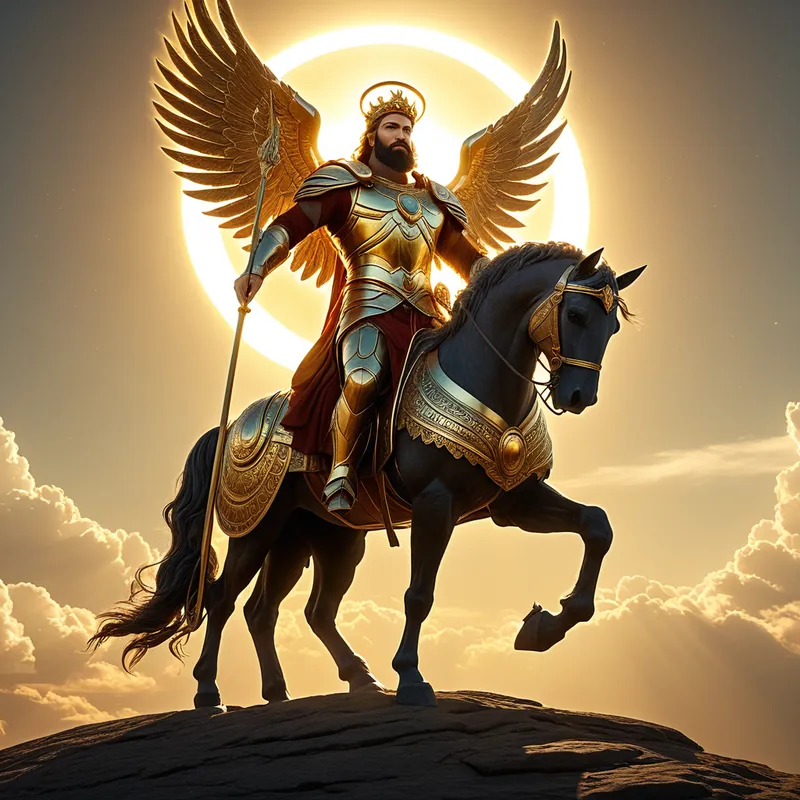
Helios/Apollo Myth Meaning & Symbolism
The myth of the sun's journey, from the celestial chariot of Helios to the lyre of Apollo, mapping the path from raw power to conscious illumination.
The Tale of Helios/Apollo
Hear now the tale of the Sun’s journey, a story not of one god, but of the light itself learning to speak.
Before the first note of music, there was only the roar. It was the roar of four immortal, flame-maned stallions—Pyrois, Aeos, Aethon, and Phlegon—straining against their harnesses of adamant. At their reins stood Helios, a being of such immense, silent power that to look upon him was to see the furnace of creation. His palace was in the farthest east, where the sky bled gold and rose. Each dawn, with a motion as inevitable as the cosmos, he would mount his chariot, a blazing disc of hammered gold, and begin his arc across the dome of heaven. The world below received his gaze: the mountains cast long shadows that shrank to nothing at his zenith, the sea became a sheet of molten silver, and the dark cloak of Nyx was relentlessly rolled back. His was a solitary, monumental duty—the unthinking, glorious expenditure of pure radiance.
But the light yearned for a voice. It descended to Delos, where Eileithyia attended Leto, who grasped a palm tree as her labor shook the floating isle. And so Apollo was born, and with his first cry, the island was anchored by roots of light. He was gold, but a different gold—not the blinding ingot, but the glint on a well-strung lyre. He sought the serpent Python at the navel of the world, Delphi, and with arrows that sang through the smoky chasm, he slew the beast of murky prophecy. From its death throes arose the clear, intoxicating vapors of truth, and a new voice spoke through the Pythia: not a roar, but a riddle.
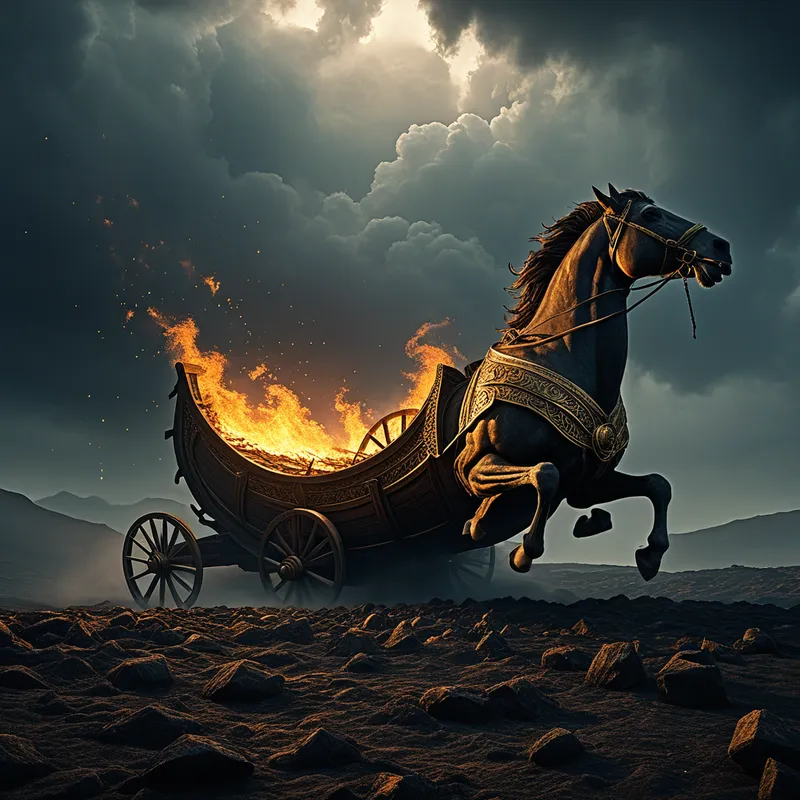
Yet the old fire remained. It burned in the heart of Phaethon, who came to his father’s eastern palace demanding proof of his lineage. Helios, bound by a fatal oath, granted his son one wish. The boy, drunk on the prospect of glory, wished to drive the sun chariot for a single day. The Titan’s face fell, for he knew the truth: the horses knew only his hand. He pleaded, but the wish was sworn. As Phaethon seized the reins, the world held its breath. The stallions, sensing weakness, bolted from the celestial road. They scorched the heavens, creating the Galaxy, then plunged too low, setting the earth ablaze. Rivers boiled, cities smoked, and the scorched skin of Africa turned to desert. To save all creation, Zeus had no choice but to strike the chariot from the sky with a thunderbolt. Phaethon fell like a shooting star, extinguished in the river Eridanos, his sisters, the Heliades, weeping amber on its banks.
And Apollo, the god of measured beauty, wept too. For in that fall, he saw the fate of raw, untempered brilliance. He took up his lyre, and where the music fell, healing followed. He established his oracle, where fire from the earth met the light of the mind to birth foresight. The sun’s journey was no longer just a path across the sky; it became a story told in poetry, a diagnosis given in a healing temple, a truth whispered in a trance. The roar had found its melody.
Cultural Origins & Context
This solar narrative is not a single myth but a layered palimpsest of Greek religious evolution. The figure of Helios is ancient, a pre-Olympian Titan whose worship was pervasive but often indirect—he was the all-seeing witness invoked in oaths, the fundamental celestial fact. His daily journey was less a story to be told than a cosmological process to be acknowledged, a pillar of the world-order (Themis). Homeric hymns describe his passage with awe, but he lacked the complex personality and cult centers of the Olympians.
Apollo’s arrival represents a profound cultural shift. Emerging in the Archaic period, he is a god of the polis, of civilization itself. His myths were performed in song by traveling bards and later solidified in the works of Hesiod, Pindar, and the tragedians. The Delphic Oracle, under his patronage, became the spiritual and political nerve center of the Greek world, guiding colonization, law, and personal conduct. The myth of Phaethon, most famously told by Ovid, served as a powerful cautionary tale about hubris, the danger of overreaching one’s nature, and the catastrophic cost of divorcing power (Kratos) from wisdom (Metis). The sun, in this integrated view, was both a physical force and a moral principle.
Symbolic Architecture
At its core, this mythic complex maps the evolution of consciousness from an unconscious, natural force to a conscious, creative, and integrative principle.
Helios represents the pure, undifferentiated Self in its primordial state—a source of immense energy and life, but one that operates autonomously, without reflection. He is the libido, the sheer psychic fuel. His chariot is the vehicle of this energy, and its fixed path signifies the compulsive, archetypal patterns of the unconscious. He sees all but does not understand; he illuminates but does not interpret.
The sun that merely rises and sets is a fact of nature. The sun that inspires an oracle, heals a wound, or structures a melody is a fact of soul.
Apollo symbolizes the birth of the conscious ego that seeks to harness and give form to this raw power. His attributes are instruments of differentiation: the lyre (harmony, art, and mathematical proportion), the bow (focused intent, discrimination), and the laurel (victory achieved through cultural, not brute, strength). Slaying the Python is the classic hero’s task of overcoming the primal, chthonic unconscious (the serpent) to establish a space for conscious order and light—the temenos of the individual psyche.
The tragedy of Phaethon is the catastrophic failure of this integration. He is the inflated ego, the son who believes he can wield the father’s (the Self’s) power without possessing the father’s nature or discipline. His fall is the inevitable psychic disaster when unconscious energies are seized by an immature consciousness—burnout, mania, and the scorching of one’s inner and outer world.
The Dreamer's Resonance
When this mythic pattern stirs in the modern dreamer, it often signals a critical phase in relating to one’s own vital energy and creative authority.
Dreaming of a blinding, silent sun or a relentless, heatless light may point to an encounter with the Helios principle: a feeling of being driven by an impersonal, overwhelming force—a career, an obsession, a biological drive. It is energy without a voice, causing anxiety or a sense of being spectated upon by an unfeeling cosmic eye.
Dreams of Apollo’s symbols—a golden lyre, a perfectly crafted bow, a sunlit temple—suggest the psyche’s movement toward integration. The dreamer may be discovering a talent, seeking truth and clarity (the oracle), or attempting to bring healing and order to a chaotic inner situation. A dream of successfully playing music that seems to emit light is a profound image of the ego beginning to channel the Self creatively.
The Phaethon dream is one of catastrophic inflation. It manifests as dreams of driving a vehicle that is far too powerful, careening out of control, or of setting things ablaze accidentally with a mere touch. It is the somatic sensation of overheating, of racing heartbeats without cause, speaking to a life situation where ambition has dangerously outstripped capability or where one is “burning the candle at both ends” with no connection to a guiding center.

Alchemical Translation
The alchemical journey mirrored in the Helios/Apollo myth is the transmutation of the sol niger—the black, scorching sun of leaden obsession—into the sol philosophicus—the wise, golden sun of integrated consciousness.
The initial state is identificatio with Helios: we are our jobs, our passions, our raw drives. We burn with a light that is not our own, on a path we did not choose. This is the massa confusa, the chaotic primal matter. The Phaethon crisis is the necessary, if destructive, separatio. The inflation must burst; the ego’s pretension to be the Self must be shattered by the thunderbolt of reality (illness, failure, burnout). This is the nigredo, the blackening, the descent into the waters of the Eridanos—a depression that feels like the end of one’s light.
The fall from the chariot is not the failure of the journey, but the beginning of the true one. It is the moment the light turns inward.
From this dissolution arises the Apollonian work: the coniunctio of opposites. The conscious mind (Apollo) must now return to the source (Helios), not to usurp it, but to dialogue with it. This is the internalization of the oracle. We learn to “consult the god within”—to listen to the body’s wisdom (healing), to give form to our impulses through art (the lyre), and to aim our desires with precision (the bow). The fixed, compulsive solar track becomes the creative, spiraling path of individuation.
The ultimate goal is not to become the sun, but to become a vessel through which its light can be meaningfully refracted. We are not Helios, nor are we Phaethon. We are, in our highest potential, the temple at Delphi—the place where the fire from the deep earth and the light from the high heaven meet to generate a voice that can say, “Know thyself.” The chariot becomes the lyre, the roar becomes a hymn, and the journey across the sky becomes the music of a life consciously lived.
Associated Symbols
Explore related symbols from the CaleaDream lexicon: