Helios / The Sun God Myth Meaning & Symbolism
The story of Helios, the all-seeing Titan who drives the sun chariot across the sky, embodying the relentless light of consciousness and the cost of divine sight.
The Tale of Helios / The Sun God
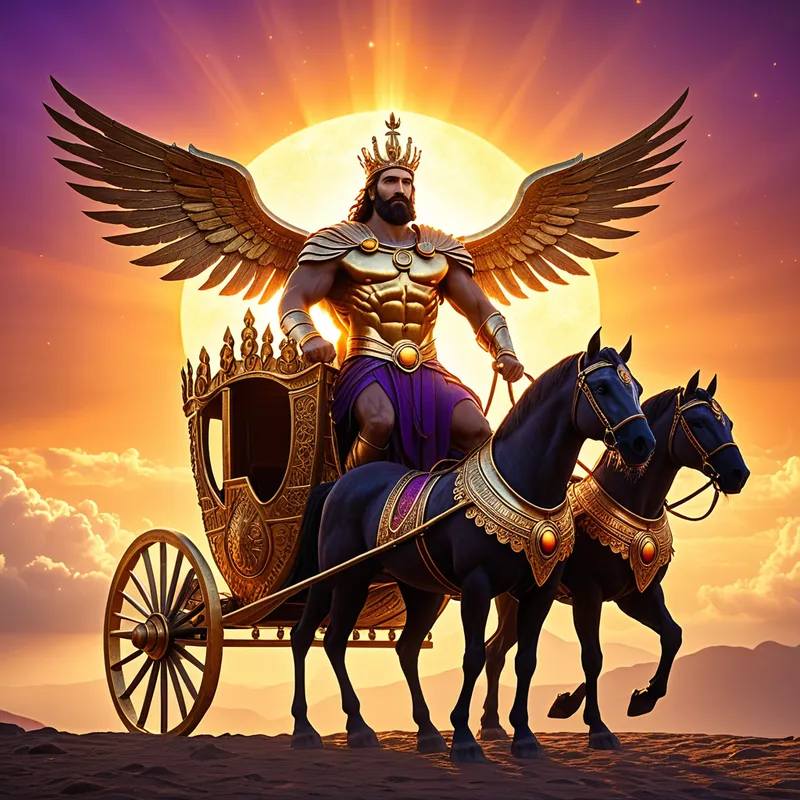
Listen. Before the laughter of the Olympians, there was the solemn, burning rhythm of the cosmos. In the beginning, there was Chaos, and from it came the first gods. Among these Titans was Helios. He was not the sun itself, but its very soul, its charioteer. His was the first face the world saw each day, and his departure marked the reign of shadows.
Each morning, in the far east, in the land of the Ethiopians, the goddess Eos would paint the sky with rosy fingers. As her light bled across the horizon, Helios would emerge from his palace, clothed in robes of purple and saffron. His chariot, a masterpiece of Hephaestus, stood ready, wrought of flawless gold and gleaming electrum. To it were harnessed four immortal steeds: Pyrois, Aeos, Aethon, and Phlegon—Fire, Dawn, Blaze, and Flame. Their breath was the hot wind of summer, their hooves sparked against the threshold of day.
Helios would mount his chariot, take the reins of light in his hands, and begin his ascent. The climb was steep, a perilous arc over the dome of the sky. Below, the world lay revealed in his unwavering gaze. Nothing was hidden. He saw the secret loves of gods and mortals, the hidden crimes in dark alleys, the silent prayers in lonely fields. His light was impartial, a terrible, beautiful justice. At the zenith, he would pause, a sovereign at the peak of his power, flooding the earth with a light so pure it bleached color from stone and truth from lies.
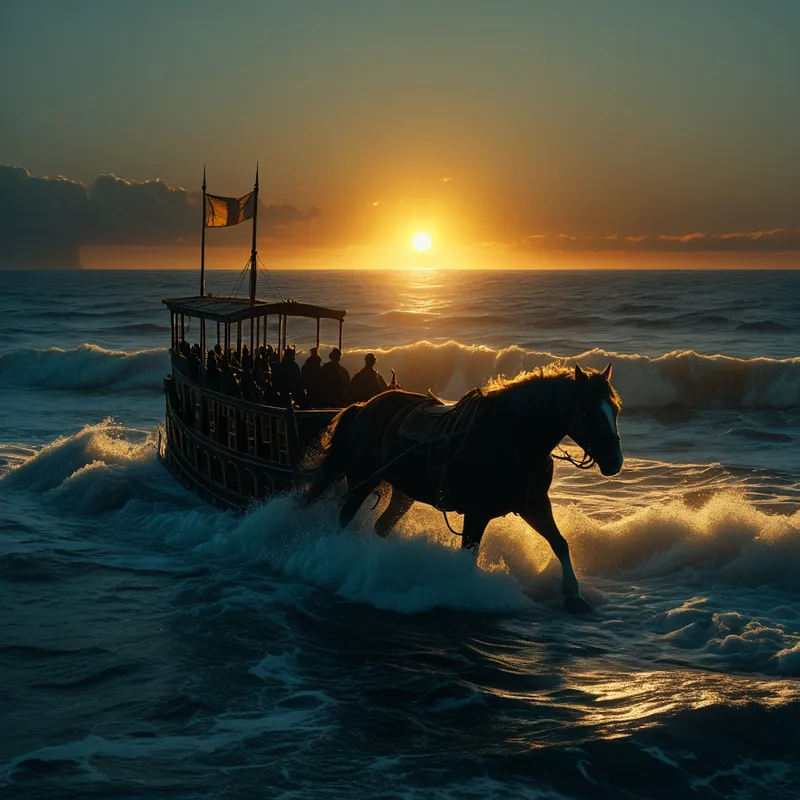
But sovereignty is a journey, not a throne. The descent began, the chariot tilting toward the west. The air grew heavy, the light molten and thick as honey. In the far west, where the sky met the endless river Oceanus, a golden cup awaited him—a vessel to carry him on a nocturnal river journey back to the east, beneath the world, through the dark waters to his starting point. As the rim of the sun-chariot touched the waves, the sea would hiss and steam, and the world would hold its breath. Then, darkness. Helios was gone, traveling the underworld river, a silent, radiant passenger in the realm of Hades, until the cycle began anew.
This was his eternal duty, his moira: to see all, to illuminate all, to trace the unbreakable circle of order amidst the chaos of the world. He was the great witness, bound to the wheel of the sky, a prisoner of his own glorious, exhausting purpose.
Cultural Origins & Context
The worship of Helios is ancient, rooted in the pre-Olympian, Indo-European past. He is a Titan, a being of an older, more elemental order than the gods of Zeus. His myth was not one of dramatic adventure or passionate romance, but of cosmic function. It was a myth of process, explaining the most reliable, fundamental phenomenon of human life: the rising and setting of the sun.
His stories were passed down by poets like Hesiod and Homer, who embedded him in the fabric of their epics. In Homer’s Odyssey, it is Helios who sees the men of Odysseus slaughter his sacred cattle on the island of Thrinacia, and who demands vengeance from Zeus, leading to their final destruction. This highlights his societal function: he was the ultimate witness. In a culture where oaths were sworn by the sun and the earth, Helios was the guarantor of truth. His all-seeing eye made hidden transgression impossible, enforcing a moral and natural order. His major cult centers, like Rhodes, celebrated him not with chaotic Dionysian frenzy, but with the disciplined offering of chariots and horses into the sea—a ritual mirroring his own journey, affirming the community’s participation in cosmic law.
Symbolic Architecture
Helios represents the principle of conscious awareness itself. He is not the creative fire of inspiration (Apollo, who later absorbed some of his solar attributes), but the steady, discerning light of observation. His chariot ride is the daily journey of the ego-consciousness across the sky of the mind, illuminating the contents of the psyche.
The sun sees everything, but is touched by nothing. This is both its power and its profound solitude.
His four horses symbolize the dynamic, powerful, and often unruly energies (the four functions of consciousness: thinking, feeling, sensation, intuition) that must be harnessed and directed by the ruling principle of the self to create coherent experience. The zenith is the peak of conscious clarity, while the descent into the cup of Oceanus represents the necessary withdrawal of consciousness into the unconscious—the nightly descent into dream, introspection, and the shadowy waters of the psyche. His underworld journey signifies that even the light of awareness must pass through and acknowledge the realm of the repressed, the forgotten, and the dead, to be regenerated.
The myth’s core conflict is between this absolute, witnessing consciousness and the human desire for secrecy, for a shadow in which to hide. Helios’s daughter, Leuce, and his tragic son, Phaethon, who could not control the solar steeds, are testaments to the dangers of this light—it can reveal, but it can also scorch and destroy when approached without the requisite strength or respect for its order.
The Dreamer's Resonance
When the archetype of Helios appears in modern dreams, it often signals a critical phase of heightened consciousness or a confrontation with unavoidable truth. To dream of a blinding, omnipresent sun, or of being watched by a great, unblinking eye from the sky, is to experience the psyche’s own witness function activating.
This can feel psychologically somatic—a pressure behind the eyes, a feeling of exposure, or an internal heat. The dreamer may be undergoing a process where self-deception is no longer possible. Perhaps a long-ignored personal truth, a pattern of behavior, or a foundational belief is being illuminated with stark, uncomfortable clarity. The dream is not punishing; it is enforcing integrity. It is the psyche’s own Helios, demanding that what has been seen in the light be acknowledged. The discomfort is the friction between the ego, which prefers the comfort of shadow, and the Self, which demands conscious alignment. Such dreams can precede breakthroughs, but also periods of intense loneliness, as one realizes the solitary responsibility that comes with true self-awareness.

Alchemical Translation
The alchemical journey mirrored in Helios’s myth is the opus contra naturam—the work against nature—which here means the work against unconsciousness. The goal is not to escape the cycle, but to consciously become the charioteer of one’s own nature.
The gold sought by the alchemist is not at the end of the journey, but is the consistent, disciplined application of heat and light—of conscious attention—to the base matter of one’s life.
The first stage (nigredo) is the pre-dawn, the latent potential in the eastern palace. The rising action (albedo) is the harnessing of the four elemental forces (the horses) and the ascent into clarity, purifying the psyche through honest self-observation. The zenith (citrinitas) is the moment of integrated insight, where the ego serves the Self. The inevitable descent is the rubedo, not a failure, but the incorporation of this conscious light into the depths—the emotional, instinctual, and shadowy parts of the self (the cup of Oceanus). The nocturnal river journey through the underworld is the essential phase where consciousness, now tempered, learns the language of the unconscious, forging a connection between the diurnal and nocturnal selves.
For the modern individual, the triumph is not in always being in the light, but in consenting to the entire circuit. It is to perform one’s daily duties (the chariot ride) with discernment, to accept the lonely responsibility of seeing oneself and one’s world clearly, and to have the courage to regularly descend—through meditation, therapy, art, or solitude—into the nourishing, regenerative darkness, trusting that the light will be renewed. To individuate is to stop fleeing the all-seeing eye and to instead take up the reins, becoming both the witness and the journey, the source of light and its humble, cyclical traveler.
Associated Symbols
Explore related symbols from the CaleaDream lexicon: