Helios & the Chariot of the Sun Myth Meaning & Symbolism
The myth of the sun god Helios, who drives his celestial chariot across the sky each day, embodying the relentless, illuminating journey of consciousness itself.
The Tale of Helios & the Chariot of the Sun
Hark, and listen to the wheel of the world turning.
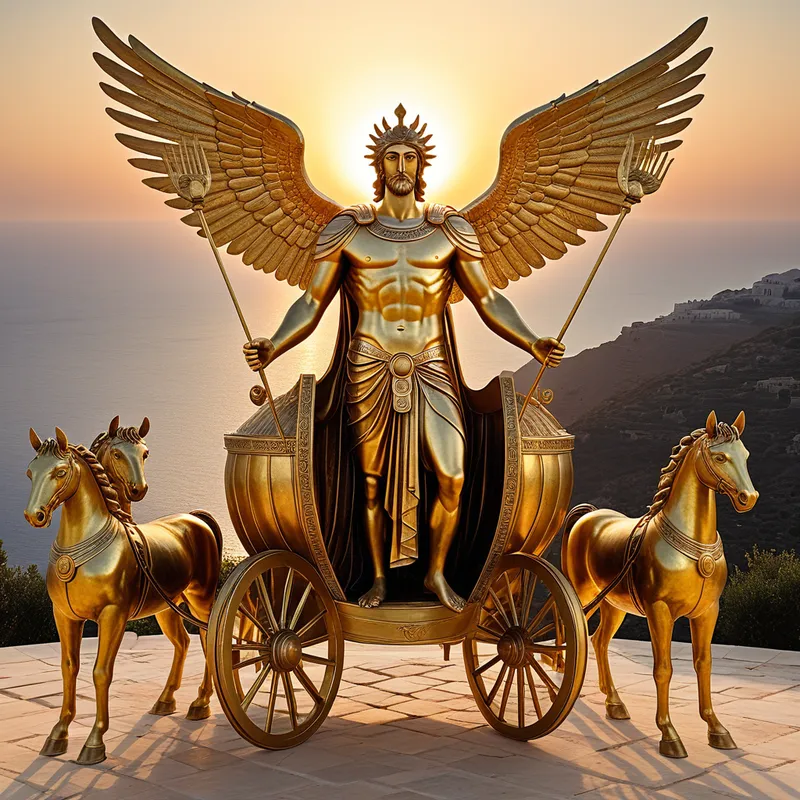
Before the first bird sings, in the silent, violet hour that is not night and not yet day, a gate of untold flame opens in the East. From the palace of Eos, whose fingers stain the clouds with rose and saffron, comes a sound—the restless stamp of hooves on the threshold of heaven. Four immortal steeds, Pyrois, Eous, Aethon, and Phlegon, breathe gusts of star-fire, harnessed to a chariot of blazing bronze and gold.
And there stands their master, Helios. He is not merely a light in the sky, but a god who sees all. His eyes are disks of molten ore, and his hair is a corona of living flame, streaming behind him like a banner. In his strong hands, he gathers the reins—not of leather, but of celestial necessity. With a silent command understood only by the cosmos, he steps into the chariot.
The journey begins not with a roar, but with a sigh—the sigh of the world anticipating light. The chariot lifts from the bank of the river Okeanos, where the sky kisses the sea. The climb is steep and perilous, a soaring arc up the dome of heaven. The horses strain, their manes scattering sparks that become the morning stars fading from view. Below, the dark, curved belly of the earth slowly reveals itself: the green folds of mountains, the silver scribble of rivers, the dark blue expanse of the wine-dark sea. Helios does not smile; his face is a mask of profound duty, for to waver is to scorch the earth or plunge it into endless night.
At the zenith, he pauses. This is the still point, the apex of his power. The light is direct, merciless, and total. Nothing is hidden from his gaze. It is said he saw the abduction of Demeter’s daughter; he witnessed the infidelities of Hera. He is the silent witness of all deeds done under his eye.
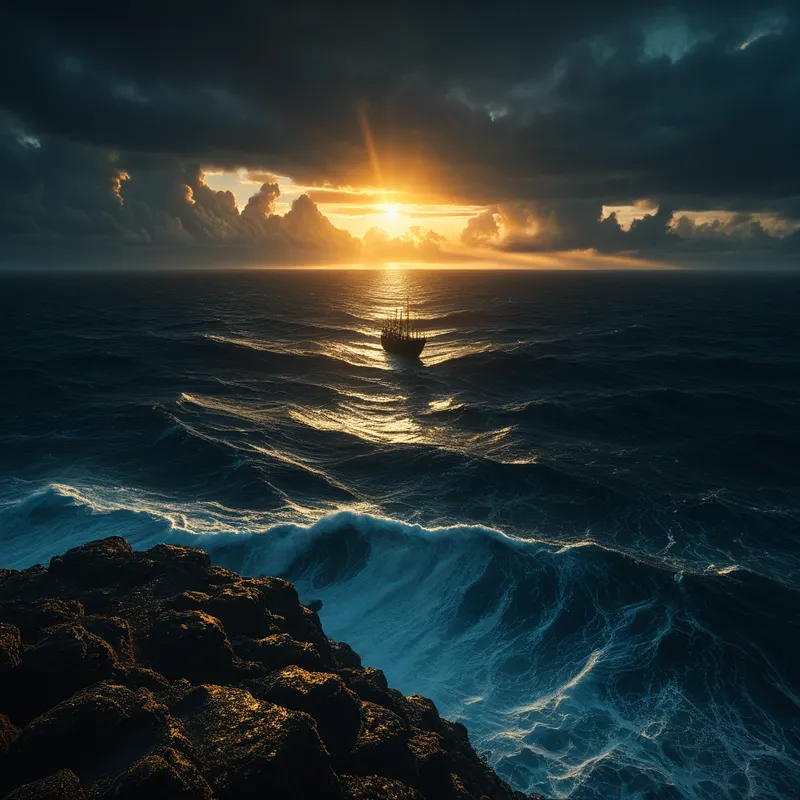
Then begins the descent. The western horizon beckons, a couch of deepening purple and gold. The pace seems to quicken, the chariot tilting toward the waiting waters of Okeanos in the far west. Here, at the end of the world, a golden cup awaits—a boat, or a chalice—crafted by the god Hephaistos. Helios, chariot and all, is ferried through the northern stream of Okeanos, back to his eastern palace, traveling beneath the earth through the night. In that dark, aquatic journey, he becomes the unseen sun, the light in the underworld, while the world above sleeps in the embrace of Nyx.
And so, as the last rim of fire dips below the western wave and the world holds its breath for twilight, know this: the chariot is already moving through the deep, unerring, inevitable, destined to break once more upon the dawn. The wheel turns. Always, it turns.
Cultural Origins & Context
The myth of Helios and his chariot is not the product of a single poet, but a foundational layer of the Greek cosmological imagination. Its roots stretch back into the pre-classical, likely Indo-European, past where the sun was often envisioned as a wheeled traveler. In the Greek world, this narrative served a critical function: it provided a coherent, animate model for the most reliable yet awesome phenomenon in human experience—the daily journey of the sun.
The story was kept alive in the oral tradition, recounted by bards and woven into the fabric of epic poetry. Hesiod’s Theogony establishes his lineage as a Titan, son of Hyperion and Theia. While later poets like Homer sometimes used “Helios” and “Apollo” interchangeably, the core image of the chariot-driver remained distinctly Helios’s. The myth was not mere entertainment; it was a sacred explanation that placed human life within a divine, orderly framework. The sun’s path was a god’s duty, its regularity a testament to cosmic law (Dike). To swear an oath by Helios was to invoke the ultimate witness, for he saw everything.
Symbolic Architecture
At its heart, this myth is a profound map of consciousness. Helios is not just the sun; he is the principle of conscious awareness itself—the illuminating force that distinguishes, reveals, and makes knowing possible.
The chariot is the vehicle of the Self, and the four horses are the powerful, instinctual energies of the psyche that must be guided, not suppressed, on the daily journey of becoming.
The four fiery steeds represent the dynamic, untamed drives of nature—passion, vitality, impulse, and spirit. Their names all speak of fire, the transformative element. Helios’s mastery of them symbolizes the ego’s necessary role: to harness this tremendous psychic energy and direct it along a meaningful, life-sustaining path (the diurnal arc). The chariot’s perilous course mirrors the fragility of consciousness, forever balanced between the heights of inflation (scorching the earth) and the depths of unconsciousness (falling into the sea). The nightly journey through the underworld river is equally critical, representing the necessary immersion of consciousness back into the unconscious—the period of rest, reflection, and integration without which the next day’s light would be impossible.
The Dreamer’s Resonance
When this myth stirs in the modern dreamer, it often signals a critical phase in the relationship between consciousness and instinct. To dream of driving a chariot of fire is to feel the tremendous responsibility of wielding one’s own power and vision. The somatic feeling is often one of exhilarating yet terrifying control—a burning in the chest, a sense of being lifted up, coupled with anxiety about the steep drop on either side.
Conversely, dreaming of the horses without the chariot, or of them running wild, speaks of instinctual forces breaking free from conscious direction—a life driven by unchecked passions or compulsions. Dreaming of the sun standing still at the zenith can indicate a moment of supreme clarity or, negatively, a state of psychological stagnation where one is “stuck in the light,” unable to move forward or descend into necessary shadow. The dream is asking: Can you hold the reins of your life? Are you on your true path, or are you in danger of burning out or crashing?
Alchemical Translation
The alchemical process mirrored in Helios’s journey is the circulatio—the circular distillation of the spirit. The myth models the individuation process perfectly: a daily, cyclical work of psychic integration.
The gold is forged not in the blinding noon, but in the complete cycle—the ascent into light, the descent into shadow, and the secret return through the night.
The nigredo, or blackening, occurs in the nocturnal voyage beneath the earth. This is the dissolution of the day’s conscious attitudes in the waters of the unconscious. The albedo is the first pure, white light of dawn—the emergence of a new, clarified perspective. The citrinitas is the golden path across the sky, the application and testing of this consciousness in the world. Finally, the rubedo is the fiery, setting sun—the integration of the experience into a perfected, enduring form, ready for its transformative journey back to the source.
For the modern individual, the myth calls for a recognition of this inner cosmology. We are each Helios. Our conscious life is a chariot we must guide with disciplined attention (prosoché). Our instincts are powerful steeds to be respected and directed. And crucially, we must honor the downward arc and the night journey—the times of retreat, depression, and unconscious processing—as essential phases of the whole. To only seek the zenith is to court psychic disaster. True wholeness, the Lapis Philosophorum, is found in committing to the entire, unending round, trusting that the light which sets within us will, by the laws of the inner cosmos, inevitably rise again.
Associated Symbols
Explore related symbols from the CaleaDream lexicon: