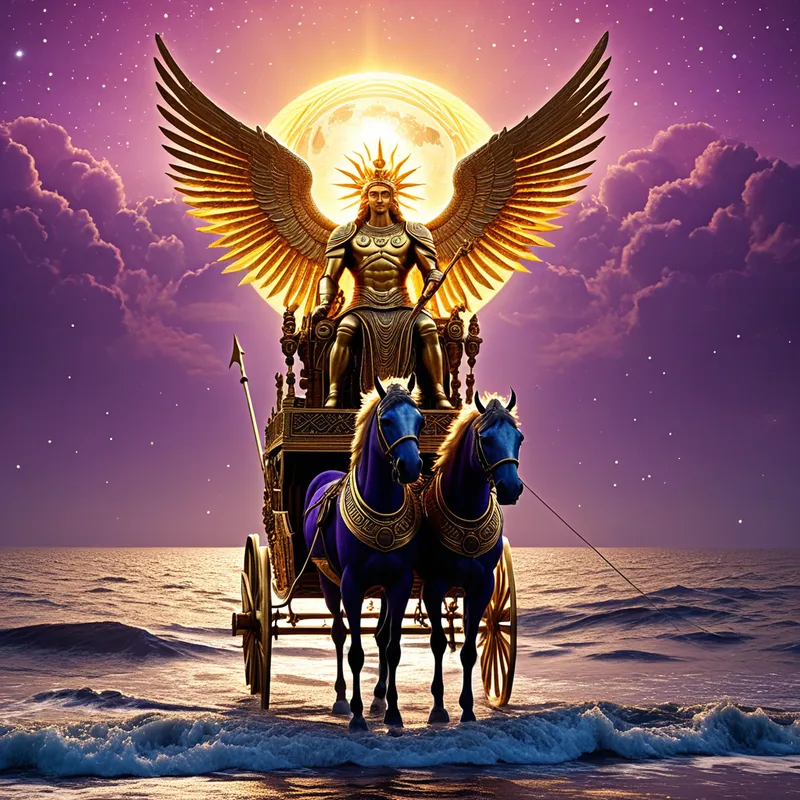
Helios' Chariot Myth Meaning & Symbolism
The sun god Helios drives his fiery chariot across the sky daily, a sacred duty whose violation by his son Phaethon brings catastrophic consequences.
The Tale of Helios' Chariot
Before the first bird sings, in the violet hour where night bleeds into day, the gates of the east open. From the Oceanus stream, in a palace of burnished copper and flame, the god emerges. He is Helios, All-Seeing, crowned with a halo of piercing light. His chariot awaits, a masterpiece of Hephaestus, wrought from gold and electrum. And his horses—Pyrois, Aeos, Aethon, Phlegon—Fire, Dawn, Blaze, and Flame—stamp their hooves, breathing gusts of heat that make the air shimmer.
This is the sacred, unbreakable rhythm: the climb from dawn’s cradle to the zenith’s throne, then the slow, deliberate descent into the welcoming arms of the western sea. The cosmos holds its breath for this journey. The stars fade in deference. The world below wakes to his gaze.
But into this perfect order steps a mortal doubt. Phaethon, son of Helios, is taunted. Is the glorious Sun truly his father? He journeys to the eastern palace, and Helios, bound by a reckless oath, must grant him one wish. The boy does not ask for wisdom or a lesser token. He points to the chariot. “Let me drive it. For one day.”
A silence colder than the depths of Tartarus falls. Helios pleads, describes the terror of the path, the untamed fury of the steeds who know only a god’s hand. Phaethon is deaf to warning, drunk on the promise of glory. He seizes the reins.
The ascent is chaos. The horses, sensing weakness, rebel. They veer from the ecliptic, soaring too high, then plunging too low. The heavens freeze; the earth burns. Ursa Major sweats in her icy berth. Rivers steam and crack. Libya becomes a desert. The earth herself, Gaia, cries out in agony, her skin blistering.
From his throne on Olympus, Zeus acts. There is no time for mercy, only necessity. With a thunderbolt forged in the heart of storm, he strikes. Phaethon, a comet of boy and failure, falls flaming into the wide river Eridanus. His sisters, the Heliades, weep amber tears until they are transformed into poplar trees. The chariot, retrieved, is returned to its rightful driver. Order is restored. The sun rises the next morning, as it must, as it always will. But the sky and the earth bear the scars.

Cultural Origins & Context
This myth, most famously recounted in Ovid’s Metamorphoses, is not merely a story of a boy’s folly. It is a foundational narrative of the Greek cosmological worldview. In a culture that perceived the universe as a delicate balance of forces (Dike), the sun’s reliable journey was the ultimate symbol of cosmic order. Helios was a Titan, an older, more elemental power than the Olympians, representing a fundamental, non-negotiable natural law.
The tale was likely part of an oral tradition long before being set down by poets. It served multiple societal functions: as an aetiological myth explaining the origins of deserts and the amber resin of poplars, as a cautionary tale about the dangers of overreaching (hubris) and youthful impetuosity, and as a theological assertion of Zeus’s ultimate authority to enforce cosmic boundaries. It reinforced the idea that some domains—the paths of the stars, the turning of the seasons—are divinely ordained and mortally inaccessible. To disrupt them is to invite cataclysm.
Symbolic Architecture
At its core, the myth of Helios’ Chariot is a profound map of psychic structure. The Chariot itself symbolizes the vehicle of consciousness, the fragile yet magnificent apparatus that carries our awareness through the day (the known world) and the night (the unconscious). Helios represents the integrating principle of the Self, the mature, conscious ego capable of managing immense energy and adhering to a life-sustaining pattern. He is the archetypal Ruler in his benevolent, ordering aspect.
Phaethon, then, is the inflated, uninitiated ego. He is pure potential and desire, untempered by experience or respect for the system he wishes to command. His wish is not for the sun’s light, but for its glory and recognition—the outer trappings of power without the inner authority.
The chariot is not the power; it is the vessel for a power that must be earned through alignment with a law greater than oneself.
The catastrophic ride is the inevitable result when personal desire attempts to usurp transpersonal order. The horses—the instinctual, libidinal energies of life—run amok when guided by an unworthy hand. The burning earth symbolizes the psyche under siege, where unregulated psychic energy (the sun’s heat) scorches the inner landscape, destroying the fertile ground of connection and growth. Zeus’s thunderbolt is the necessary, brutal intervention of reality—the shocking, often painful correction that brings a runaway complex back into alignment with the whole.
The Dreamer's Resonance
When this mythic pattern stirs in the modern dreamer, it often manifests as dreams of losing control of a powerful vehicle—a car with failed brakes, a plane in a nosedive, or a speeding train. One may dream of intense, scorching heat or a sun that moves erratically, threatening to crash. The somatic experience is one of panic, overheating, and vertigo—a literal fever dream.
Psychologically, this signals a state where an aspect of the personality (the Phaethon complex) has seized control of a life energy or responsibility for which it is not prepared. This could be a sudden promotion one feels unfit for, the intoxicating rush of a new romance that consumes all boundaries, or an obsessive creative project that burns out all other life. The dream is an alarm from the Self: the central governing principle of the psyche senses that the individual is off-path, that their daily “journey” is no longer sustainable and is causing damage to their inner world (the scorched earth) and relationships.
Alchemical Translation
The alchemical process modeled here is not one of gentle refinement, but of catastrophic correction leading to reintegration. The prima materia is the raw, arrogant potential of Phaethon. The nigredo, the blackening, is the burning of the world and his own fiery fall—the utter annihilation of the inflated identity.
The lightning strike of Zeus is the separatio—the violent but necessary separation of the ego from a role it cannot healthily embody.
The resolution is not Phaethon’s survival, but the restoration of the chariot to Helios. For the modern individual, this translates to the painful but crucial process of ceding control. It is the burnout who must learn to delegate, the perfectionist who must accept “good enough,” the people-pleaser who must set a boundary. One must allow the Phaethon-like ambition to die, to fall into the river of forgetfulness (the unconscious), so that the Helios principle—the mature, responsible, life-giving aspect of the Self—can resume its rightful place.
The goal is not to destroy ambition, but to transmute it from a demand for glory into a capacity for stewardship. We are not meant to be the sun, but to learn how to harness its light, to follow its reliable path, and to respect the awesome, disciplined journey that brings warmth without destruction. In this alignment, we find our true orbit, and our life becomes not a catastrophic flight, but a dawning.
Associated Symbols
Explore related symbols from the CaleaDream lexicon: