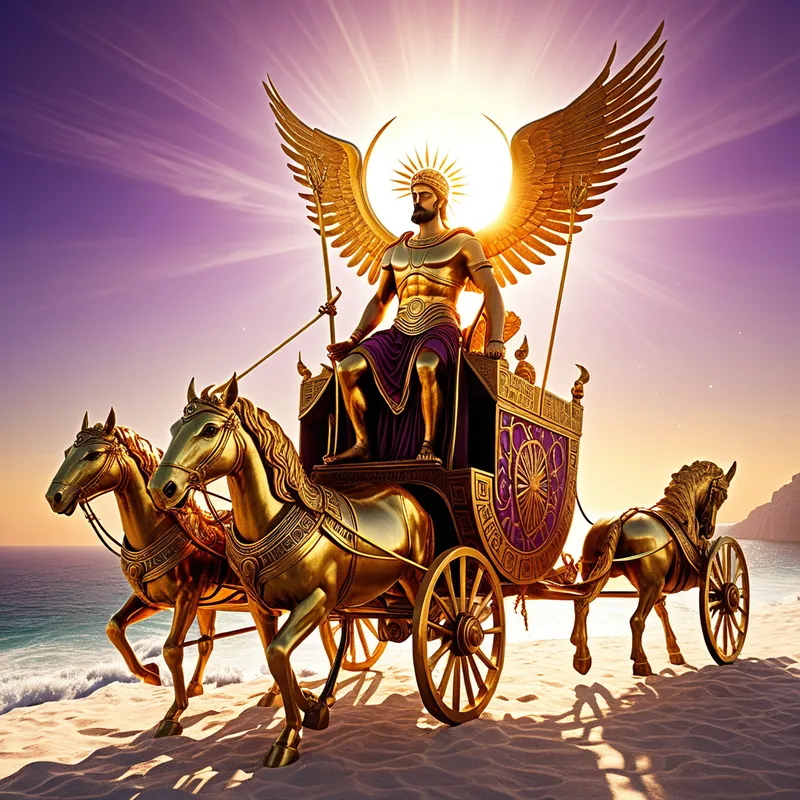
Helios and His Chariot Myth Meaning & Symbolism
The sun god Helios drives his celestial chariot daily across the sky, a myth of cosmic order, divine duty, and the peril of losing control.
The Tale of Helios and His Chariot
Before the first bird sings, in the deep violet hour that is not yet day, he stirs. In the farthest east, where [the sky](/myths/the-sky “Myth from Persian culture.”/) kisses [the river](/myths/the-river “Myth from Buddhist culture.”/) [Oceanus](/myths/oceanus “Myth from Greek culture.”/), the gates of [pearl](/myths/pearl “Myth from Chinese culture.”/) and coral open with a sound like a sigh. And he emerges: [Helios](/myths/helios “Myth from Greek culture.”/), the all-seeing, the golden-tressed, the lord of light.
His chariot awaits, a masterpiece of [Hephaestus](/myths/hephaestus “Myth from Global/Universal culture.”/), wrought from imperishable gold and electrum, its wheels ringing with a promise of heat. To it are harnessed his steeds: Pyrois, Aeos, Aethon, and Phlegon—Fire, Dawn, Blaze, and Flame. They stamp and snort, breathing gusts of warmth into the cool, salty air, their coats gleaming like molten metal. Helios, in robes that shimmer with the promise of noon, steps into [the chariot](/myths/the-chariot “Myth from Tarot culture.”/). He takes the reins, not of leather, but of living light.
With a command that is felt more than heard, the journey begins. The chariot lifts, and [the world](/myths/the-world “Myth from Tarot culture.”/) holds its breath. The first spear of light pierces [the horizon](/myths/the-horizon “Myth from Various culture.”/). Dawn, his sister Eos, paints the sky in rosy fingers ahead of him, but it is Helios who brings the day. He ascends the steep vault of heaven, a solitary, sovereign driver on a path worn by eternity. Below, [the earth](/myths/the-earth “Myth from Hindu culture.”/) awakens to his gaze. He sees everything—the green valleys, the blue seas, the cities of men and the high halls of the gods. His is a lonely, magnificent duty: to bring order, to mark time, to give life.
But one day, the rhythm of the cosmos faltered. His mortal son, [Phaethon](/myths/phaethon “Myth from Global/Universal culture.”/), consumed by doubt and pride, came to the eastern palace. To prove his divine lineage, he begged his father for one wish. Bound by a sacred oath, Helios granted it. The boy’s wish was not for treasure or power, but for the one [thing](/myths/thing “Myth from Norse culture.”/) his father could not safely give: to drive the chariot of the sun for a single day.
Helios pleaded, his radiant face clouded with dread. He described the terror of the path—the dizzying heights, the raging constellations, the precipitous drop to [the sea](/myths/the-sea “Myth from Greek culture.”/). But Phaethon, blind with youthful arrogance, would not be swayed. As the hour approached, Helios anointed his son’s face with sacred oil to protect him from the flame, a father’s futile blessing. “Keep to the middle path,” he whispered, his voice heavy with prophecy. “Do not go too high, nor too low.”
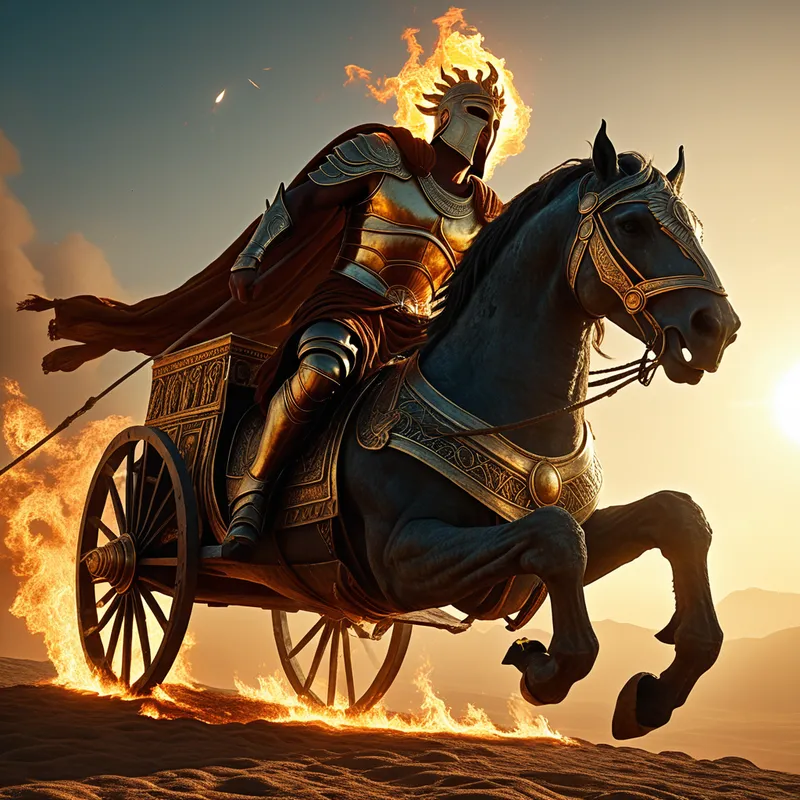
The moment Phaethon seized the reins, the knowing steeds felt the unfamiliar, feeble hand. They bolted. The chariot lurched violently, careening off the celestial track. It soared too high, scorching the stars and creating the constellation we call [the Milky Way](/myths/the-milky-way “Myth from Greek culture.”/). Then, in panic, it plunged too low, dragging its blistering wheels across the earth. Rivers boiled away into steam. Forests became ash. Great cracks opened in the soil, and Libya was burned into a desert. The earth itself cried out in agony to Zeus.
From the peak of [Mount Olympus](/myths/mount-olympus “Myth from Global/Universal culture.”/), Zeus saw the chaos. With a thunderous frown, he took up his master bolt, the only force greater than the sun’s fire. He took aim and hurled it. The lightning struck Phaethon from the chariot, a flash of terrible [justice](/myths/justice “Myth from Tarot culture.”/). The boy fell like a shooting star, trailing smoke, into the distant river Eridanus. The horses, masterless and terrified, were finally corralled by the gods, and the chariot, smoking and damaged, was guided back to its stable. The next dawn, with the world still smoldering, Helios resumed his duty, his grief as vast and silent as the sky he traversed. Order was restored, but at a cost written in the scars of the earth.
Cultural Origins & Context
The myth of Helios and his chariot is not the product of a single poet, but a deep, collective imagining woven into the fabric of Greek consciousness. It finds its most famous telling in Ovid’s [Metamorphoses](/myths/metamorphoses “Myth from Greek culture.”/), but its roots are far older, reaching into the oral traditions of the pre-classical world. Helios was a Titan, a generation older than [the Olympian gods](/myths/the-olympian-gods “Myth from Greek culture.”/), representing a more primal, elemental force—the sun itself, not merely its influence.
This story was not just entertainment; it was a foundational cosmology. For agrarian and maritime societies, the reliable journey of the sun was synonymous with life, law, and survival. The myth gave a face and a story to this daily miracle, explaining the sunrise and sunset, the heat of summer, and the existence of deserts. It was a narrative anchor in a vast, unpredictable universe. Bards would recite it, not only to awe their listeners but to reinforce a cultural truth: the cosmos operates on a delicate, divine order that mortals transgress at their peril. The story of Phaethon served as a powerful cautionary tale about the limits of human ambition and the sacred, dangerous boundary between the mortal and the divine.
Symbolic Architecture
At its [heart](/symbols/heart “Symbol: The heart symbolizes love, emotion, and the core of one’s existence, representing deep connections with others and self.”/), this myth is a profound map of [consciousness](/symbols/consciousness “Symbol: Consciousness represents the state of awareness and perception, encompassing thoughts, feelings, and experiences.”/) and its governance. [Helios](/symbols/helios “Symbol: Helios symbolizes the sun, embodying light, life, and divine energy in various mythological traditions.”/) is not merely a sun god; he is the archetypal principle of conscious [awareness](/symbols/awareness “Symbol: Conscious perception of self, surroundings, or internal states. Often signifies awakening, insight, or heightened sensitivity.”/) itself—the illuminating, discerning light that allows us to see the world and ourselves clearly.
The chariot is the vehicle of the psyche, and the reins are the discipline of the ego. The four fiery steeds represent the powerful, instinctual drives of the unconscious—passion, energy, vitality, and raw creative force.
Helios’s perfect, daily [journey](/symbols/journey “Symbol: A journey in dreams typically signifies adventure, growth, or a significant life transition.”/) symbolizes the successful [integration](/symbols/integration “Symbol: The process of unifying disparate parts of the self or experience into a cohesive whole, often representing psychological wholeness or resolution of internal conflict.”/) of these powerful instincts under the steady hand of conscious [direction](/symbols/direction “Symbol: Direction in dreams often relates to life choices, guidance, and the path one is following, emphasizing the importance of navigation in personal journeys.”/). It is the ideal of a well-regulated Self, where immense power is channeled into [life](/symbols/life “Symbol: The symbol of ‘Life’ represents a journey of growth, interconnectedness, and existential meaning, encompassing both the joys and challenges that define human experience.”/)-giving, world-illuminating [purpose](/symbols/purpose “Symbol: Purpose signifies direction, meaning, and intention in life, often reflecting personal ambitions and core values.”/).
Phaethon’s disastrous ride is the [shadow](/symbols/shadow “Symbol: The ‘shadow’ embodies the unconscious, repressed aspects of the self and often represents fears or hidden emotions.”/) of this ideal. He represents the inflated ego, the part of us that identifies with a divine inheritance (our potential, our talents, our inner god-[image](/symbols/image “Symbol: An image represents perception, memories, and the visual narratives we create in our minds.”/)) but lacks the wisdom, [strength](/symbols/strength “Symbol: ‘Strength’ symbolizes resilience, courage, and the ability to overcome challenges.”/), and maturity to wield it. His failure is not due to a lack of divine [blood](/symbols/blood “Symbol: Blood often symbolizes life force, vitality, and deep emotional connections, but it can also evoke themes of sacrifice, trauma, and mortality.”/), but a lack of earned sovereignty. He cannot hold the reins. The subsequent [chaos](/symbols/chaos “Symbol: In Arts & Music, chaos represents raw creative potential, uncontrolled expression, and the breakdown of order to forge new artistic forms.”/)—the scorching of [heaven](/symbols/heaven “Symbol: A symbolic journey toward ultimate fulfillment, spiritual transcendence, or connection with the divine, often representing life’s highest aspirations.”/) and [earth](/symbols/earth “Symbol: The symbol of Earth often represents grounding, stability, and the physical realm, embodying a connection to nature and the innate support it provides.”/)—symbolizes the psychic catastrophe that occurs when unconscious contents (the steeds) are let loose without the mediating, ordering principle of consciousness. The earth scorched represents the desolation of one’s outer life and relationships, while the sky burned signifies the [inflation](/symbols/inflation “Symbol: A dream symbol representing feelings of diminishing value, loss of control, or expansion beyond sustainable limits in one’s life or psyche.”/) and [breakdown](/symbols/breakdown “Symbol: A sudden failure or collapse of a system, structure, or mental state, often signaling a need for fundamental change or repair.”/) of one’s spiritual or intellectual [framework](/symbols/framework “Symbol: Represents the underlying structure of one’s identity, emotions, or life. It signifies the mental or emotional scaffolding that supports or confines the self.”/).
The Dreamer’s Resonance
When this myth stirs in the modern unconscious, it often manifests in dreams of失控的车辆—a car with no brakes, a speeding train, a bicycle hurtling downhill. The somatic feeling is one of exhilarating yet terrifying acceleration, a loss of agency paired with immense momentum. You may dream of being behind the wheel of something overwhelmingly powerful, knowing you are not qualified to drive it.
Psychologically, this signals a “Phaethon complex.” The dreamer is likely grappling with a situation where their ambition, desire, or a sudden influx of power (a promotion, a creative inspiration, a relationship) has outpaced their internal capacity to manage it. There is a recognition of a “divine right” or a grand opportunity, coupled with a deep, often unacknowledged fear of failure and catastrophic collapse. The dream is the [psyche](/myths/psyche “Myth from Greek culture.”/)’s urgent message: the instincts are in the driver’s seat, and the conscious self has lost its authoritative grip. The burning landscape in the dream points to areas of life already suffering from this neglect or inflation.
Alchemical Translation
The myth models the complete cycle of psychic alchemy, the individuation process. We begin in the [nigredo](/myths/nigredo “Myth from Alchemical culture.”/), the blackening: the chaotic, scorched earth after Phaethon’s fall. This is a state of depression, burnout, or crisis, where an ego-inflation has painfully collapsed. It is a necessary, if brutal, humbling.
The lightning bolt of Zeus is not merely punishment, but a violent act of differentiation. It severs the identification of the ego with the Self, forcing a crucial separation.
From this ashes arises the work. Helios’s return to the chariot the next day is the key. It represents [the ego](/myths/the-ego “Myth from Jungian culture.”/), chastened and grief-stricken, reluctantly but resolutely picking up the reins of duty and consciousness once more. This is the albedo, the whitening—not a return to innocence, but a commitment to conscious work with newfound humility.
The ultimate goal is not to be Helios, but to learn to drive his chariot. It is the [rubedo](/myths/rubedo “Myth from Alchemical culture.”/), the reddening or golden dawn, of achieving a mature ego-Self axis. The individual learns to harness their fiery instincts (the steeds) not through suppression, but through respectful, skilled partnership. They learn the “middle path”—avoiding the inflation of soaring too high into spiritual grandiosity and the depression of plunging too low into instinctual chaos. They become the steady driver of their own life-force, illuminating their world with a consistent, reliable light that fosters growth rather than destruction. In this translation, the myth ceases to be a warning and becomes an instruction manual for sovereign consciousness.
Associated Symbols
Explore related symbols from the CaleaDream lexicon: