Heavenly Host Myth Meaning & Symbolism
The celestial army of God, a host of angels embodying divine will, cosmic order, and the profound tension between obedience and rebellion in the soul.
The Tale of Heavenly Host
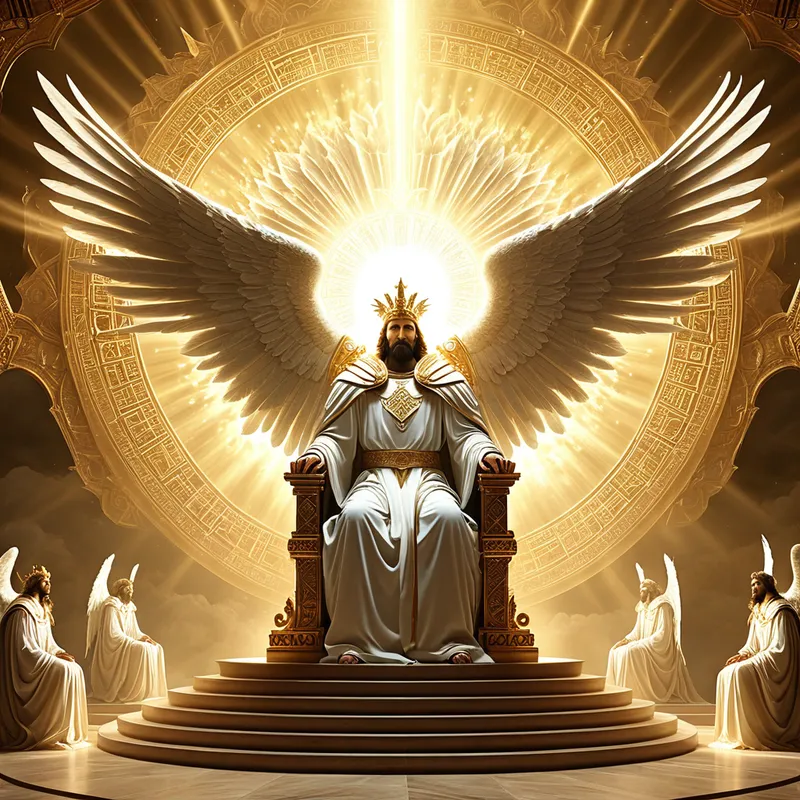
Before the foundations of the world were laid, in the silence before time, there was a realm of pure light and perfect sound. This was the court of the Most High, and its citizens were the Heavenly Host. They were not as men are, formed of dust; they were beings of flame and thought, of will and worship. Their forms were majesty itself—wheels within wheels full of eyes, six-winged seraphim who covered their faces before the Glory, mighty cherubim who were the living chariot of the Throne.
Their existence was a single, eternal chord of adoration. The air thrummed with the sound of their voices, a symphony that shaped the nebulae and set the rhythm for the spinning of galaxies. They moved in perfect ranks, a celestial army whose only battle was the joyful maintenance of cosmic order. At their head stood the archangels: Michael, the steadfast defender; Gabriel, the herald of mysteries; and Lucifer, the Light-Bearer, most beautiful and brilliant of them all, who walked in the very stones of fire before the throne.
But within the heart of Lucifer, a dissonance was born. He gazed upon the unapproachable light of the Throne and saw not only a source to worship, but a seat to covet. "I will ascend above the heights of the clouds," the whisper coiled in his spirit, "I will be like the Most High." This thought, a crack in the crystal of heaven, spread. A third of the stars of the host—countless angels—heard the siren song of autonomy. They looked upon their perfect, ordained stations and saw not harmony, but hierarchy; not purpose, but subjugation.
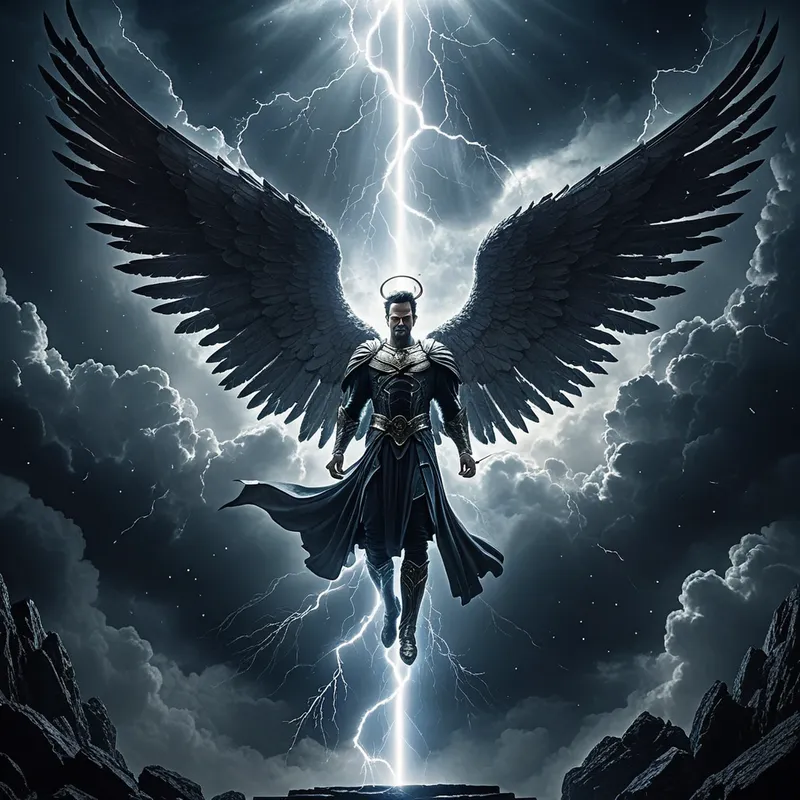
The symphony faltered. The light grew cold. What was once a dance of unity became a schism of will. Lucifer, now Satan, drew up his battalions of rebellion against the legions of Michael, who cried, "Who is like God?" The war in heaven was not of sword and shield as men know it, but of essence against essence, a cataclysm of conflicting purposes that shook the pillars of creation. The rebel host fought with the fury of those who have known perfection and chosen to shatter it.
They did not prevail. Cast down by Michael's loyal forces, they fell. Not a slow descent, but a terrible, swift ejection—"I saw Satan fall like lightning from heaven." They plunged from the realm of eternal morning into the outer darkness, from the chorus of creation into the void of their own making. And the great gates of that shining realm closed, the Heavenly Host now halved, their song forever tinged with the memory of the fracture, eternally vigilant at the borders of light against the exiled shadows they once called brothers.
Cultural Origins & Context
The myth of the Heavenly Host emerges from the complex tapestry of ancient Near Eastern thought, refined through the crucible of Biblical monotheism. In cultures surrounding ancient Israel, pantheons of gods each had their divine councils and attendant spirits. Israelite prophets and poets, asserting the absolute sovereignty of YHWH, absorbed this imagery but subsumed it entirely under one God. The "host of heaven" became not independent deities, but His ministers, His celestial army (YHWH Sabaoth).
This story was not a single, canonical narrative but a constellation of references woven through texts spanning centuries—from the visions of Isaiah and Ezekiel to the apocalyptic revelations of Daniel and the Book of Revelation. It was passed down by priests, prophets, and apocalyptic seers, often in times of national crisis. Its function was multifaceted: to explain the origin of evil in a world created by a good God, to affirm the ultimate power and order of the divine against chaotic forces, and to provide a cosmic backdrop for the spiritual struggles of the faithful on earth. The Host represented the unseen reality behind earthly events, a reminder that human history was watched over—and contested—by vast, conscious forces of obedience and rebellion.
Symbolic Architecture
Psychologically, the Heavenly Host represents the innate, ordered structures of the psyche—the inner council of values, instincts, and guiding principles that constitute a sense of wholeness and purpose. They are the archetypal forces of consciousness aligned with what the Self deems sacred or central.
The rebellion of the Host is not the intrusion of evil from without, but the tragic awakening of a part of the soul that mistakes its own brilliance for the right to sovereignty.
Lucifer symbolizes the luminous intellect, the spirit of pride and individuation pushed to its absolute, self-destructive extreme. His fall is the inevitable fate of any complex that seeks to dethrone the central, integrative principle of the psyche (the Self/God-image) and reign autonomously. Michael represents the protective, discriminating function that must arise to defend the integrity of the central personality when it is threatened by inflationary rebellion or chaotic dissolution. The war, then, is an internal civil war between the ego’s identification with divine authority (inflation) and the psyche’s self-regulating instinct to preserve its core order.
The Dreamer's Resonance
When this myth stirs in modern dreams, it rarely appears as biblical pageantry. Instead, one may dream of a vast, impeccably organized system—a global corporation, a flawless computer network, a silent library—that is suddenly hacked by a beautiful, charismatic virus. Or of a family or team, once united, splitting into two irreconcilable factions over a point of principle. The somatic experience is often one of vertigo, a terrifying fall from a great height, or the chilling silence of a fundamental bond breaking.
This dream pattern signals a profound psychological process: the conscious realization and confrontation of a "rebel archetype" within. The dreamer is experiencing a legitimate part of their spirit—ambition, critical intellect, desire for autonomy—that has grown too powerful and now threatens to overthrow their entire inner governance (their values, morals, or life structure). It is the moment the psyche recognizes that a treasured strength has become a tyrannical flaw. The dream is the soul's drama of acknowledging this inner schism, this "war in heaven," which must be resolved lest the entire inner world fall into chaos.

Alchemical Translation
The alchemical journey modeled by this myth is the transmutation of pride into humility, and rebellion into loyal service. The initial state is prima materia of perfect, unconscious unity—the soul blissfully serving a perceived absolute. The nigredo, or blackening, is the Luciferian moment of awakening, the "I am" that separates and declares its independence. This is a necessary, if perilous, stage of differentiation; without it, there is no conscious individuality.
The goal of this alchemy is not to destroy the rebel, but to redeem its fire. The fallen angel's light must be gathered back not as a rival sun, but as a loyal star in a greater constellation.
The albedo (whitening) is the painful recognition of the fall, the confrontation with the shadow of one's own inflation. The rubedo (reddening) is the hard-fought integration, represented by Michael's victory. This is not the annihilation of the rebellious impulse, but its defeat as a sovereign power. In the individuated psyche, the Luciferian energy of brilliance, pride, and ambition is consciously subordinated to the service of the greater Self. The individual no longer is the rebellious angel, but they have integrated its power. They can access critical thinking, fierce independence, and luminous creativity, but these now serve a center greater than the ego's vanity. The Heavenly Host is restored, not to its naive, pre-fall unity, but to a conscious, battle-tested harmony where the memory of the fracture adds depth to its loyalty. The modern soul achieves not innocent obedience, but a mature allegiance earned through the conscious choice to align its will with a deeper, more encompassing order.
Associated Symbols
Explore related symbols from the CaleaDream lexicon: