Heavenly Bureaucracy Myth Meaning & Symbolism
A celestial empire mirrors the earthly, where gods as bureaucrats manage cosmic order, reflecting the soul's journey through structure, judgment, and ultimate integration.
The Tale of Heavenly Bureaucracy
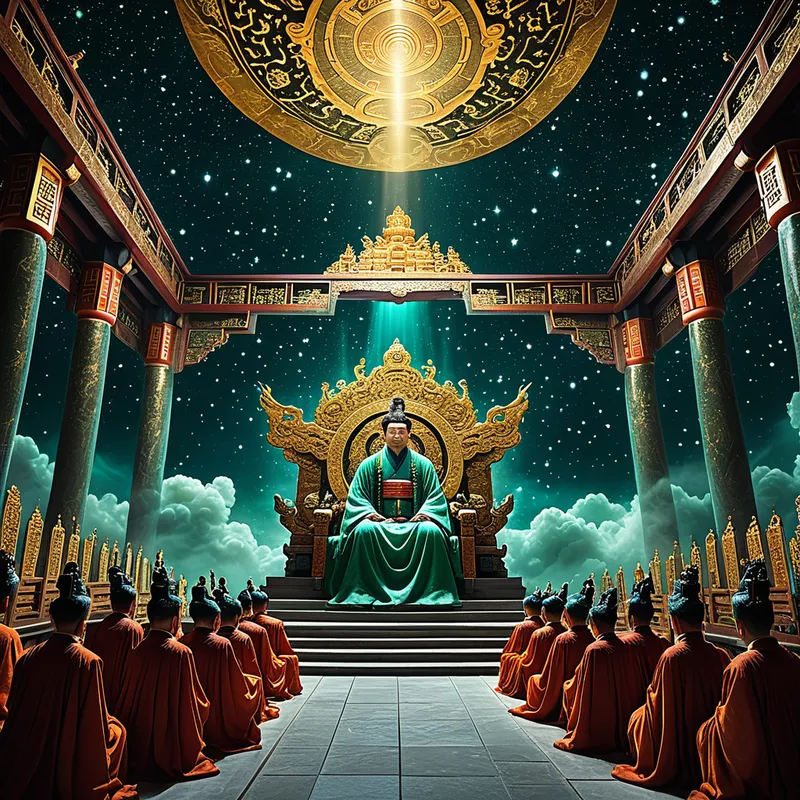
Listen, and hear of the empire beyond the clouds. It does not begin with a bang, but with the quiet, eternal hum of cosmic administration. High above the mortal realm, where the Wu Xing weave the fabric of reality, lies the Celestial Court. Its spires are not of stone, but of condensed starlight and virtue; its walls, the very membrane between chaos and order.
Here, the Jade Emperor reigns, not with a thunderous voice, but with the silent authority of a perfected ledger. His face is a landscape of benevolent impartiality. Around him, the ministries of heaven operate with a precision that makes the turning of seasons seem haphazard. There is the Ministry of Thunder, where generals with faces of storm-clouds debate the merits of a cleansing downpour. There is the Ministry of Fate, where ancient star-deities, their beards like flowing galaxies, consult the Register of Life and Death, their brushes dripping with ink made from midnight.
Our tale follows not a great hero, but a common soul—let us call him Li. His earthly breath has ceased. He finds himself on a grey road, the Road of Yellow Springs, flanked by whispering reeds. He is met not by a fearsome reaper, but by two polite, if stern, officials in court robes: the Gods of the City Wall and the Moats. They check his name against a list. The bureaucracy has begun its work even at the gates of death.
He is escorted across the Naihe Bridge, not by force, but by procedure. Below, the souls of the forgetful swirl. He arrives at the first great hall, the court of King Qinguang. The air smells of old paper and sandalwood. Before the king’s dais, a mirror—the Mirror of Reflection—hangs, cold and vast. Li’s life is not narrated, but projected upon it, every hidden thought, every secret act, illuminated for the scribes who scratch diligently on their tablets. No scream is needed; the evidence is irrefutable.
His journey continues through nine more such courts, each presided over by a Yanluo Wang, each specializing in a domain of moral accounting. The Ministry of Wealth assesses his generosity. The Ministry of Relationships examines his filial piety and broken promises. It is exhaustive, meticulous, and utterly devoid of malice—simply the cold arithmetic of the soul. Finally, after what feels like eons of audit, a verdict is rendered. Not a sentence of heaven or hell, but a prescription: a new incarnation, a specific station, a karmic balance to address. A clerk stamps a document with a seal that flashes like a captured sun. The process is complete. Order, terrifying and beautiful, has been served.
Cultural Origins & Context
This mythic framework did not spring fully formed from a single text, but evolved over millennia, mirroring the most enduring institution of Chinese civilization: the imperial bureaucracy. Its roots are tangled in early Taoist animism, where natural forces were seen as deified officials, and in folk beliefs about ancestor spirits who required administrative care in the afterlife. It was profoundly systematized with the integration of Buddhist concepts of karma and reincarnation during the Tang and Song dynasties.
The myth was passed down not by bards in mead halls, but through a vast corpus of vernacular literature, temple murals, Mulian opera, and the ubiquitous Joss paper printed with images of celestial banknotes and passports for the dead. Its primary storytellers were often the ritual Taoist priests and Buddhist monks who performed funerary rites, literally guiding the soul through the bureaucratic pitfalls of the afterlife with chants and burned documents. Societally, it functioned as a powerful engine of social cohesion and moral enforcement, externalizing the inner conscience into a cosmic civil service that was both awe-inspiring and strangely familiar to every peasant and scholar who had ever petitioned a magistrate.
Symbolic Architecture
The Heavenly Bureaucracy is the ultimate symbolic externalization of the psyche’s innate drive for order, meaning, and moral accounting. It represents the superstructure of the ego and the persona, projected onto the cosmos.
The celestial court is not a place, but a process—the psyche’s own relentless tribunal where experience is sorted, judged, and filed into the archives of memory and identity.
The Jade Emperor symbolizes the central, organizing principle of the Self, the ultimate authority that transcends the petty conflicts of the inner ministries. The myriad deities and officials represent the complex, often compartmentalized, aspects of our own psyche: the inner critic (the judges), the meticulous record-keeper (the scribes), the gatekeeper of consciousness (the City God). The Mirror of Reflection is the brutal, unfiltered light of self-awareness, where the persona is stripped away and the shadow is forced into view. The entire journey through the ten courts is a metaphor for the soul’s painful but necessary confrontation with its own consequences—the karma of choices made, the debts of relationships, the unfulfilled potentials that demand resolution.
The Dreamer's Resonance
When this mythic pattern erupts into modern dreams, it seldom appears as a glorious palace. Instead, the dreamer finds themselves in a labyrinth of endless, impersonal corridors, waiting in line before a disinterested clerk, or frantically searching for a lost form or identification number in a vast, silent archive. The somatic feeling is one of profound anxiety, constriction, and helplessness—a Kafkaesque nightmare.
This is the psyche signaling a crisis of integration. The dreamer is likely experiencing a period where life feels overwhelmingly governed by external systems, rules, and judgments (social, professional, familial), to the point where their authentic self feels buried under paperwork. The dream is the soul’s rebellion against being reduced to a file. It indicates that the inner "bureaucracy"—the habitual ways the ego manages the personality—has become tyrannical, stifling spontaneity and depth. The faceless officials are personifications of internalized critics and societal demands. The dream is a call from the Self to audit this internal administration, to question its outdated protocols, and to reclaim authority from the petty officials of fear and obligation.

Alchemical Translation
The individuation process modeled by this myth is not one of slaying dragons, but of assuming the throne. The alchemical work is the transmutation of the soul from a passive subject of the cosmic bureaucracy into its conscious administrator, and ultimately, its sovereign.
The goal is not to destroy the court, but to become the Jade Emperor who presides over it—to integrate the judging functions into a wise, compassionate wholeness.
The first step is the audit: the courageous descent into one's personal underworld courts, holding up the mirror to one's shadow, acknowledging the "karmic ledgers" of past actions and patterns without flinching. This is the psychological equivalent of the soul's journey before the ten kings. The second step is reorganization: the dreamer must consciously engage with their inner "ministries." Instead of being tyrannized by an inner critic, one appoints it as a minister of discernment. The meticulous record-keeper becomes the minister of memory and learning. The gatekeeper becomes the protector of healthy boundaries.
The final, alchemical translation is the issuance of the sovereign decree. This is the moment when the integrated Self, having reviewed all the reports from its inner ministries, makes a conscious, authoritative choice that aligns with deepest purpose, not just external rule. It is the soul stamping its own document with its unique seal, authorizing its next incarnation—not as a fate imposed from without, but as a destiny consciously chosen from within. The Heavenly Bureaucracy thus becomes internalized as the elegant, efficient order of a soul that has mastered its own domain, ruling not with an iron fist, but with the impeccable balance of the Tao.
Associated Symbols
Explore related symbols from the CaleaDream lexicon: