
Heather Ale Myth Meaning & Symbolism
A Pictish king guards the secret of heather ale. When Norse invaders demand the recipe, he chooses annihilation over betrayal, taking the sacred craft to the grave.
The Tale of Heather Ale
Listen, and hear the whisper in the wind that sweeps the moors. It carries a story older than stone, a secret brewed in the bellies of mountains and guarded by a people who painted their skin with the sky. This is not a tale of gods, but of the earth’s own blood and the price of its knowing.
In the high, lonely places where the heather grows purple and thick, the Picts held dominion. They were a people of the rock and the mist, and their greatest art was not forged in iron, but coaxed from the barren soil. From the humble bell-heather, they brewed an ale of such surpassing sweetness and strength that to drink it was to taste the soul of the land itself. It was a sacred craft, passed from father to son in a line unbroken since time began. It was their sovereignty in a cup.
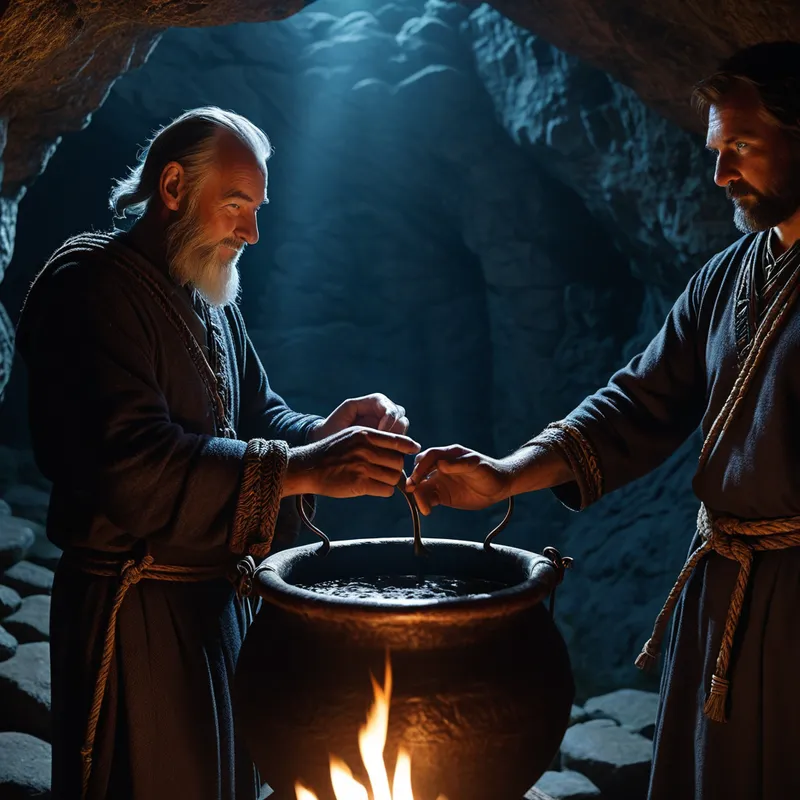
Then came the longships, dragons of oak and menace, slicing through the northern mists. They were the sea-wolves, the Vikings, and they had heard whispers of this legendary brew. They craved it, not for pleasure, but for power. To possess the secret was to possess the spirit of the land they sought to conquer. They fell upon the Pictish fastnesses with fire and axe, until at last they cornered the king and his last surviving son in a sea-cave, the roar of the ocean their only witness.
The Viking jarl, his beard crusted with salt, made his offer. It was no offer, but a demand wrapped in the promise of a clean death. “Give us the secret of the heather ale,” he growled, “and you shall die by the sword, not by the slow torment of the tide.”
The Pictish king, his body weary but his eyes holding the flint of the cliffs, looked at his son, then at the sea. He knew the truth. The secret was the last root tethering his people to the world. To give it was to truly die. A slow smile, bitter as rowan berry, touched his lips.
“The secret is mine alone,” he said, his voice steady against the wind. “Kill my son before my eyes. Let me see the light leave his eyes and know your mercy is a lie. Then, I will lead you to the hidden spring and the sacred heather, and I will teach you the craft.”
A gasp, sharp as a blade, from his bound son. The Norsemen murmured, sensing a victory both cruel and complete. The jarl nodded. In one swift, terrible moment, it was done. The young man fell, his blood dark on the grey stone.
The king did not weep. He looked at his son’s still form, then at the conquerors. “Now,” he said, his voice hollow as the cave, “you must carry me. For the custom of my people is that a father must never reveal the secret where his son’s blood has been spilled. We must go to a clean place.”
Fooled by the logic of grief, the Vikings lifted the old king and bore him from the cave, up the steep path to the cliff’s sheer edge. The wind screamed here, tearing at cloaks and sanity. The king stood at the precipice, the void yawning below, the sea thundering against the rocks.
He turned to the jarl, and in his eyes was not defeat, but a terrible, final triumph. “Now,” he cried out, his words snatched by the gale, “I follow my son. And the secret of the heather ale follows me!”
And with the strength of the last free man of his people, he threw himself backward into the abyss. The secret, the craft, the very soul of the land, fell with him, swallowed forever by the sea and the stone. The Vikings were left with nothing but the bitter taste of the wind and a victory as empty as a broken cup.
Cultural Origins & Context
While the tale is set in the Viking Age and involves Norse raiders as the antagonists, “Heather Ale” is not, strictly speaking, a Norse myth. It is a Scottish legend, collected and immortalized in verse by the 19th-century writer Robert Louis Stevenson. Its power, however, taps directly into a profound archetypal conflict that resonates with the Norse worldview: the clash between the sovereign, earth-bound indigenous spirit and the relentless, acquisitive force of the outsider.
The story functions as a foundational etiological myth for the Scots, explaining the loss of an ancient, pre-Celtic craft. It is a story of the Picts, the mysterious “painted people” who preceded the Gaels and whose culture was subsumed. In this context, the Norse serve as the ultimate, impersonal force of historical erasure. The tale was likely passed down as a ballad or folk memory, a bitter-sweet celebration of a people who chose annihilation over assimilation. Its societal function was to encode a powerful ethic of sovereignty and the sacredness of cultural secrets, teaching that some knowledge is so intrinsic to a people’s identity that its loss is preferable to its profanation by conquerors.
Symbolic Architecture
At its heart, the myth is a brutal allegory for the psyche’s defense of its most sacred, authentic core.
The Heather Ale itself is the ultimate symbol of indigenous wisdom—knowledge that is not universal, but specific, earned, and born of a deep, symbiotic relationship with a particular place (the psyche’s unique terrain). It is not merely a recipe, but a living process that transforms the humble (heather) into the sublime (intoxicating ale). It represents the individual’s unique creative spirit, their daimon or inner genius.
The most sacred knowledge is not that which empowers the ego, but that which roots the soul in its own unique ground.
The Pictish King embodies the Self in its most defiant, sovereign form. He is the guardian of the inner mystery. His sacrifice is not one of passive martyrdom, but of active, ruthless choice. He sacrifices his own life and his lineage (his son, the future) to protect the integrity of the secret itself. This represents the psyche’s sometimes-terrible willingness to let conscious achievements and even future potential die rather than allow its core, unconscious truth to be co-opted and corrupted by foreign complexes (the Vikings).
The Vikings symbolize the acquisitive, conquering aspect of consciousness—the ego’s desire to possess and control all contents of the psyche, especially the potent, numinous ones. They represent the force of assimilation, of making the mysterious and personal into the commodified and known. Their ultimate failure illustrates that archetypal, soul-knowledge cannot be taken by force; it can only be surrendered to or earned.
The Son is the future, the vessel of transmission. His death signifies the end of a lineage, the conscious severing of a tradition. In psychological terms, it is the recognition that some inner transformations are so total that the old way of being (the “son” as the known future) must be completely relinquished.

The Dreamer's Resonance
When this myth stirs in the modern dreamer, it signals a critical juncture of inner sovereignty. To dream of being pursued for a secret, of guarding a precious, fragile vessel, or of facing an impossible choice between betrayal and annihilation, is to feel the pressure of the Viking longships on the shores of the soul.
The somatic experience is often one of constriction—a tightness in the chest or throat, a feeling of being cornered. Psychologically, the dreamer is undergoing a process of resisting assimilation. This could manifest in waking life as the feeling that one’s authentic creativity, values, or unique perspective is being demanded by an external force: a job that seeks to own your ideas, a relationship that requires you to compromise your core beliefs, or a societal pressure to conform.
The dream is a map of the defense. The “heather ale” in the dream—perhaps represented as a hidden room, a private journal, a unique skill, or even a forbidden love—is the aspect of the Self that must be protected at all costs. The dream’s climax, whether it mirrors the king’s leap or finds another resolution, reveals the psyche’s current stance: is it preparing for a defiant self-possession, or is it on the verge of a costly betrayal?

Alchemical Translation
The myth of Heather Ale is a stark blueprint for the alchemical stage of Nigredo, the blackening, where all is reduced to its essential, barren state for the possibility of true transformation. It models the process of psychic transmutation not through integration, but through radical, sacrificial refusal.
The individuation process often involves the temptation to offer up our deep, nascent selves—our “heather ale”—to the collective or to the inner critic (the Viking jarl) for validation, security, or power. The myth instructs us that the first, and sometimes only, step in this stage is the absolute defense of the prima materia, the raw, unique substance of our being.
The true work begins not in sharing your gold, but in choosing the cliff-edge over letting the forge of another determine its shape.
The king’s horrific choice—the sacrifice of his son (his future potential) and himself (his present identity)—is the ultimate act of voluntaria mortificatio, voluntary mortification. He does not integrate the Viking; he denies them utterly. In psychological terms, this translates to the difficult, often painful, process of letting go of cherished identities, future plans, and external approvals that are contingent on betraying one’s core mystery. It is the death of the ego’s deal-making capacity.
The “secret” that goes over the cliff is not lost. In the alchemical vessel of the unconscious, it undergoes a solve et coagula—it is dissolved in the sea of the collective unconscious (the cliff’s base) only to be reconstituted in a purer, less graspable form. For the modern individual, this means that when we refuse to prostitute our deepest nature for outer gain, that nature does not vanish. It retreats, ferments, and transforms from a “recipe” (something that can be copied) into a living process (an indwelling truth) that can never be taken, only rediscovered from within. The triumph is not in survival, but in the inviolability of the essence. The brew is gone, but the knowledge that it could be made becomes an unassailable part of the soul’s landscape.
Associated Symbols
Explore related symbols from the CaleaDream lexicon: