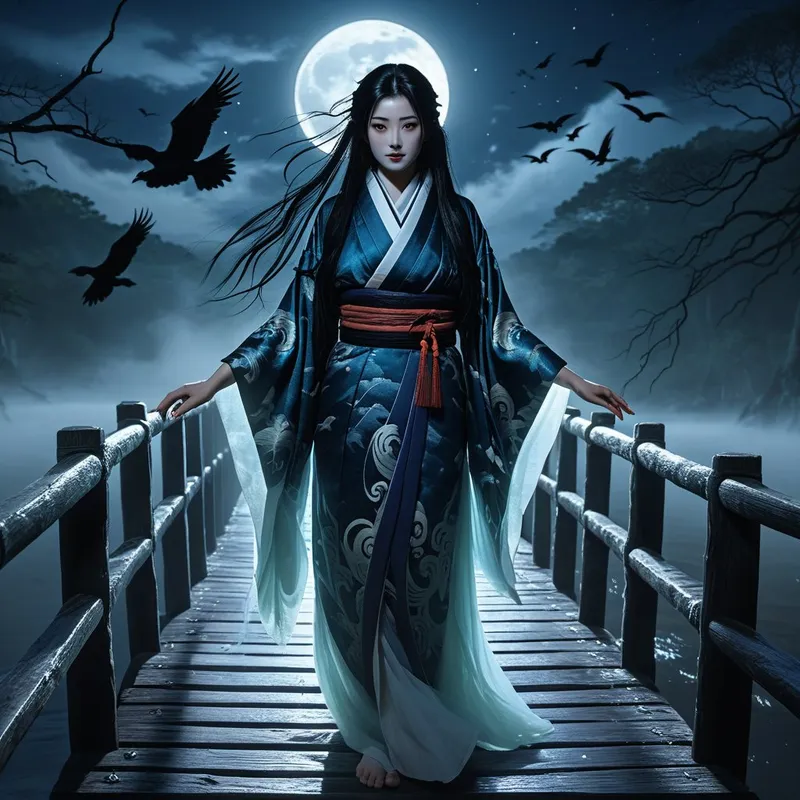
Hashihime Myth Meaning & Symbolism
A woman's heartbreak transforms her into a vengeful river demon, embodying the shadow born from betrayal and the terrifying power of unexpressed emotion.
The Tale of Hashihime
Listen, and hear the tale that flows not from the mountain’s peak, but from the dark, slow heart of the river. It begins not with a god, but with a woman. An ordinary woman, they say, whose heart was a vessel too small for the sorrow that filled it.
She lived in a time when the world was woven from whispers and woodsmoke, near the banks of the Uji-gawa. Her love was given, wholly and without condition, to a man who traveled often across the river. Each dusk, she would stand upon the old wooden bridge—the hashi—and wait, her eyes scanning the far shore for his return. The bridge became her altar, her vigil post, the narrow spine between her hope and her despair.
But the world turned, as it always does, on the axis of betrayal. The man did not return. Or worse, he returned with another. The whispers of the village, carried on the river wind, spoke of his new love in the distant capital. Her devotion curdled in her breast, turning from sweet wine to black vinegar. A poison took root, fed by isolation and the mocking laughter of the water below.
Driven to the precipice of her sanity, she sought a path of terrible power. On a night when the moon was a sliver of cold iron, she descended to the riverbank. For seven days and seven nights, she performed the rites of transfiguration. She bathed in the waters of the misogi, but not for purification. She sought a different baptism. She bound her long, black hair with a single-pronged comb, and she chanted an oath to the kami of vengeance, Fudō Myōō.
“Let me become a demon,” she vowed, her voice a dry rustle against the river’s song. “Let me live in this river. Let me destroy all who cross this bridge, man and woman alike. For this jealousy that consumes me, let it consume the world.”
On the final night, she painted her body with vermilion, donned a scarlet robe, and crowned herself with an iron tripod bearing flaming torches. The gentle woman was gone. In her place stood the Hashihime, a being of pure, concentrated rage. Her beauty was now terrifying, her eyes burning coals. She took her throne beneath the bridge, and her wrath became a new current in the river. Any who dared cross after dark would hear the phantom sound of a comb running through endless hair, then see the fiery apparition rise from the mist to tear them apart. The bridge, once a connector of lives, became a threshold of death, guarded by the heartbreak she had become.
Cultural Origins & Context
The legend of Hashihime is a kaidan, a strange tale, that finds its roots in the rich soil of Shinto animism and the Buddhist understanding of the hungry ghost. It is most famously recorded in the medieval story collection Konjaku Monogatarishū, but its essence is older, flowing from oral tradition. These were tales told not in palaces, but in villages, by firelight, to explain the uncanny.
The bridge itself is the key to its societal function. In ancient Japan, bridges were liminal, dangerous places—neither here nor there, spanning the realm of humans and the realm of spirits, utsushiyo and kakuriyo. They were often sites of ritual and taboo. Hashihime embodies the terror of the transition, the consequence of breaking social bonds (the betrayal of the lover), and the palpable fear of a woman’s emotion when it escapes domestic confines and transforms into a wild, natural, and destructive force. She is a cautionary tale about the power of broken vows and the very real, in the pre-modern psyche, danger of attracting the attention of a wronged spirit.
Symbolic Architecture
Hashihime is not merely a monster; she is a perfect symbolic vessel for the psychological shadow born from profound betrayal. Her myth maps the alchemy of emotional poison.
The Woman on the Bridge represents the ego in a state of suspension and waiting, its identity dependent on another. The Betrayal is the shattering of this projected identity. The Seven-Day Ritual is the conscious, if twisted, incubation of the pain. She does not suppress her jealousy; she nurtures it, dedicates herself to it fully. This is the genesis of the shadow complex—a split-off part of the psyche, fueled by humiliation and rage, that takes on a life of its own.
The bridge is the psyche itself, and the demon is the toll exacted for an unlived life, for love turned back upon itself in isolation.
The Vermilion Paint and Flaming Crown symbolize the violent externalization of an internal state. The private hurt becomes a public, terrifying spectacle. Her new domain, Beneath the Bridge, is the classic dwelling of the shadow—in the dark, supporting structure of consciousness, unseen until one ventures across a threshold. Her attack on all travelers shows the shadow’s non-discrimination; it threatens the whole personality, not just the original source of the wound. She is the embodied curse of the unexpressed, the ultimate consequence of a heart that has turned its love entirely inward, where it festers and transforms.

The Dreamer's Resonance
When the pattern of Hashihime stirs in the modern dreamer, it signals a profound encounter with a crystallized pocket of betrayed feeling. This is not everyday frustration, but a deep, historic wound related to abandonment, betrayal of trust, or romantic humiliation that has been “stored” and demonized.
Somatically, one might dream of standing frozen on a bridge, feeling the planks decay beneath their feet, or of hearing the rhythmic, menacing sound of a comb—a symbol of vanity and preparation turned obsessive. The dreamer may be paralyzed as a fiery figure approaches, representing the feared eruption of their own long-contained rage or grief. The river in the dream may be stagnant, polluted, or flowing with a sinister, dark current.
Psychologically, this dream marks a point where the shadow material, once safely submerged, is now rising to the threshold of consciousness. The ego is at the bridge, the point of decision: to retreat from the terrifying feeling, or to find a way to meet it. The Hashihime dream is a call to acknowledge that a part of oneself has become a vengeful guardian of an old oath—an oath to never be hurt again, which now hurts the self more than any other.
Alchemical Translation
The myth presents a brutal, failed individuation. Hashihime’s ritual is a dark parody of the transformative process; she transmutes herself, but into a fixed state of vengeance, not a integrated whole. The alchemical work for the modern individual is to undertake the same ritual—facing the deep betrayal and jealousy—but with a different intent.
The first step is Vigil on the Bridge: consciously stationing oneself at the liminal space to feel the old waiting, the old dependence. The second is Descending to the Riverbank: moving from the point of observation (the bridge) to the place of emotion itself (the river). Here, one must Witness the Seven-Day Ritual within—not to nurture the vengeance, but to acknowledge, with full sensory detail, the depth of the pain and the fantasy of retribution.
The goal is not to slay the demon, but to recover the woman from the demon, to hear the original oath of love beneath the later oath of destruction.
The alchemical translation occurs when one can Meet Hashihime without Crossing. This means confronting the fiery rage and terror not as an external monster to be destroyed, but as an internal state to be recognized. “I see you. I feel the heat of your betrayal. You are part of me.” This recognition begins to dissolve the demonic form. The vermilion paint washes away to reveal the wound. The flaming crown dims to the original spark of love that felt it deserved more.
The final, crucial transmutation is in Redefining the Oath. The original vow was one of destruction born from pain. The new vow, forged in conscious encounter, is one of self-possession. The energy that was bound to destroying others (or oneself) is reclaimed. The bridge, once a site of terror, can become a true connector—not between oneself and another’s approval, but between the conscious ego and this powerful, wounded, and ultimately vital aspect of the soul. The river flows again, carrying the story, but no longer poisoning the land.
Associated Symbols
Explore related symbols from the CaleaDream lexicon: