
Harpocrates Myth Meaning & Symbolism
The story of the infant god of silence, born from chaos, whose raised finger holds the secret power of unspoken wisdom and the completion of the cosmos.
The Tale of Harpocrates
Let the noise of the world fall away. Listen, instead, to a story born in the silence between heartbeats, in the sacred space before a word is spoken.
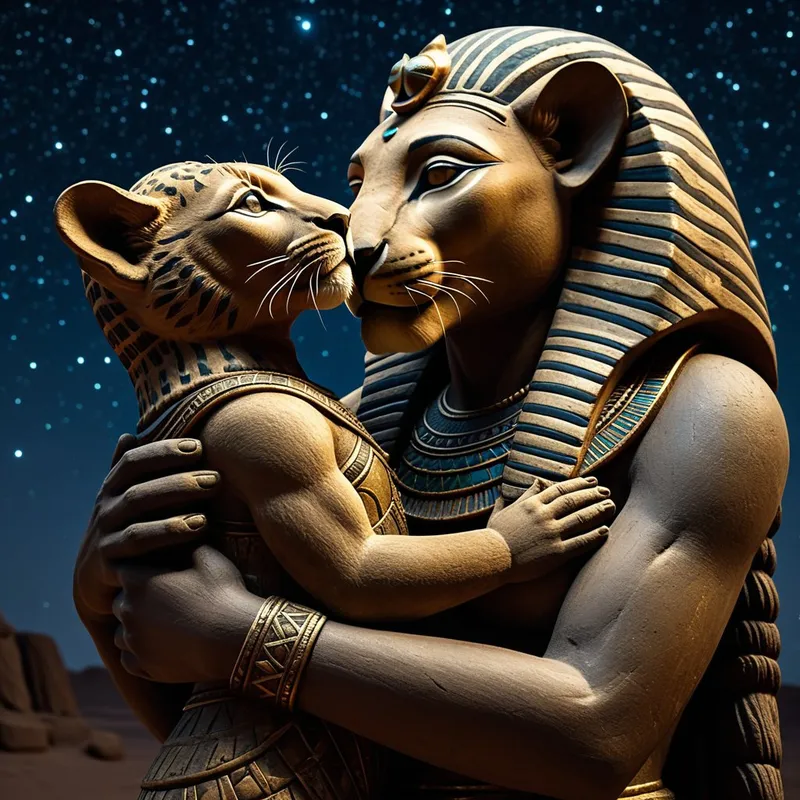
In the time when the world was still wet with creation, a great disturbance rippled through the divine realms. The formidable Sekhmet, her breath like desert wind and her eyes like burning coals, had been unleashed. Her rage was a storm that scoured the land, a necessary but terrible force. When her work was done, a profound exhaustion settled upon her—a rage spent, leaving only the hollow echo of its own fury. The gods, in their wisdom, knew such raw power could not simply be discarded; it must be transformed.
They called upon Hathor, whose voice could soothe the savage and whose embrace could mend the shattered. To her, they brought the weary Sekhmet. Hathor did not fight the lioness; she sang to her. She offered not confrontation, but nectar, a draught so sweet and calming that it flowed through Sekhmet’s divine essence like a cooling river. And from this alchemy of fierce rage gentled by boundless love, a new spark was kindled. Not a diminishing, but a transmutation.
From the union of this pacified power and nurturing grace, a child was born. He did not arrive with a cry, but in a pool of profound quiet. He was Harpocrates, and he was placed upon the primordial lotus that rose from the waters of Nun. The blossom cradled him, a throne of potential floating in the void. As the first rays of the sun—his elder aspect, Horus—touched the petals, the infant god opened his eyes. They were old eyes, eyes that had seen the fury of Sekhmet and felt the compassion of Hathor, eyes that held the memory of chaos before form.
He did not reach for a weapon or a scepter. Slowly, with a gravity that belied his infant form, he brought his chubby finger to his lips. Hush. It was not a gesture of weakness, nor of secrecy for its own sake. It was a commandment of completion. In that gesture, the last echoing clamor of creation’s violent birth was stilled. The cosmic argument found its full stop. The wordless wisdom of the lotus, the pacified strength of his origin, and the dawning light of consciousness all coalesced into that single, silent signal. The world, now, was not just made; it was listening.
Cultural Origins & Context
The figure we know as Harpocrates is a fascinating artifact of cultural syncretism. His journey into the “Greek” mythological lexicon began in Hellenistic Egypt, particularly in the cosmopolitan hub of Alexandria. The Greeks encountered the Egyptian child god Har-pa-khered (Horus the Child) and reinterpreted him through their own linguistic and philosophical lens. "Harpocrates" is a Greek rendering of that Egyptian name.
This was not mere translation, but transformation. The Greeks, with their love for mystery cults and philosophical inquiry into the nature of the divine, imbued the figure with new layers of meaning. He became less specifically a solar child king and more universally the god of silence, secrecy, and sacred mystery. His cult flourished among initiates of the Isiac mysteries, where silence (σιγή, sigē) was a paramount virtue for the preservation of esoteric knowledge. To reveal the mysteries was to profane them. Thus, Harpocrates’ gesture migrated from a depiction of childish infancy to a potent symbol of initiatory discipline—a reminder that the deepest truths are not shouted in the agora, but whispered in the sanctum of the prepared soul.
Symbolic Architecture
Harpocrates is a god of profound paradox. He is the child who holds the wisdom of the ages, the silence that speaks volumes, the end that is also a beginning. His symbolism is an intricate architecture built on restraint.
His primary symbol, the finger pressed to closed lips, is the keystone. This is not the silence of absence, but of potent, pregnant fullness. It is the silence that contains the unspoken word, the unheard symphony, the thought before it is crystallized into language. It represents the moment of understanding that transcends explanation, the secret that must be protected to retain its power, and the conscious choice to withhold speech as an act of strength, not incapacity.
The most profound truths are not found in the answer, but held in the sacred space of the unasked question.
His association with the lotus is equally critical. Born from the mud and rising to bloom immaculate on the water’s surface, the lotus symbolizes spiritual emergence, purity, and creation itself. Harpocrates seated upon it signifies that true wisdom and divine authority arise from the murky depths of the unconscious (the Nun) and the transformative struggles of life (the lineage of Sekhmet and Hathor). He is the beautiful, silent result of that arduous ascent.
Psychologically, Harpocrates represents the integrated Self. He is the child born from the reconciliation of opposing inner forces: the destructive, passionate rage (Sekhmet) and the nurturing, connective love (Hathor). His silence is the peace that follows inner conflict resolved, the state where opposing voices within the psyche have ceased their war and now contribute to a deeper, wordless knowing.
The Dreamer's Resonance
When the archetype of Harpocrates stirs in the modern dreamscape, it often signals a critical phase of internal processing. To dream of this figure, or of his symbolic gestures, is to encounter the psyche’s mandate for sacred silence.
A dreamer may find themselves in a situation where they are compelled to speak—to defend, to explain, to confess—but their voice fails them, or a hand (their own or another’s) gently enforces quiet. This is not a nightmare of repression, but a somatic enactment of the need for inner containment. The psyche is working on a problem at a level deeper than language. The dream is instructing the ego to stand down, to cease its frantic commentary and analysis, and to allow the slower, more profound intelligence of the body and the unconscious to complete its work.
Dreams of finding a silent, knowing child in a place of chaos, or of discovering that a secret object is simply an empty, peaceful space, also resonate with this myth. These dreams point toward the birth of a new, more authentic self-concept—one that does not need to loudly proclaim its identity but can simply be, rooted in a quiet confidence that comes from integrated experience, not external validation. The somatic process is one of settling, of a physiological sigh after a long-held tension, where the nervous system moves from sympathetic arousal (Sekhmet’s rage) into parasympathetic rest and digest (Hathor’s nurture), culminating in the poised alertness of Harpocrates’ silent watch.

Alchemical Translation
The myth of Harpocrates provides a masterful model for the alchemical process of individuation—the journey toward psychic wholeness. It maps the transmutation of raw, unconscious content into a conscious, guiding principle.
The initial nigredo, the blackening, is represented by the unleashed chaos of Sekhmet: our unintegrated anger, our primal passions, our destructive impulses that feel alien and terrifying. The albedo, the whitening, is the soothing, reconciling work of Hathor: self-compassion, therapeutic understanding, the loving acceptance of our own shadow material. This is not about eliminating the Sekhmet energy, but about bathing it in awareness until its nature changes.
Individuation is not the victory of one inner voice over another, but the sacred silence that hears the chorus and understands it as a single song.
From this union arises the citrinitas, the yellowing or dawn—the birth of Harpocrates. This is the nascent, childlike emergence of a new attitude, a new center of gravity in the personality. It is fragile, precious, and utterly authentic. Finally, the rubedo, the reddening or culmination, is the eternal gesture of the raised finger. This is the conscious, sustained embodiment of that integrated state. It is the discipline of sacred silence: the ability to hold the complexity of one’s being without needing to justify, explain, or act out. It is the power of restraint that protects the nascent self from being diluted by the world’s noise.
For the modern individual, the “alchemical translation” of this myth is the practice of moving from compulsive expression to conscious containment. It is finding the courage to not speak the unkind word, to not share the half-formed insight, to not seek closure where mystery is more nourishing. It is the cultivation of an inner sanctum, a naos, where the integrated self—born of our struggles and our nurturance—can sit in silent sovereignty, its mere presence a complete and potent statement. In a world drowning in information and opinion, Harpocrates offers the ultimate rebellion and the deepest wisdom: the power of the unspoken, the authority of the listening heart, and the profound completion found in a sacred, knowing silence.
Associated Symbols
Explore related symbols from the CaleaDream lexicon: