Harp of Dagda Myth Meaning & Symbolism
The Dagda's magical harp, stolen by the Fomorians, is reclaimed by its master's call, playing melodies of sorrow, joy, and deep sleep to restore balance.
The Tale of the Harp of Dagda
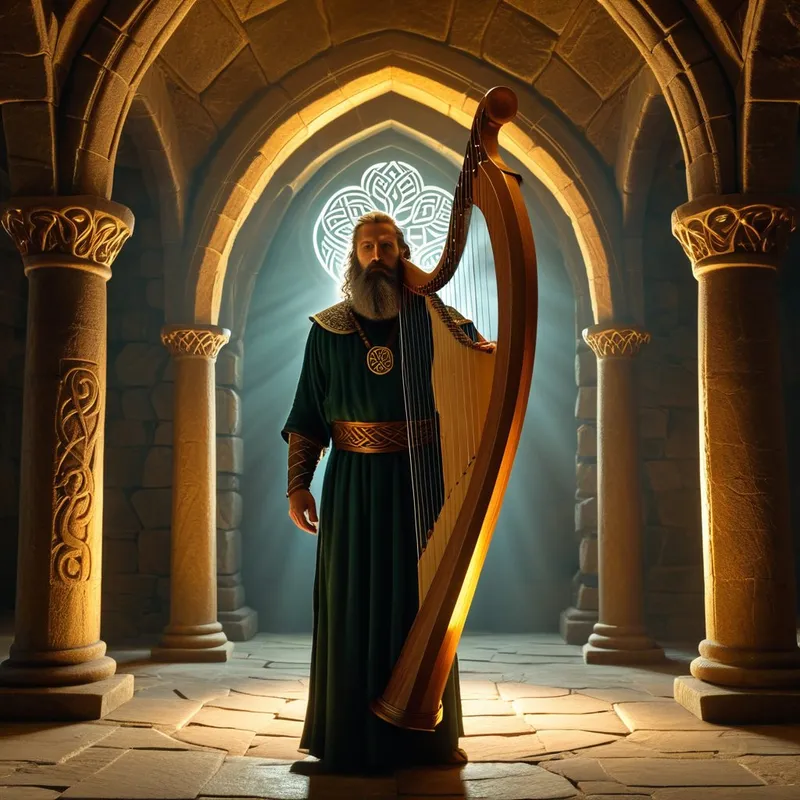
Listen, and let the fire’s shadows tell the tale. In the time after the first battles, when the Tuatha Dé Danann had won the land but not yet peace, there lived [the Dagda](/myths/the-dagda “Myth from Celtic culture.”/). He was the Good God, the All-Father, a figure of immense girth and greater heart, whose club could slay nine men with one end and restore them to life with the other. But his true soul was not in the club, nor in his cauldron of plenty. It was held in the curves of wood and the tension of strings—his great oak harp, Uaithne.
This was no ordinary instrument. Carved from sacred oak, inlaid with silver like captured starlight, it lived beside him. He did not merely play it; he conversed with it. With it, he commanded the seasons. One melody, the Goltraí, the Strain of Sorrow, would draw tears from stone and bend [the willow](/myths/the-willow “Myth from Celtic culture.”/) in grief. Another, the Geantraí, the Strain of Joy, would set the hillsides dancing with flowers and cause laughter to bubble from the deepest springs. The third, the Suantraí, the Strain of Slumber, would calm the raging sea and lay the fiercest warrior into a dreamless, restoring sleep.
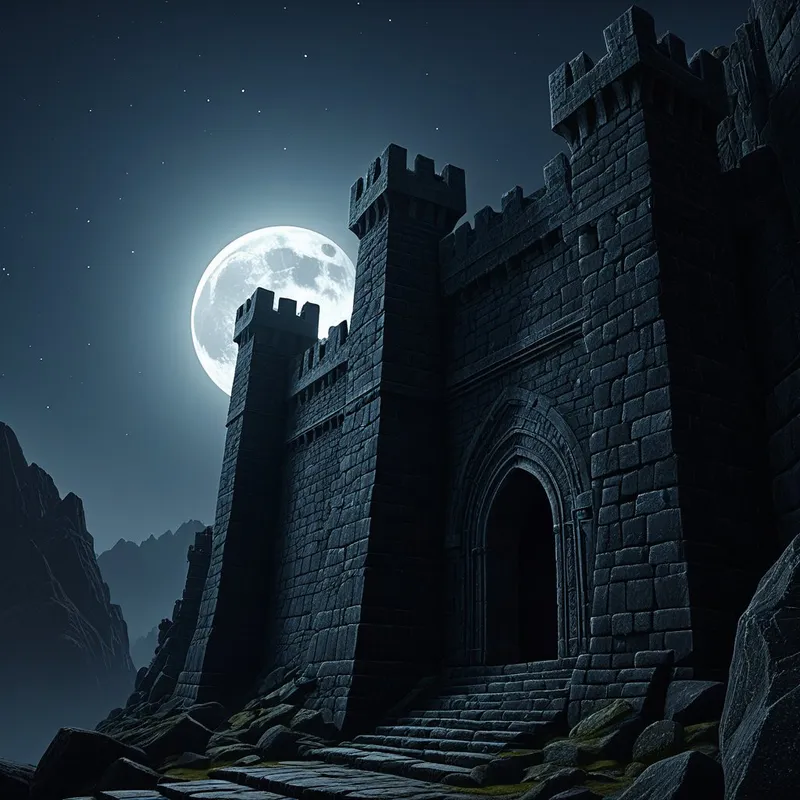
But peace is fragile. The [Fomorians](/myths/fomorians “Myth from Irish culture.”/), those grim lords of chaos and cold, hated the harmony the Dagda spun. In a coward’s hour, while the Dagda was away tending the wounds of the land, they stole into his hall. They took the harp, not understanding its voice, seeing only a trophy to break the people’s spirit. They bore it away to their grim fortress, a place of shadows and grating iron, and hung it upon a barren wall.
The Dagda returned to silence. The very air of his hall was stale, lifeless. He knew the theft in his bones. With his son Aengus Óg and the fierce warrior Ogma beside him, he journeyed to the Fomorian stronghold. They entered not with clashing arms, but with a silence deeper than the enemy’s gloom. They found the feasting hall, where the Fomorian chiefs reveled in their malice, the stolen harp hanging useless, a dead [thing](/myths/thing “Myth from Norse culture.”/) on the wall.
The Dagda stood in the doorway, a mountain of quiet rage. He stretched forth his hand, and he called. Not with a shout, but with [the true name](/myths/the-true-name “Myth from Various culture.”/) of the harp, the name that was a part of his own soul. “Come to me, Uaithne,” his spirit sang.
And the harp awoke. With a sound like a cracking glacier, it tore itself from the wall, flying through the smoky air, killing nine of the Fomorians as it passed, and came to rest in the Dagda’s waiting hands. The hall fell into a terrified hush.
Then, the Dagda played. His fingers found the strings and drew forth the Goltraí. A wave of unbearable sorrow filled the chamber. The Fomorian warriors wept like children, their weapons falling from numb fingers, their cruel hearts drowning in a grief they had never allowed themselves to feel.
As their wails reached a peak, the Dagda’s touch shifted. The Geantraí flowed out, bright and irresistible. The weepers began to laugh, a hysterical, helpless laughter that cramped their sides. They danced, clumsy and forced, jigging in agonizing joy until they collapsed, breathless and broken.
Finally, the Dagda played the Suantraí. The melody was a soft blanket, a mother’s whisper. One by one, the Fomorians slumped to the floor, falling into a sleep so profound it was akin to death. The Dagda, with Aengus and Ogma, gathered his harp. They walked out of the silent fortress, leaving its masters entranced, and carried the restored music back into the heart of [the world](/myths/the-world “Myth from Tarot culture.”/).
Cultural Origins & Context
This myth survives in the medieval Irish textual tradition, most notably in the Lebor Gabála Érenn (The Book of Invasions) and the tale Cath Maige Tuired (The Battle of Mag Tuired). It is crucial to remember these are literary compilations from a Christian monastic era, preserving fragments of a much older, pre-Christian oral tradition. The storytellers were the filid, the poet-seers who functioned as historians, jurists, and custodians of sacred lore.
The myth’s societal function was multifaceted. On one level, it is a sovereignty myth. The harp is an emblem of the true king’s power—not merely brute force, but the ability to regulate the emotional and spiritual climate of the people. The Dagda’s retrieval of the harp legitimizes the Tuatha Dé Danann’s rule; they bring order (music) against the Fomorian chaos (discord). The harp’s three strains directly correspond to the three primary functions of the poet in Celtic society: to satirize and bring shame (Goltraí), to praise and bring honor (Geantraí), and to enchant or bring peace (Suantraí).
Symbolic Architecture
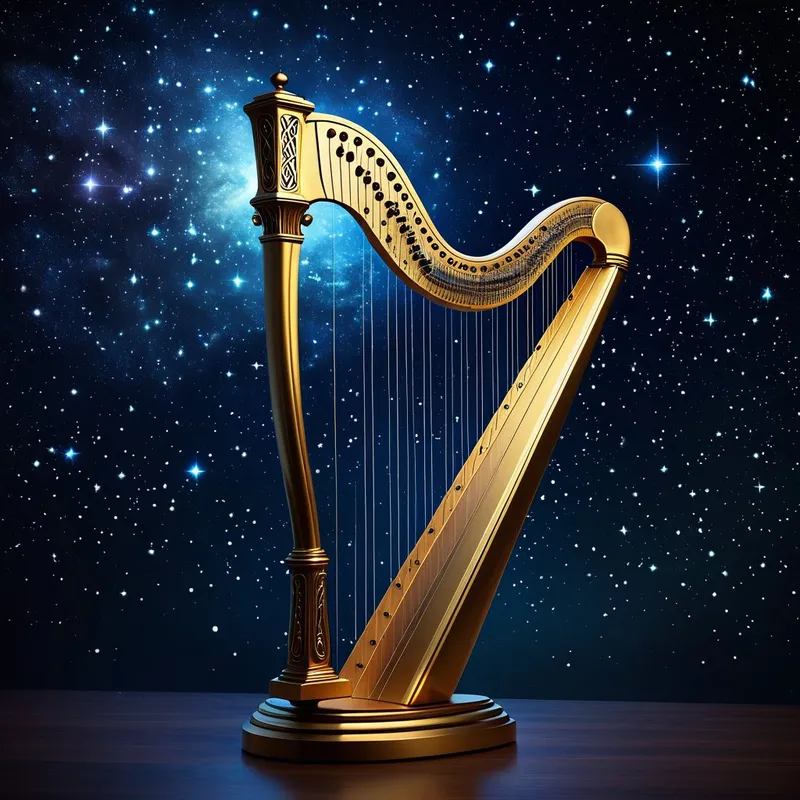
The [Harp](/symbols/harp “Symbol: The harp is a stringed instrument symbolizing harmony, spirituality, and creativity, often associated with divine inspiration and emotional depth in music.”/) of Dagda is not an [instrument](/symbols/instrument “Symbol: An instrument symbolizes creativity, communication, and the means by which one expresses oneself or influences the world.”/) of entertainment, but an engine of cosmic and psychological order. It represents the sovereign self, the integrated [psyche](/myths/psyche “Myth from Greek culture.”/) capable of modulating its own internal states and, by extension, influencing its environment.
The true power does not lie in never being robbed of your song, but in the unwavering knowledge of how to call it back from the darkest fortress.
The Dagda himself embodies the [archetype](/symbols/archetype “Symbol: A universal, primordial pattern or prototype in the collective unconscious that shapes human experience, behavior, and creative expression.”/) of the ruler, but a ruler whose [authority](/symbols/authority “Symbol: A symbol representing power structures, rules, and control, often reflecting one’s relationship with societal or personal governance.”/) stems from nurturance and deep [connection](/symbols/connection “Symbol: Connection symbolizes relationships, communication, and bonds among individuals.”/), not tyranny. His girth symbolizes containment and [abundance](/symbols/abundance “Symbol: A state of plentifulness or overflowing resources, often representing fulfillment, prosperity, or spiritual richness beyond material needs.”/). The theft by the Fomorians represents any force—external oppression, internal [trauma](/symbols/trauma “Symbol: A deeply distressing or disturbing experience that overwhelms the psyche, often manifesting in dreams as unresolved emotional wounds or psychological injury.”/), addiction, or [despair](/symbols/despair “Symbol: A profound emotional state of hopelessness and loss, often signaling a need for transformation or surrender to deeper truths.”/)—that severs us from our core creative and emotional faculties. We all have our “harp” stolen, our innate [harmony](/symbols/harmony “Symbol: A state of balance, agreement, and pleasing combination of elements, often associated with musical consonance and visual or social unity.”/) disrupted.
The three magical strains are the archetypal emotional tones of existence itself: Sorrow, Joy, and Rest. A healthy psyche can access and command these states, moving fluidly between them. The Fomorians, trapped in a mono-tone of grim tyranny, are destroyed by this fluidity; they cannot hold the complexity. Their defeat is not by sword, but by being subjected to the full [spectrum](/symbols/spectrum “Symbol: A continuum of possibilities, representing diversity, transition, and the full range of existence from one extreme to another.”/) of feeling they had denied.
The Dreamer’s Resonance
When this myth pattern stirs in the modern unconscious, it often manifests in dreams of loss and reclamation. You may dream of a treasured object—a locket, a book, a piece of art—being stolen and hidden in a labyrinthine, oppressive building (the office of a former boss, a childhood home turned [sinister](/myths/sinister “Myth from Roman culture.”/)). The somatic feeling is one of hollow dread, a vital piece of [the self](/myths/the-self “Myth from Jungian culture.”/) missing.
The turning point in the dream is the act of calling. Not fighting through guards, but standing your ground and invoking the true name of what was lost. This is the psyche signaling the beginning of re-integration. The dream may not show the retrieval, but the shift from helplessness to authoritative call is the critical movement. The body may jolt awake at this moment, heart pounding not with fear, but with the shock of reclaimed agency. The dreamer is undergoing the process of identifying what core aspect of their vitality or creativity has been captive to an internalized “Fomorian”—a critical inner voice, a pattern of neglect, a frozen trauma.
Alchemical Translation
The alchemical journey modeled here is the recovery of the animating principle from [the shadow](/myths/the-shadow “Myth from Jungian culture.”/). [The first stage](/myths/the-first-stage “Myth from Alchemical culture.”/) is [nigredo](/myths/nigredo “Myth from Alchemical culture.”/): the theft, the blackening, the awareness of loss and the descent into the fortified shadow-land (the Fomorian fortress). This is a necessary, if painful, confrontation with what has been disowned.
The Dagda’s silent entry represents the meditative approach—the conscious ego setting aside its usual weapons of defense and rationalization to enter the unconscious on its own terms. The call to the harp is the [rubedo](/myths/rubedo “Myth from Alchemical culture.”/), the reddening, the infusion of libido or life-force into the forgotten symbol. It is the act of investing a lost part of the self with love and recognition.
Individuation is not about creating a new self from nothing, but about remembering the true names of the soul-parts hanging silent on the walls of forgetfulness, and calling them home.
Finally, the application of the three strains is the albedo, the whitening, the purification and ordering of the reclaimed contents. The individual learns to consciously orchestrate their inner states: to allow authentic sorrow its cleansing flow, to permit unbridled joy its expansive dance, and to invoke the deep, restorative sleep of the psyche that integrates and heals. The retrieved harp is the symbol of the individuated Self—no longer a passive possession, but an active, commanding center capable of bringing harmony to the inner kingdom, transforming chaotic inner forces into a balanced, life-affirming music.
Associated Symbols
Explore related symbols from the CaleaDream lexicon: