Harlequin Myth Meaning & Symbolism
A servant in diamond rags, a trickster with a broken heart, whose chaotic dance mends the world by first unmasking the self.
The Tale of Harlequin
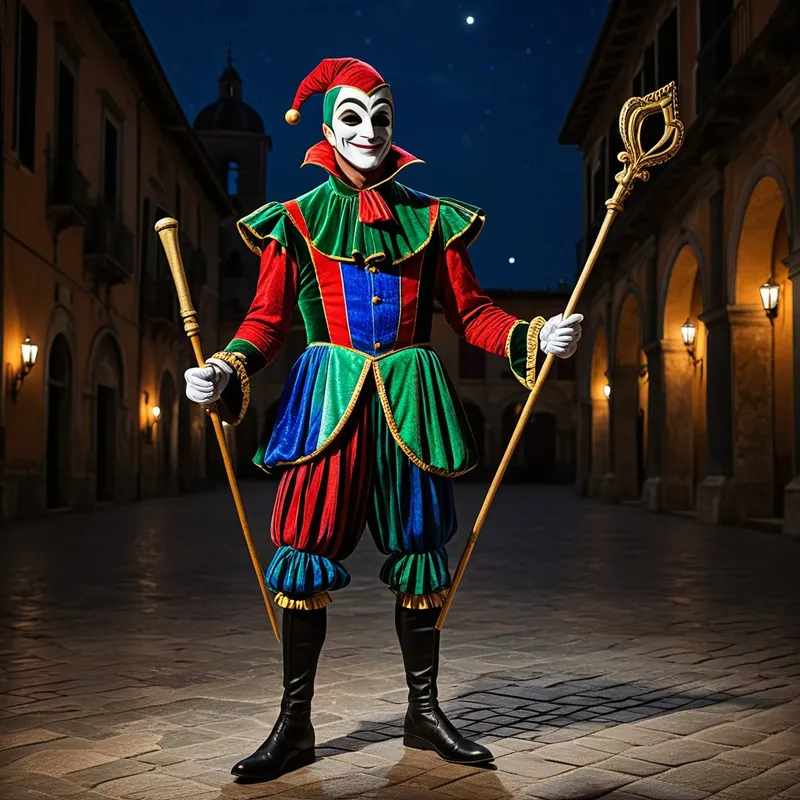
Listen, and let the cobblestones of old Bergamo whisper. In the time when the world’s laughter was a brittle thing, masking a deeper sigh, there lived a servant. He was not born with a name, only a condition: hunger. They called him Arlecchino, and his world was the space between a master’s shout and a kitchen’s scraps.
His body was a puppet of perpetual need, a collection of angles and aches. His livery was a testament to poverty’s ingenuity—a patched coat, a mosaic of a hundred different misfortunes, stitched into diamonds of faded green, blue, and rust-red. Upon his face, not a mask of porcelain, but one of soot-stained leather, with eyes that held the glint of a trapped animal and the ghost of a clever thought. In his hand, he carried the batte, two slats of wood that cracked together not with violence, but with the startling punctuation of fate.
His days were a liturgy of want. For a bowl of thin soup, he would become a whirlwind—delivering love notes for his master, the bombastic Pantalone, to the beautiful Colombina, while his own heart, a silent, starving bird, beat only for her. For a crust of bread, he would contort his body into impossible shapes, dodging the blows of the pompous Dottore. His intelligence was a sharp, survivalist thing, a spark in the damp kindling of his existence.
The core of his myth is not a battle with a dragon, but a dance with despair. One evening, as a cold fog swallowed the piazza, his hunger became a hollow universe inside him. Colombina, in a moment of pity sharper than cruelty, offered him not love, but a mirror—a chipped piece of glass. In its reflection, he did not see a man, but a creature of patchwork and performance. The laughter of the crowd, which he had worn like a second skin, fell away. In that silence, he heard the sound of his own fractured soul.
And so, Harlequin began to dance. Not the jig of the fool, but a desperate, sacred pantomime. He danced his hunger, his longing, his servitude. He used his batte to beat out the rhythm of his own chaotic pulse. He leapt not for coins, but to touch the indifferent moon. In this raw, unscripted ritual, a miracle of the mundane occurred. The patches on his coat, those scars of poverty, began to shimmer. They drank the moonlight and the torchlight, transforming into luminous diamonds of emerald and sapphire and ruby. The soot-black mask no longer hid him; it framed the profound, tragicomic wisdom in his eyes. He was not mending his clothes; he was integrating his fragments. From a slave to circumstance, he became the master of the moment—the Trickster who rules by revealing the absurd truth that underpins all order.
Cultural Origins & Context
The myth of Harlequin was not penned by a single poet but was breathed into life by the collective spirit of the Commedia dell'arte troupes that roamed Italy from the 16th century onward. This was a theatre of the people, performed in piazzas on makeshift stages. The actors were not reciting fixed texts but improvising around a scenario, drawing from a deep well of stock characters and familiar relationships.
Harlequin, or Arlecchino, was a zanni—the servant class. His myth was transmitted not through books, but through the body: the acrobatic leap, the hungry slump of the shoulders, the specific cadence of his Lombard dialect. He was the id of the social order, the embodiment of base needs—food, sex, avoidance of pain—who, through sheer chaotic vitality, exposed the hypocrisy of the powerful vecchi. His societal function was cathartic and subversive. He allowed the common audience to laugh at the struggles of the lowly, while simultaneously seeing their own cunning and resilience glorified in his triumphant survivals. He was a pressure valve, transforming social tension into the liberating medicine of laughter.
Symbolic Architecture
Harlequin is the archetypal Trickster in his most human, poignant form. His symbolism is a profound map of the psyche’s lower depths and its potential for alchemy.
- The Patchwork Costume: This is not mere poverty, but the very image of the fragmented self. Each diamond is a shard of experience, a trauma, a forgotten joy, a societal role hastily donned. Harlequin’s journey begins with wearing this fragmentation as an identity of lack.
- The Leather Mask: Unlike the rigid, full-face masks of the masters, Harlequin’s is a half-mask. It signifies the duality of his existence—part hidden instinct, part revealed humanity. It is the persona, but one that is worn thin, through which the authentic self begins to gleam.
- The Slapstick (Batte): It is the instrument of chaotic creation. Its crack is the sound of disruption, the breaking of rigid patterns, the necessary shock that precedes insight. It is psychic energy in its raw, undirected form.
- The Unrequited Love for Colombina: This represents the soul’s longing for integration with the anima—the feeling, connective aspect. His love is forever thwarted, forever motivating, symbolizing that the drive toward wholeness is a perpetual pursuit, not a final possession.
The Trickster does not destroy the world out of malice, but out of a sacred necessity to prove that the world, as it is perceived, is already an illusion. His chaos is the solvent for a frozen reality.
Psychologically, Harlequin represents the shadow—our basest instincts, our appetites, our clumsy, unpolished, and shameful parts. He is the part of us we send to the kitchen of the psyche, hoping it will stay quiet. His myth tells us that redemption lies not in repressing this shadow, but in engaging with its chaotic dance, in stitching its fragments into a dazzling, complex whole.
The Dreamer's Resonance
When Harlequin pirouettes through a modern dream, he announces a crisis of authenticity. The dreamer may be experiencing a sense of being a patchwork of roles—parent, professional, partner—with no cohesive center. Harlequin’s appearance signals that the persona has become a prison.
Somatically, this might manifest as a nervous, restless energy, a feeling of being "hungry" for something indefinable, or physical clumsiness (the body acting out the psyche’s fragmentation). Psychologically, it is the process of shadow-work beginning in earnest. The dreamer is being confronted with their own neglected appetites, their unexpressed cunning, their suppressed vitality that has been serving the "masters" of external expectation. Dreaming of frantically patching clothes, of performing absurd tasks for an unseen authority, or of finding beauty in a pile of rags—all are Harlequin’s calling cards. He appears when the soul is ready to trade the security of servitude for the terrifying freedom of its own chaotic, creative dance.

Alchemical Translation
The Harlequin myth is a precise model of psychic individuation, framed not as a heroic conquest, but as a trickster’s transmutation. The nigredo is his state of servitude and hunger—the blackness of despair, the felt sense of being nothing but fragmented reactions. The albedo is the moment with the mirror, the shocking recognition of one’s own condition, the separation from the projected identity.
His dance is the citrinitas, the active, chaotic engagement with the material of the self. Here, the base lead of his shameful patches is subjected to the inner fire of attention and expression. Finally, the rubedo is not a arrival at perfection, but the moment the patches become luminous diamonds. The fragmented shadow is not eliminated; it is integrated, its very brokenness becoming the source of its unique brilliance.
Individuation is not the creation of a flawless gem, but the conscious, loving assembly of a mosaic from the shattered pottery of one’s life. The glue is the courage to dance with one’s own disgrace.
For the modern individual, Harlequin’s path advises: stop trying to hide the patches. Instead, animate them. Give your hunger, your clumsiness, your unsophisticated longing, a sacred dance floor. Use the slapstick of your mistakes to break the hypnotic rhythm of conformity. Your goal is not to win Colombina (the idealized other), but to become so vibrantly, authentically yourself in your multifaceted complexity that you no longer seek completion from outside. You become the servant who, by fully embracing his servitude to his own nature, discovers he is the king of a kingdom of shimmering, chaotic, and utterly real diamonds.
Associated Symbols
Explore related symbols from the CaleaDream lexicon: