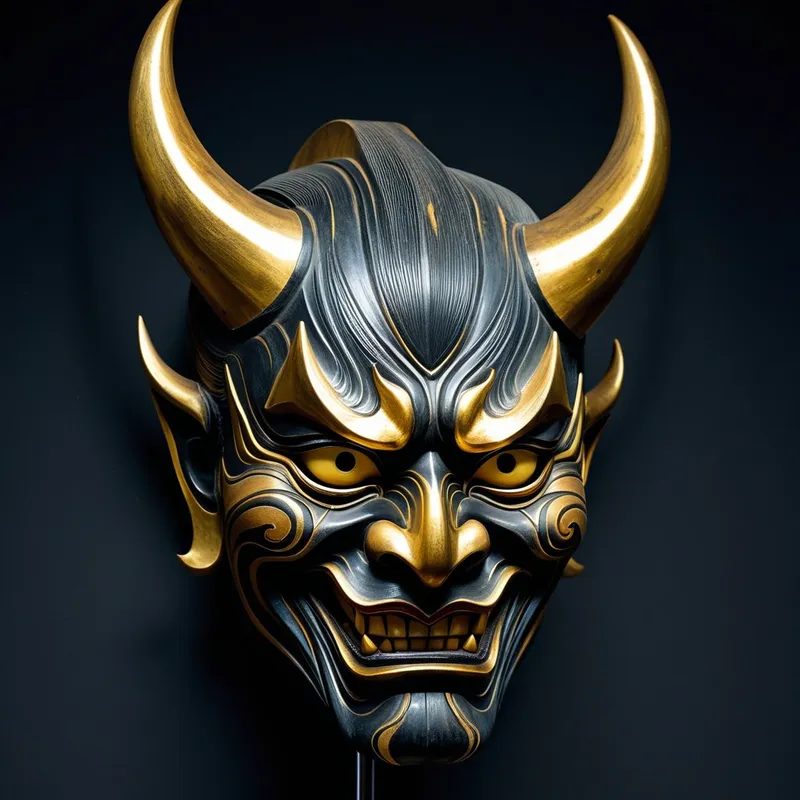
Hannya Mask Myth Meaning & Symbolism
A woman's betrayed love and consuming jealousy transform her into a horned demon, her face forever frozen in a mask of tragic fury and sorrow.
The Tale of Hannya Mask
Listen, and hear the tale that is carved not in stone, but in the heartwood of a cypress tree, and worn upon the face of an actor who becomes a ghost.
Once, in the still, incense-heavy air of the Heian court, there lived a woman of uncommon grace. Her name is lost to us, remembered only by the shape of her sorrow. She was a lady-in-waiting, her world a delicate lattice of silk screens, poetry exchanges, and the rustle of jūnihitoe. Her heart was given completely to a nobleman, a man whose words were as finely crafted as his swords. In secret gardens and through whispered verses, they pledged a love that would outlast the cherry blossoms.
But the court is a mirror that distorts. Whispers turned to rumors, and the nobleman’s visits grew scarce, then ceased. The truth arrived not with a confrontation, but with a glimpse through bamboo blinds: her love, laughing, his sleeve entwined with that of a woman of higher station. The betrayal did not cut; it burned. It was a cold fire that started in her gut and climbed her throat.
Her love did not wither. It fermented. In the solitude of her chambers, the elegant poetry of her mind curdled into a single, repeating chant of why and how. She stopped eating the delicate meals. She stared for hours at the tsubo-niwa, seeing not the raked gravel but the ashes of her future. The beautiful, disciplined order of her life cracked, and from the fissure, a new energy emerged—a possessive, devouring heat. She began to pray. But her prayers were not to Kannon. They were incantations of vengeance, directed at any spirit that would listen.
Her form began to change. The elegant arch of her eyebrows thickened, crawling upward like dark flames. Her eyes, once soft pools, hardened into golden, predatory slits. From her brow, twin horns of ossified rage pushed through skin and bone. Her mouth, trained to speak only in polite fragments, stretched into a permanent, silent scream, revealing fangs where pearls once gleamed. The woman was gone. In her place stood a Hannya—a demon born entirely from the unchecked alchemy of human passion.
She haunted the places of her betrayal, a storm of jealousy given form. Yet, when a traveling monk, armed only with a shakujō and sutras, finally confronted her on a moonlit bridge, something miraculous flickered in her hellish eyes. As he chanted the Hannya Shingyō—the very sutra whose name she now bore—the demon’s fury wavered. A single, luminous tear traced a path through the demonic contortion of her cheek. In that tear was the ghost of the woman, the memory of the love that started it all. The mask of the demon remained, but within it, now and forever, was frozen that impossible moment: the simultaneous, eternal presence of the all-consuming rage and the bottomless, human grief from which it was forged.
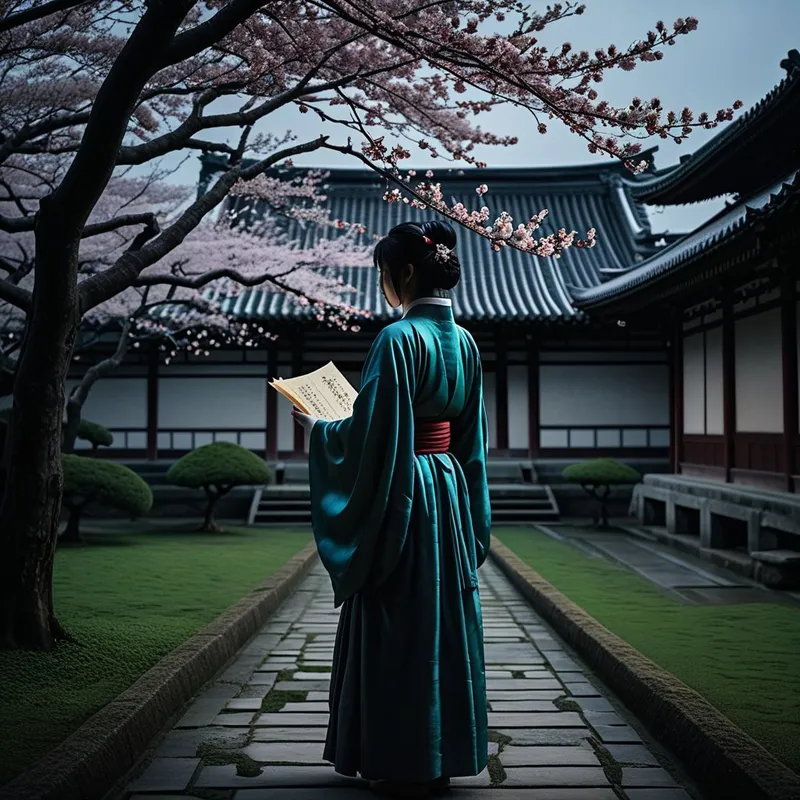
Cultural Origins & Context
The Hannya is not a singular myth from a sacred text, but a living entity born from the convergence of Japanese theatrical genius and spiritual anxiety. Its primary stage is Noh theater, a minimalist, hypnotic art form where a single mask can contain a universe of emotion. The mask itself, carved from lightweight Japanese cypress, is a masterpiece of ambivalence. Tilt it down, and the face is shadowed in profound, almost human sorrow; tilt it up into the light, and it is fully revealed as a snarling, horned demon.
This duality served a deep cultural function. In the Buddhist cosmology that permeated medieval Japan, obsessive attachment—whether to a person, a status, or a grievance—was seen as a primary cause of suffering and a barrier to enlightenment. The Hannya became the ultimate kyōgen-kata (lesson-demon) for the aristocratic class. The plays featuring her, such as Aoi no Ue or Dōjōji, were not mere ghost stories. They were communal exorcisms and profound psychological studies, performed for samurai and courtiers alike, illustrating how the very passions that defined their world of honor and romance could, if left unmastered, transform them into monsters. The myth was passed down not by bards around a fire, but by actors in slow, deliberate movements and the haunting drone of the nohkan, teaching a lesson that resonated in the bone.
Symbolic Architecture
The Hannya is the psyche’s own portrait of a soul in catastrophic civil war. It is not a symbol of evil, but of perverted love. Every element of the myth and mask is a hieroglyph of a specific psychological process.
The horns are not mere demonic adornment; they are the concretization of a one-pointed, piercing fixation. The golden, metallic eyes see only the object of obsession, blinding the self to all other reality. The fanged, leering mouth is the embodiment of the desire to consume, to possess, to take back what was lost by devouring the world that caused the loss. This is the shadow of the Lover archetype—not its absence, but its malignant inversion.
The Hannya does not represent the death of love, but its imprisonment in the dungeon of the ego. It is passion that has forgotten how to connect, and remembers only how to claim.
Most critically, the single tear is the key to the entire symbol. It signifies that the original humanity, the authentic feeling of love and loss, is not destroyed. It is trapped. The demonic form is a fortress of pain built around a still-bleeding wound. The Hannya is thus the ultimate symbol of identification with a complex. The woman does not have jealousy; she becomes Jealousy itself. Her entire identity collapses into a single, toxic emotion, and in doing so, she loses her self to her shadow.
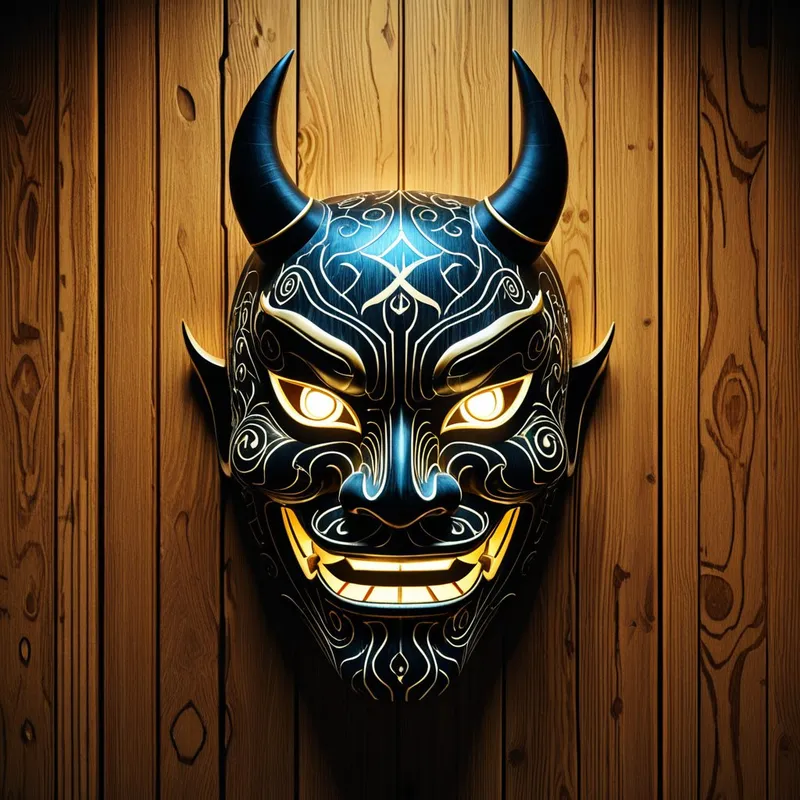
The Dreamer's Resonance
When the Hannya pattern stirs in the modern unconscious, it rarely appears as a literal mask. Its visitation is more subtle, more somatic. One might dream of a relationship that feels like a slow poisoning, or of a rivalry so consuming it alters the dreamer’s face in a mirror. The body may speak first: a tightening in the jaw (the nascent snarl), a burning sensation in the gut or chest (the cold fire of resentment), or a tension headache that feels like pressure on the brow (the horns pushing through).
Psychologically, the dreamer is in the grip of what Carl Jung called a autonomous complex—a bundle of thoughts, feelings, and memories that has split off from conscious control and operates like a separate personality. This complex is often fueled by a perceived betrayal, a humiliation, or an injustice that has not been metabolized. The dream ego may find itself engaging in behaviors that feel alien yet compelling—acts of spite, obsessive rumination, or fantasies of revenge that shock the waking self. This is the "hannification" process: the gradual possession of the personality by a single, powerful negative emotion. The dream is a snapshot of the psyche building its own mask, warning the dreamer that they are in danger of becoming the prison guard of their own pain.

Alchemical Translation
The path of individuation modeled by the Hannya myth is not about slaying the demon, but about performing the impossible alchemy the story itself implies: holding the rage and the grief in the same field of awareness until they reveal their shared root.
The first, most difficult step is recognition without identification. One must have the courage to look in the psychological mirror and say, "This jealousy, this burning resentment, is in me." This is the moment the actor holds the Hannya mask—acknowledging its power but not yet putting it on. The second step is tracing the demon back to its human source. The question is not "Why am I so angry?" but "What precious thing did I lose, or fear losing, that hurt so much?" This inquiry leads to the tear within the demon: the original, vulnerable love, the genuine wound of betrayal or abandonment.
The transmutation occurs when the energy locked in the horned fortress of rage is reclaimed by the weeping woman at its center. The demon is not banished; it is dissolved in the saltwater of conscious sorrow.
The final, alchemical act is to wear the integrated knowledge. Like the Noh actor who can convey both the demon and the woman with a subtle tilt of the head, the individual learns to contain these powerful opposites. The passion of the Lover archetype is reclaimed, but now tempered with the wisdom of its shadow. One learns to love without the demand to possess, to commit without the guarantee of reciprocity, and to grieve a loss without constructing a monument of bitterness to it. The integrated Hannya is a testament to the fact that our deepest wounds and our most destructive passions are, at their core, fractured pieces of our capacity to love profoundly. To reclaim them is not to become less human, but to become whole.
Associated Symbols
Explore related symbols from the CaleaDream lexicon: