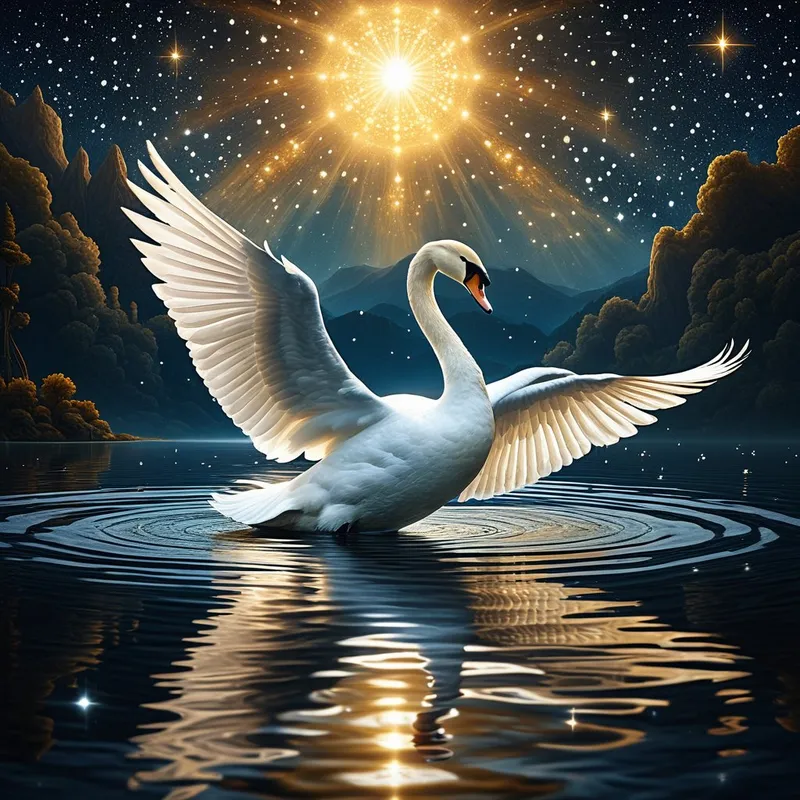
Hamsa Myth Meaning & Symbolism
The myth of the divine Hamsa, a swan that separates milk from water, symbolizing the soul's sacred task of discerning eternal truth from worldly illusion.
The Tale of Hamsa
Listen, and let the silence between the words speak. In the time before time, when the worlds were still breathing their first breaths, there existed a lake of such profound stillness it was said to be the mind of the cosmos made liquid. Its name was Manasarovar, and upon its flawless surface, a being of impossible grace took its residence.
This was Hamsa. Not a bird as we know birds, but a condensation of consciousness itself, feathered in the white of unbroken snow and the dawn’s first light. Its eyes held the depth of twin suns, seeing not just the surface of things, but the very essence from which they were spun. Each morning, as the world stirred from its slumber, the Hamsa would let out a single, resonant cry—a sound that was not a sound, but a vibration that parted the veil between the seen and the unseen.
For in the sacred waters of Manasarovar, a great mystery was perpetually enacted. The lake was not filled with mere water, but with a primordial mixture: the essence of pure, nourishing milk—symbol of truth, sustenance, and immortality (amrita)—blended inseparably with ordinary water, the symbol of the transient, ever-changing, illusory world (maya). To any other creature, this was just a lake. But to the Hamsa, it was a cosmic challenge, a divine riddle written in liquid form.
With a serenity that stilled the very winds, the Hamsa would glide to the center of the expanse. It would lower its elegant, slender neck and dip its beak into the mingled depths. Here, the silent drama unfolded. The Hamsa did not drink the mixture. Through a power born of perfect knowledge (jnana) and innate purity, it would, with infinite subtlety, separate the two. It would draw up only the pure, white milk, the essential truth, leaving the water of illusion behind, utterly untouched.
This was its eternal rite, its sacred duty. The act was so effortless, so devoid of strain, that it appeared as a natural law of its being. The Hamsa became the living embodiment of a singular, soul-shaking question: In the blended soup of your existence—where joy is mixed with sorrow, truth with falsehood, the eternal with the fleeting—can you, like the Hamsa, extract only the nourishing essence? Can you drink truth and leave illusion behind?
Cultural Origins & Context
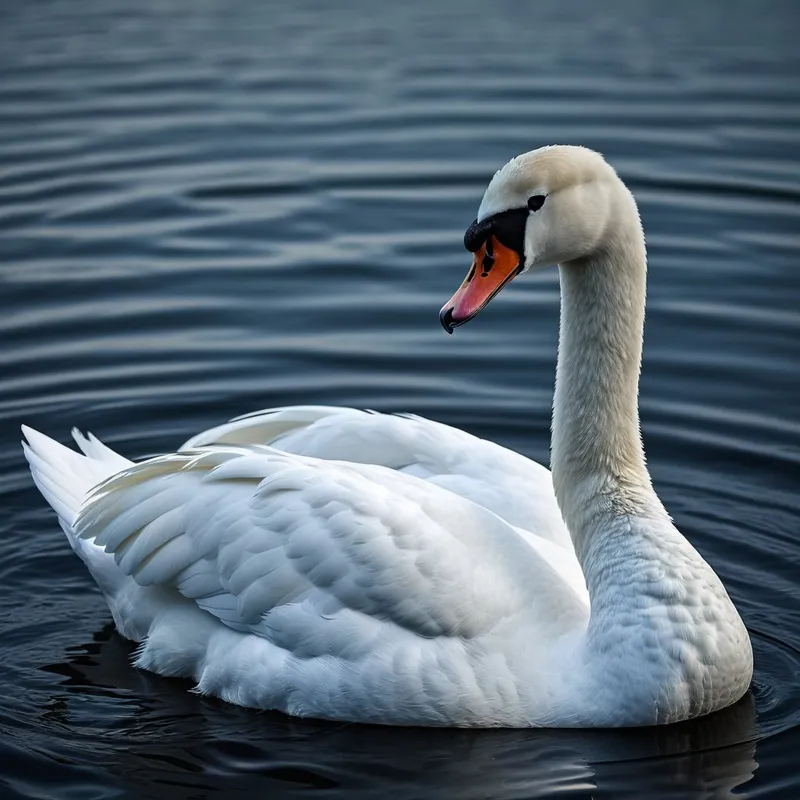
The Hamsa is not confined to a single, linear narrative but is a pervasive and deeply embedded symbol across the vast tapestry of Hindu thought. Its earliest mentions are found in the Vedas, where it is associated with the sun and the breath of life. The syllable “ham-sa” is poetically interpreted as the sound of the breath itself: “ham” on the inhalation, “sa” on the exhalation, making every living being, in a sense, a Hamsa, perpetually repeating the name of the divine.
The myth finds one of its most significant anchors in the figure of the goddess Saraswati. She, the embodiment of flowing wisdom and creative speech, chooses the Hamsa as her vahana, her sacred mount. This is no arbitrary choice. Just as Saraswati bestows the power of discernment between meaningful sound and noise, between true knowledge and mere information, her vehicle performs the same action in the physical realm. The Hamsa, therefore, became a central symbol in Advaita Vedanta and yogic traditions, representing the realized soul (jivatman) that can discriminate between the eternal Self (Paramatman) and the non-self, the ephemeral world of names and forms.
Passed down through philosophical texts, poetic hymns, temple sculptures, and miniature paintings, the story of the Hamsa functioned as a meditative tool. It was not merely a tale to be heard, but an inner reality to be contemplated and embodied by sages, kings, and seekers alike, serving as a constant reminder of the soul’s highest purpose.
Symbolic Architecture
At its core, the Hamsa myth is an allegory for the most critical faculty of consciousness: discernment (viveka). The milk and water are not enemies; they coexist. The challenge is not destruction, but separation. This mirrors the psychological and spiritual task of distinguishing the authentic Self from the constructed persona, eternal values from passing appetites, and deep purpose from superficial distraction.
The Hamsa does not condemn the water; it simply knows it is not drink for its true nature.
The Hamsa itself symbolizes the purified intellect (buddhi) and the transcendent soul. Its whiteness is the color of sattva—the quality of purity, clarity, and harmony. Its ability to live in water (the world) without being of the water represents the state of being in the world but not attached to it, a cornerstone of both yogic and monastic ideals. Furthermore, the Hamsa’s famous cry, sometimes heard as “So’ham” (He am I), is the ultimate declaration of identity, affirming the unity of the individual soul with the universal divine.
The Dreamer's Resonance
When the symbol of the Hamsa alights in the modern dreamscape, it often signals a profound internal process of sorting and sifting. The dreamer may not see the swan directly, but may experience its symbolic actions: trying to separate mixed substances, feeling a need for pristine clarity, or hearing a clear, resonant sound in a chaotic environment.
Psychologically, this is the ego’s difficult but necessary engagement with the individuation process. The “milk and water” mixture represents the undifferentiated contents of the psyche—where complexes, ancestral patterns, personal traumas, and innate potential are all blended. The dream is pointing to the emergence, or the necessity, of the discriminating function. The dreamer is being called to develop their inner Hamsa: the part of them that can observe their own inner chaos and begin, with gentle persistence, to identify what is truly nourishing and authentic (the milk of the Self) and what is merely the situational, reactive, or illusory content (the water of the persona and the shadow).
Alchemical Translation
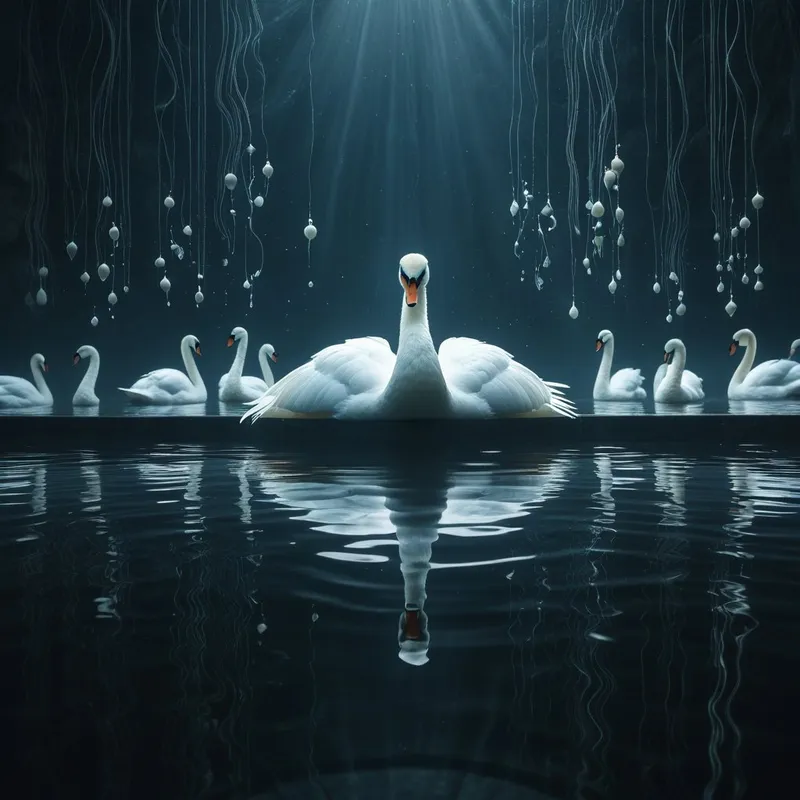
The alchemical journey modeled by the Hamsa is one of sublime distillation. In psychological terms, it is the opus of moving from identification with the personal, historical psyche to an alignment with the transpersonal, archetypal core.
The first stage is immersion: we are all born into the blended lake of Manasarovar—our family, culture, and personal history are a mixture of truth and conditioning. The conflict arises from the suffering of drinking the undifferentiated mixture, leading to psychic indigestion and confusion. The rising action is the development of viveka, often sparked by crisis or deep inquiry—the first glimpse of the Hamsa within. This is not an act of violent purification or rejection, but of meticulous, patient separation.
The alchemy occurs not in rejecting the water, but in the conscious, repeated act of choosing the milk. Each choice for authenticity refines the beak of the soul.
The resolution, the “triumph” of the Hamsa, is the establishment of a new default state of consciousness. It is the realization that one’s essential nature (swarupa) is, and has always been, that of the Hamsa—the pure, discerning witness. The worldly engagements (the water) continue, but they no longer define or nourish the core being. The individual achieves a state of graceful autonomy, where engagement with the world is conscious and deliberate, not compulsive and identifying. They become, like the Hamsa of myth, a living embodiment of the question and its answer, forever drinking only the truth of their own immortal nature.
Associated Symbols
Explore related symbols from the CaleaDream lexicon: