Halo Myth Meaning & Symbolism
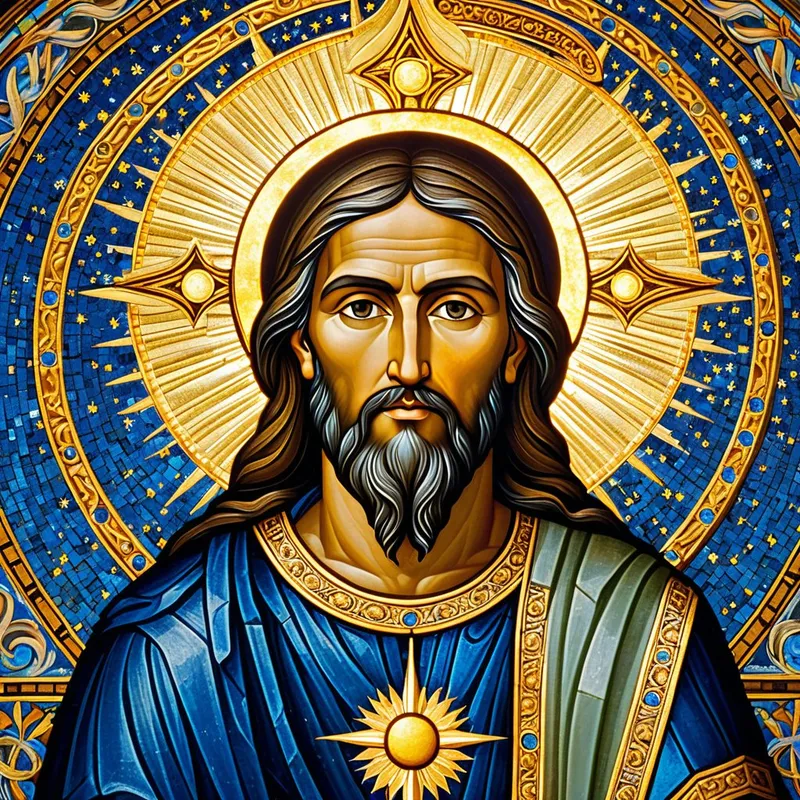
A luminous crown of divine light, marking the sacred boundary where mortal flesh touches the eternal, signifying sanctified consciousness and ultimate union.
The Tale of Halo
Listen. In the beginning, before the word was even spoken into the void, there was only Light—uncreated, boundless, and pure. It was the breath of the Father, the song of the Logos, the living fire of the Spirit. This Light was not of sun or star; it was the substance of divinity itself.
When the Word took flesh and walked the dust of Galilee, this Light did not abandon Him. It dwelt within, a hidden sun beneath the skin. But in moments of supreme revelation—on the mount of transfiguration, in the silent hours of prayer—it would press against the limits of His humanity. Then, witnesses would fall to the ground, not from a blaze they saw with their eyes, but from a brilliance they felt in their bones. His face shone like the sun, and His clothes became white as light. It was not a crown He wore, but a crown He was.
This Light was contagious. It sought other vessels. It found them in the desert hermits, their faces gaunt from fasting but their spirits fat with prayer. It found them in the martyrs, standing in the arena as the beasts were loosed, a strange peace settling upon them like a mantle. And as they prayed, or preached, or faced the sword, a wonder occurred. The artists, those scribes of the soul, began to see it. With hands guided by memory and faith, they painted not just the man or the woman, but the Light that had claimed them. They drew a circle of gold behind the head—a nimbus, a halo. It was a map of a territory where flesh had become transparent to glory.
The halo was not jewelry. It was a wound from heaven, a scar left by grace. It marked the place where the relentless Love of the Divine had finally worn through the stubborn opacity of the self. In the icons, the saints do not smile at their halos; they gaze through them, their eyes portals to a country where every soul is a sun, and the only shadow is the memory of having once lived in darkness.
Cultural Origins & Context
The halo, or nimbus, did not spring fully formed from Christian scripture. Its roots are syncretic, drawing from the radiance (aureole) that encircled the heads of pagan gods and deified emperors in Roman art, and from the solar disks of earlier Eastern traditions. Early Christians, often clandestine in their worship, adopted and radically repurposed this existing visual vocabulary. By the 4th century, as Christianity moved from the catacombs to the basilicas, the halo became a formalized theological shorthand.
Its primary function was didactic and hierarchical. In the vast, illiterate congregations of the Byzantine and Medieval worlds, mosaics, frescoes, and icons were the "books of the poor." The halo instantly communicated a figure's sanctified status, differentiating Christ (often with a cruciform halo), the Virgin Mary, and the saints from ordinary mortals. It was a badge of divine favor, sanctioned by the Church and created by artisans whose work was considered a form of prayer. The halo was not merely decorative; it was a doctrinal statement in pigment and gold leaf, a visible sign of an invisible reality—the indwelling grace that sanctifies human nature.
Symbolic Architecture
At its core, the halo is a symbol of achieved integration. It represents the successful marriage of heaven and earth, spirit and matter, within a single consciousness.
The halo is the psyche’s own event horizon: the visible boundary where the gravitational pull of the Divine finally overcomes the scattering resistance of the ego.
Psychologically, it signifies a state of sanctified consciousness. The head, the seat of intellect and identity, becomes encircled—not imprisoned, but framed and completed—by a higher, unifying light. This light does not erase the individual; it perfects it. The struggle of the spiritual life—the asceticism, the prayer, the confrontation with shadow—is the process of polishing the opaque glass of the self until it becomes a lens, focusing and transmitting a light not its own.
The circular form is paramount. It is a symbol of wholeness, eternity, and containment. It marks a sacred perimeter, a temenos, around the individual who has become a vessel. The halo is the crown of the true Self, as opposed to the temporal crown of the ego. It is the visual proof that the long, often painful, work of inner alignment has reached a point of stable radiance.
The Dreamer's Resonance
When the halo appears in modern dreams, divorced from its religious context, it speaks to a profound process of recognition and validation within the dreamer’s psyche. It rarely appears as a gilded disc from a Renaissance painting. More often, it manifests as a ring of unusual light—a glow from a smartphone screen encircling the head, a shimmering heat-haze above one’s own reflection, or a crown of tangled, luminous wires.
Such a dream often arrives at a crossroads of identity. The dreamer may be integrating a hard-won insight, finally owning a talent or a truth they have long minimized, or emerging from a period of crisis with a new, more authentic sense of purpose. The halo-dream is the psyche’s somatic celebration of this achievement. It marks the moment when a complex or an archetypal energy (the Senex, the Magna Mater, the Inner Guide) has become fully conscious and operational, casting its illuminating influence over the entire personality. Conversely, a cracked, fading, or painfully bright halo might indicate the burden of a spiritualized complex, an "inflation" where the ego mistakes itself for the Self, or the fear of owning one’s own brilliance.

Alchemical Translation
The myth of the halo provides a potent map for the Jungian process of individuation. It models the alchemical opus: the transformation of base lead (the fragmented, ego-driven personality) into spiritual gold (the integrated Self).
The initial stages are the nigredo—the shadow work, the confrontation with one’s own darkness, the "desert" experiences of doubt and aridity. This is the necessary grinding down of the opaque self. The albedo, or whitening, follows: the purification, the clarifying of intention, the dedicated practice (whether therapy, art, or meditation) that begins to make the psyche receptive.
The halo is the rubedo made visible: the glorious reddening, the final fixation of the gold, where the work is complete and the transformed substance shines with its own inherent, perfected nature.
For the modern individual, this is not about sainthood but wholeness. The "halo moment" is that point of integration where a core conflict is resolved, where a talent is fully embraced without arrogance or shame, where love is given without possession, or where wisdom is exercised without cruelty. It is the moment the light we have long sought in scriptures, teachers, and theories is finally recognized as our own native radiance, earned through the labor of a conscious life. The halo is the symbol that this radiance, once integrated, creates a new center of gravity—a Self that can hold the tension of opposites and, in doing so, emits a steady, transformative light into the world.
Associated Symbols
Explore related symbols from the CaleaDream lexicon: