Gwragedd Annwn Myth Meaning & Symbolism
A tale of a mortal man who marries a woman from the Welsh otherworld, only to lose her by breaking a single, profound taboo.
The Tale of Gwragedd Annwn
Listen now, and let the hearth-fire grow low. Let the wind outside speak of the old places, the hollow hills and the deep, still waters. This is not a story of battles, but of a silence broken, and a love found in the wrong world.
In the green, rain-washed valleys of Wales, where the mountains hold the clouds like secrets, there was a lake. Not just any lake, but Llyn y Fan Fach. Its waters were dark, even at noon, and the locals knew to speak softly near its shores. They knew it was a threshold. A young farmer, a man of honest toil and quiet heart, often grazed his cattle on the lush grasses nearby. He was content with the sun on his back and the earth under his feet.
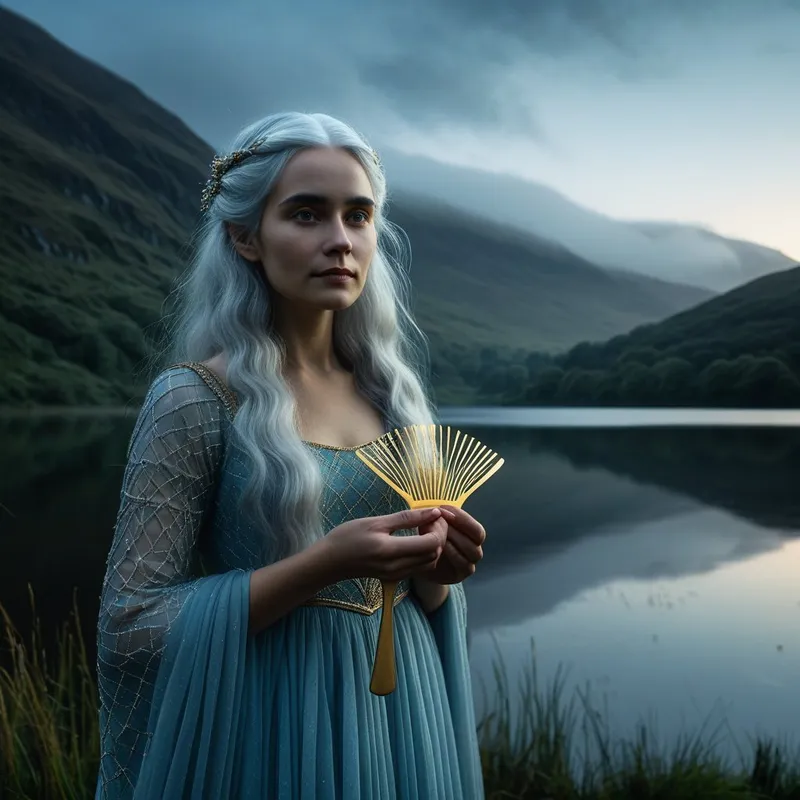
One evening, as the sun bled into the west and the first star pricked the violet sky, he saw her. Rising from the very center of the lake, as if stepping from a doorway of water, was a woman. She was not of his kind. Her hair was the color of moonlight on frost, her gown woven from mist and the memory of reeds. She was combing that silver hair with a comb of pale gold, and the sight stole the breath from his lungs. She was one of the Gwragedd Annwn, a woman of the deep otherworld.
Love, or a fascination so profound it wears love’s face, struck him like a fever. He knew the old warnings, but his heart was a drum he could not silence. Day after day, he returned. He offered her the only gifts he had: bread from his hearth. The first time, she vanished, repelled by the hard, stale loaf. The second time, he brought bread that was under-baked, and again she slipped beneath the waves without a word. Despair began to gnaw at him. On the third day, his mother, with a knowing sigh, gave him bread that was perfect—soft, golden, and warm.
He held it out over the water. This time, the maiden approached. She took the bread, and her touch was cool, like river stones. “You have proven your patience and your heart’s true intent,” she said, her voice the sound of water over smooth pebbles. “I will marry you, son of the green world, but you must swear to me one oath. You must never strike me three times without cause.”
The farmer, his world suddenly alight with impossible joy, swore the oath without a second thought. She left the lake, her feet leaving no prints on the damp earth, and became his wife. She brought with her a dowry of cattle that emerged from the lake, beasts with coats red as fox-fur and milk sweeter than summer honey. For years, they lived in profound happiness. She bore him sons, who would become the famed Physicians of Myddfai, gifted with uncanny healing knowledge from their mother’s lineage. Their farm prospered; love thrived.
But an oath concerning a “strike” is a slippery thing. The first blow was a tap, a playful nudge to hurry her to a wedding. She turned her great, dark eyes on him and said, “Remember.” The second was a flick of his glove, tossed at her in gentle exasperation. The color drained from her face. “You have struck me twice.” A cold dread settled in the man’s bones. He became a ghost in his own home, terrified of any gesture that could be misconstrued.
The third time was an accident born of grief. At the funeral of a dear friend, lost in sorrow, he reached out and touched her shoulder to steady himself—or to be steadied. It was not a strike of anger, but a blow of despair. She did not flinch. She simply looked at him, and in her eyes, he saw the deep, still waters of Llyn y Fan Fach. “The third blow has been struck. The time of our union is over.”
She called to her cattle from the farmyard, and from hill and dale they came, the red herd lowing. She walked from his house, his life, back toward the lake, the beasts flowing behind her like a living river. At the water’s edge, she turned one last time. Then she stepped into the lake, and the waters closed over her and all her kindred beasts, leaving the man alone on the shore, the silence now complete and eternal.
Cultural Origins & Context
This tale, most famously associated with Llyn y Fan Fach in Carmarthenshire, is a cornerstone of Welsh folklore. It belongs not to the high medieval literature of the Mabinogion, but to the vibrant, living oral tradition passed down by shepherds, farmers, and cyfarwyddiaid (storytellers) by firesides for centuries before being recorded by antiquarians like William Wirt Sikes and John Rhŷs in the 19th century.
Its function was multifaceted. On one level, it was an etiological myth, explaining the origin of the renowned Physicians of Myddfai, a real historical medical dynasty, thus grounding otherworldly magic in a lineage of human service. On a deeper level, it served as a social and psychological contract with the landscape. The Annwn was not a distant heaven but an immanent, parallel reality. Stories like this enforced respect for specific liminal sites—lakes, mounds, ancient groves—teaching that interaction with these powers required strict adherence to ritualized behavior (the three attempts with bread) and solemn taboos. The myth codified the belief that profound gifts (fertility, knowledge, prosperity) from the otherworld come with a non-negotiable cost and a fragile, sacred boundary.
Symbolic Architecture
The myth is a perfect vessel of symbolic truth. The Gwragedd Annwn herself is the anima, the soul-image, emerging from the unconscious (the lake). She represents the totality of psychic life that is alien to the conscious ego (the farmer)—the realm of intuition, deep emotion, poetic inspiration, and ancestral wisdom.
The taboo is not a arbitrary rule, but the fundamental law of the psyche: the sacred must not be made profane through familiarity, neglect, or unconscious violence.
The three types of bread symbolize stages of conscious development: the stale (rigid, defended consciousness), the unbaked (immature, unformed consciousness), and finally, the perfectly baked (the integrated, nourishing ego capable of relationship). The three “blows” are the inevitable, often unintentional, wounds the conscious mind inflicts upon the sensitive soul-connection through coarseness, trivialization, and ultimately, the projection of its own mortal suffering onto the eternal. The departure of the cattle signifies the withdrawal of the vital, instinctual energy and creativity that the connection to the deep psyche provides.
The Dreamer's Resonance
When this myth stirs in modern dreams, it often manifests as a profound sense of irreversible loss connected to a specific, seemingly minor action. The dreamer may experience:
- Recurring Imagery: A partner or beloved figure turning away and walking into a body of water, a mirror, or a fog. A cherished object (like a comb, cup, or key) sinking into deep water, just out of reach.
- Somatic Tone: A heavy, sinking feeling in the chest—the “weight of the lake.” A chilling numbness, the somatic echo of the otherworldly wife’s cool touch becoming permanent distance.
- Psychological Process: This is the psyche working through the trauma of a “broken taboo” in one’s inner life. It may relate to the moment inspiration died after it was criticized, when intuition was ignored for logic, or when a deep emotional need was met with casual disregard. The dream is not about a past relationship, but about the dreamer’s current relationship with their own inner Gwragedd Annwn—their creative spirit or deepest feeling function—which has withdrawn due to repeated psychic “blows.”
Alchemical Translation
The alchemical process modeled here is the Coniunctio, the sacred marriage, and its subsequent Separatio. For individuation to begin, the ego must first court and win the commitment of the unconscious (the three tests of bread). A new, fertile consciousness is born from this union, producing the “healing sons”—integrated capacities and talents.
The myth’s tragedy is not the failure of the process, but its necessary, agonizing phase. The loss is the catalyst for the final, most profound work: the internalization of the other.
The breaking of the taboo and the wife’s departure represent the inevitable failure of the ego to perfectly sustain the connection. This is not a moral failure, but a human one. The true alchemical work begins in the aftermath, on the barren shore. The farmer is left with the memory, the sons (the lasting gifts of the union), and the unending longing. The transmutation is in this longing itself. It forces the ego to stop trying to retrieve the anima as an external object and to begin the lifelong task of becoming the vessel that can hold her essence internally. The lake remains; the access is changed. The seeker must now dive into his own depths, guided only by the memory of her light, to find that the gold was not the cattle she took, but the enduring, painful, and transformative love she left etched upon his soul. He must become, in his solitude, both the farmer and the lake.
Associated Symbols
Explore related symbols from the CaleaDream lexicon: